
Mind map
Communicative Language Teaching. (Richards, 2006)
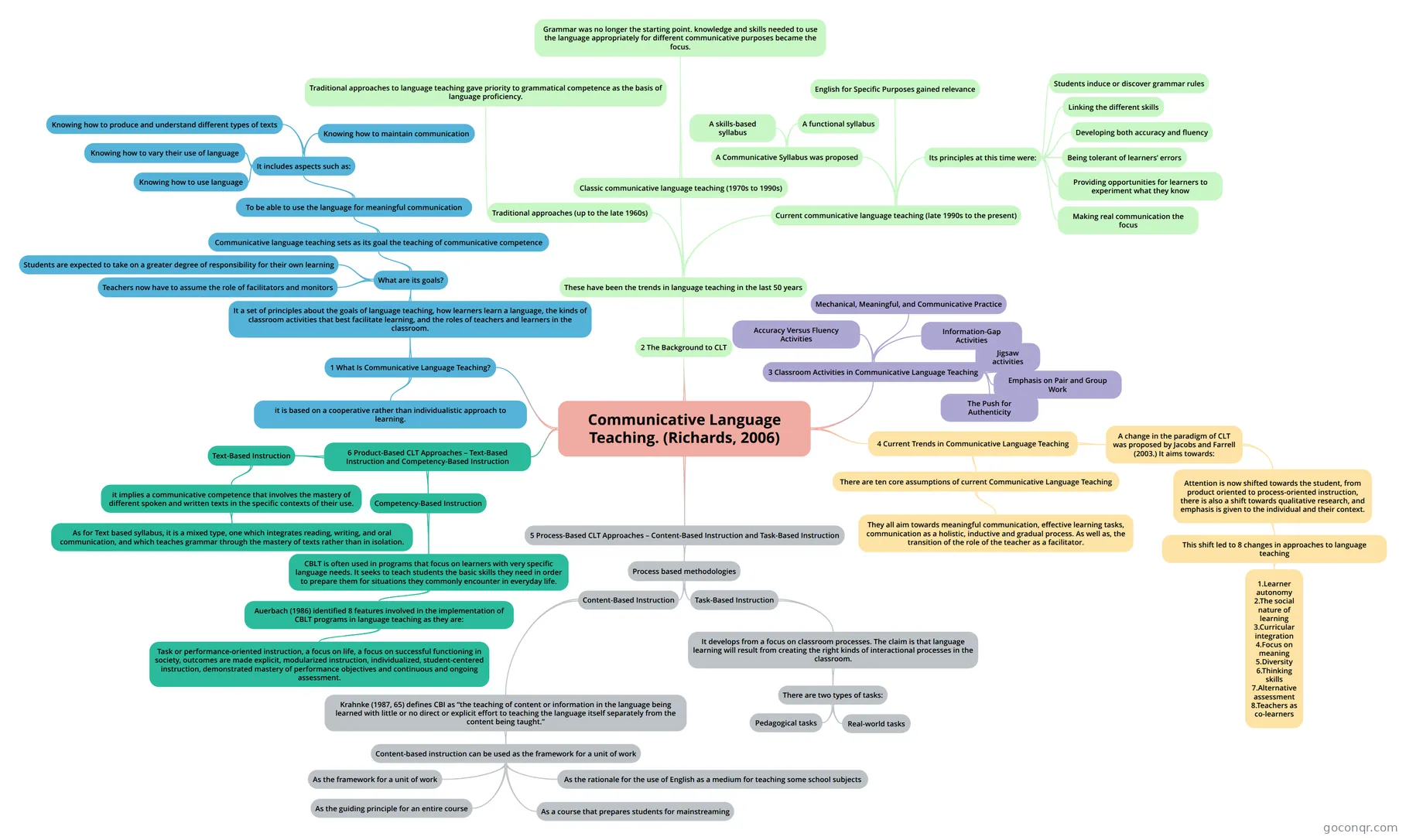
Mind map: Communicative Language Teaching
Map content
Communicative Language Teaching. (Richards, 2006)
6 Product-Based CLT Approaches – Text-Based Instruction and Competency-Based Instruction
- Text-Based Instruction
- it implies a communicative competence that involves the mastery of different spoken and written texts in the specific contexts of their use.
- As for Text based syllabus, it is a mixed type, one which integrates reading, writing, and oral communication, and which teaches grammar through the mastery of texts rather than in isolation.
- it implies a communicative competence that involves the mastery of different spoken and written texts in the specific contexts of their use.
- Competency-Based Instruction
- CBLT is often used in programs that focus on learners with very specific language needs. It seeks to teach students the basic skills they need in order to prepare them for situations they commonly encounter in everyday life.
- Auerbach (1986) identified 8 features involved in the implementation of CBLT programs in language teaching as they are:
- Task or performance-oriented instruction, a focus on life, a focus on successful functioning in society, outcomes are made explicit, modularized instruction, individualized, student-centered instruction, demonstrated mastery of performance objectives and continuous and ongoing assessment.
- Auerbach (1986) identified 8 features involved in the implementation of CBLT programs in language teaching as they are:
- CBLT is often used in programs that focus on learners with very specific language needs. It seeks to teach students the basic skills they need in order to prepare them for situations they commonly encounter in everyday life.
- Text-Based Instruction
1 What Is Communicative Language Teaching?
- It a set of principles about the goals of language teaching, how learners learn a language, the kinds of classroom activities that best facilitate learning, and the roles of teachers and learners in the classroom.
- What are its goals?
- Communicative language teaching sets as its goal the teaching of communicative competence
- To be able to use the language for meaningful communication
- It includes aspects such as:
- Knowing how to use language
- Knowing how to vary their use of language
- Knowing how to produce and understand different types of texts
- Knowing how to maintain communication
- It includes aspects such as:
- To be able to use the language for meaningful communication
- Students are expected to take on a greater degree of responsibility for their own learning
- Teachers now have to assume the role of facilitators and monitors
- Communicative language teaching sets as its goal the teaching of communicative competence
- What are its goals?
- it is based on a cooperative rather than individualistic approach to learning.
- It a set of principles about the goals of language teaching, how learners learn a language, the kinds of classroom activities that best facilitate learning, and the roles of teachers and learners in the classroom.
4 Current Trends in Communicative Language Teaching
- There are ten core assumptions of current Communicative Language Teaching
- They all aim towards meaningful communication, effective learning tasks, communication as a holistic, inductive and gradual process. As well as, the transition of the role of the teacher as a facilitator.
- A change in the paradigm of CLT was proposed by Jacobs and Farrell (2003.) It aims towards:
- Attention is now shifted towards the student, from product oriented to process-oriented instruction, there is also a shift towards qualitative research, and emphasis is given to the individual and their context.
- This shift led to 8 changes in approaches to language teaching
- 1.Learner autonomy 2.The social nature of learning 3.Curricular integration 4.Focus on meaning 5.Diversity 6.Thinking skills 7.Alternative assessment 8.Teachers as co-learners
- This shift led to 8 changes in approaches to language teaching
- Attention is now shifted towards the student, from product oriented to process-oriented instruction, there is also a shift towards qualitative research, and emphasis is given to the individual and their context.
- There are ten core assumptions of current Communicative Language Teaching
2 The Background to CLT
- These have been the trends in language teaching in the last 50 years
- Traditional approaches (up to the late 1960s)
- Traditional approaches to language teaching gave priority to grammatical competence as the basis of language proficiency.
- Classic communicative language teaching (1970s to 1990s)
- Grammar was no longer the starting point. knowledge and skills needed to use the language appropriately for different communicative purposes became the focus.
- Current communicative language teaching (late 1990s to the present)
- A Communicative Syllabus was proposed
- A skills-based syllabus
- A functional syllabus
- English for Specific Purposes gained relevance
- Its principles at this time were:
- Making real communication the focus
- Providing opportunities for learners to experiment what they know
- Being tolerant of learners’ errors
- Developing both accuracy and fluency
- Linking the different skills
- Students induce or discover grammar rules
- A Communicative Syllabus was proposed
- Traditional approaches (up to the late 1960s)
- These have been the trends in language teaching in the last 50 years
3 Classroom Activities in Communicative Language Teaching
- Accuracy Versus Fluency Activities
- Mechanical, Meaningful, and Communicative Practice
- Information-Gap Activities
- Jigsaw activities
- Emphasis on Pair and Group Work
- The Push for Authenticity
5 Process-Based CLT Approaches – Content-Based Instruction and Task-Based Instruction
- Process based methodologies
- Task-Based Instruction
- It develops from a focus on classroom processes. The claim is that language learning will result from creating the right kinds of interactional processes in the classroom.
- There are two types of tasks:
- Pedagogical tasks
- Real-world tasks
- There are two types of tasks:
- It develops from a focus on classroom processes. The claim is that language learning will result from creating the right kinds of interactional processes in the classroom.
- Content-Based Instruction
- Krahnke (1987, 65) defines CBI as “the teaching of content or information in the language being learned with little or no direct or explicit effort to teaching the language itself separately from the content being taught.”
- Content-based instruction can be used as the framework for a unit of work
- As the framework for a unit of work
- As the guiding principle for an entire course
- As a course that prepares students for mainstreaming
- As the rationale for the use of English as a medium for teaching some school subjects
- Content-based instruction can be used as the framework for a unit of work
- Krahnke (1987, 65) defines CBI as “the teaching of content or information in the language being learned with little or no direct or explicit effort to teaching the language itself separately from the content being taught.”
- Task-Based Instruction
- Process based methodologies
Information
- Description
- Mind Map on Communicative Language Teaching. (Richards, 2006), created by Andres G on 10/08/2019.
- Created by
- Andres G
- Views
- 1
- Rating