
Mind map
Systems of Policing
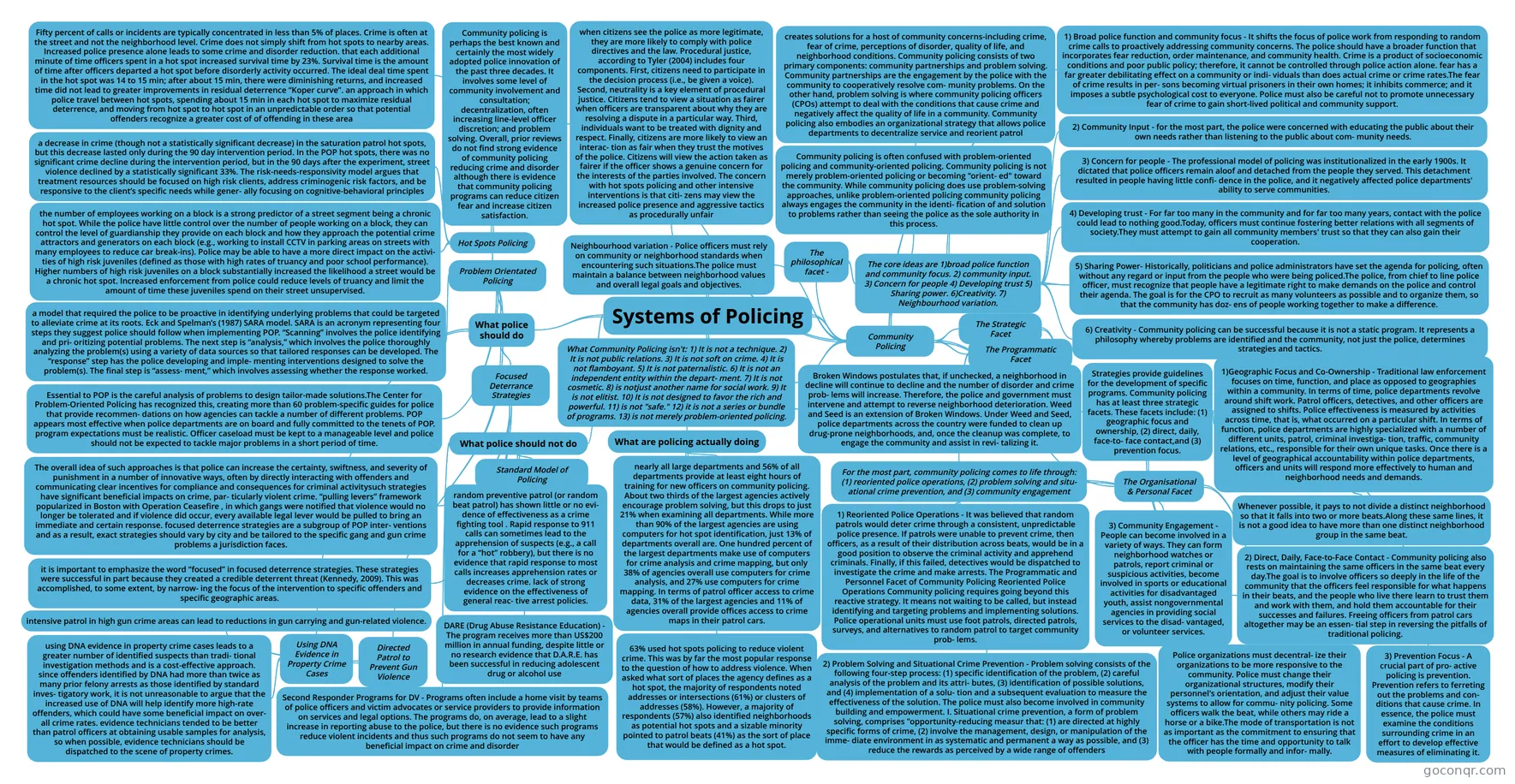
Mind map: Systems of policing
Map content
Systems of Policing
Community Policing
- Community policing is perhaps the best known and certainly the most widely adopted police innovation of the past three decades. It involves some level of community involvement and consultation; decentralization, often increasing line-level officer discretion; and problem solving. Overall, prior reviews do not find strong evidence of community policing reducing crime and disorder although there is evidence that community policing programs can reduce citizen fear and increase citizen satisfaction.
- creates solutions for a host of community concerns-including crime, fear of crime, perceptions of disorder, quality of life, and neighborhood conditions. Community policing consists of two primary components: community partnerships and problem solving. Community partnerships are the engagement by the police with the community to cooperatively resolve com- munity problems. On the other hand, problem solving is where community policing officers (CPOs) attempt to deal with the conditions that cause crime and negatively affect the quality of life in a community. Community policing also embodies an organizational strategy that allows police departments to decentralize service and reorient patrol
- Community policing is often confused with problem-oriented policing and community-oriented policing. Community policing is not merely problem-oriented policing or becoming "orient- ed" toward the community. While community policing does use problem-solving approaches, unlike problem-oriented policing community policing always engages the community in the identi- fication of and solution to problems rather than seeing the police as the sole authority in this process.
- The philosophical facet -
- The core ideas are 1)broad police function and community focus. 2) community input. 3) Concern for people 4) Developing trust 5) Sharing power. 6)Creativity. 7) Neighbourhood variation.
- 1) Broad police function and community focus - It shifts the focus of police work from responding to random crime calls to proactively addressing community concerns. The police should have a broader function that incorporates fear reduction, order maintenance, and community health. Crime is a product of socioeconomic conditions and poor public policy; therefore, it cannot be controlled through police action alone. fear has a far greater debilitating effect on a community or indi- viduals than does actual crime or crime rates.The fear of crime results in per- sons becoming virtual prisoners in their own homes; it inhibits commerce; and it imposes a subtle psychological cost to everyone. Police must also be careful not to promote unnecessary fear of crime to gain short-lived political and community support.
- 2) Community Input - for the most part, the police were concerned with educating the public about their own needs rather than listening to the public about com- munity needs.
- 3) Concern for people - The professional model of policing was institutionalized in the early 1900s. It dictated that police officers remain aloof and detached from the people they served. This detachment resulted in people having little confi- dence in the police, and it negatively affected police departments' ability to serve communities.
- 4) Developing trust - For far too many in the community and for far too many years, contact with the police could lead to nothing good.Today, officers must continue fostering better relations with all segments of society.They must attempt to gain all community members' trust so that they can also gain their cooperation.
- 5) Sharing Power- Historically, politicians and police administrators have set the agenda for policing, often without any regard or input from the people who were being policed.The police, from chief to line police officer, must recognize that people have a legitimate right to make demands on the police and control their agenda. The goal is for the CPO to recruit as many volunteers as possible and to organize them, so that the community has doz- ens of people working together to make a difference.
- 6) Creativity - Community policing can be successful because it is not a static program. It represents a philosophy whereby problems are identified and the community, not just the police, determines strategies and tactics.
- The core ideas are 1)broad police function and community focus. 2) community input. 3) Concern for people 4) Developing trust 5) Sharing power. 6)Creativity. 7) Neighbourhood variation.
- Neighbourhood variation - Police officers must rely on community or neighborhood standards when encountering such situations.The police must maintain a balance between neighborhood values and overall legal goals and objectives.
- The Organisational & Personal Facet
- Police organizations must decentral- ize their organizations to be more responsive to the community. Police must change their organizational structures, modify their personnel's orientation, and adjust their value systems to allow for commu- nity policing. Some officers walk the beat, while others may ride a horse or a bike.The mode of transportation is not as important as the commitment to ensuring that the officer has the time and opportunity to talk with people formally and infor- mally.
- The Strategic Facet
- Strategies provide guidelines for the development of specific programs. Community policing has at least three strategic facets. These facets include: (1) geographic focus and ownership, (2) direct, daily, face-to- face contact,and (3) prevention focus.
- 1)Geographic Focus and Co-Ownership - Traditional law enforcement focuses on time, function, and place as opposed to geographies within a community. In terms of time, police departments revolve around shift work. Patrol officers, detectives, and other officers are assigned to shifts. Police effectiveness is measured by activities across time, that is, what occurred on a particular shift. In terms of function, police departments are highly specialized with a number of different units, patrol, criminal investiga- tion, traffic, community relations, etc., responsible for their own unique tasks. Once there is a level of geographical accountability within police departments, officers and units will respond more effectively to human and neighborhood needs and demands.
- Whenever possible, it pays to not divide a distinct neighborhood so that it falls into two or more beats.Along these same lines, it is not a good idea to have more than one distinct neighborhood group in the same beat.
- 2) Direct, Daily, Face-to-Face Contact - Community policing also rests on maintaining the same officers in the same beat every day.The goal is to involve officers so deeply in the life of the community that the officers feel responsible for what happens in their beats, and the people who live there learn to trust them and work with them, and hold them accountable for their successes and failures. Freeing officers from patrol cars altogether may be an essen- tial step in reversing the pitfalls of traditional policing.
- 3) Prevention Focus - A crucial part of pro- active policing is prevention. Prevention refers to ferreting out the problems and con- ditions that cause crime. In essence, the police must examine the conditions surrounding crime in an effort to develop effective measures of eliminating it.
- 1)Geographic Focus and Co-Ownership - Traditional law enforcement focuses on time, function, and place as opposed to geographies within a community. In terms of time, police departments revolve around shift work. Patrol officers, detectives, and other officers are assigned to shifts. Police effectiveness is measured by activities across time, that is, what occurred on a particular shift. In terms of function, police departments are highly specialized with a number of different units, patrol, criminal investiga- tion, traffic, community relations, etc., responsible for their own unique tasks. Once there is a level of geographical accountability within police departments, officers and units will respond more effectively to human and neighborhood needs and demands.
- Strategies provide guidelines for the development of specific programs. Community policing has at least three strategic facets. These facets include: (1) geographic focus and ownership, (2) direct, daily, face-to- face contact,and (3) prevention focus.
- The Programmatic Facet
- For the most part, community policing comes to life through: (1) reoriented police operations, (2) problem solving and situ- ational crime prevention, and (3) community engagement
- 1) Reoriented Police Operations - It was believed that random patrols would deter crime through a consistent, unpredictable police presence. If patrols were unable to prevent crime, then officers, as a result of their distribution across beats, would be in a good position to observe the criminal activity and apprehend criminals. Finally, if this failed, detectives would be dispatched to investigate the crime and make arrests. The Programmatic and Personnel Facet of Community Policing Reoriented Police Operations Community policing requires going beyond this reactive strategy. It means not waiting to be called, but instead identifying and targeting problems and implementing solutions. Police operational units must use foot patrols, directed patrols, surveys, and alternatives to random patrol to target community prob- lems.
- 2) Problem Solving and Situational Crime Prevention - Problem solving consists of the following four-step process: (1) specific identification of the problem, (2) careful analysis of the problem and its attri- butes, (3) identification of possible solutions, and (4) implementation of a solu- tion and a subsequent evaluation to measure the effectiveness of the solution. The police must also become involved in community building and empowerment. I. Situational crime prevention, a form of problem solving, comprises "opportunity-reducing measur that: (1) are directed at highly specific forms of crime, (2) involve the management, design, or manipulation of the imme- diate environment in as systematic and permanent a way as possible, and (3) reduce the rewards as perceived by a wide range of offenders
- 3) Community Engagement - People can become involved in a variety of ways. They can form neighborhood watches or patrols, report criminal or suspicious activities, become involved in sports or educational activities for disadvantaged youth, assist nongovernmental agencies in providing social services to the disad- vantaged, or volunteer services.
- For the most part, community policing comes to life through: (1) reoriented police operations, (2) problem solving and situ- ational crime prevention, and (3) community engagement
- What Community Policing isn't: 1) It is not a technique. 2) It is not public relations. 3) It is not soft on crime. 4) It is not flamboyant. 5) It is not paternalistic. 6) It is not an independent entity within the depart- ment. 7) It is not cosmetic. 8) is notjust another name for social work. 9) It is not elitist. 10) It is not designed to favor the rich and powerful. 11) is not "safe." 12) it is not a series or bundle of programs. 13) is not merely problem-oriented policing.
What police should do
- Problem Orientated Policing
- a model that required the police to be proactive in identifying underlying problems that could be targeted to alleviate crime at its roots. Eck and Spelman’s (1987) SARA model. SARA is an acronym representing four steps they suggest police should follow when implementing POP. “Scanning” involves the police identifying and pri- oritizing potential problems. The next step is “analysis,” which involves the police thoroughly analyzing the problem(s) using a variety of data sources so that tailored responses can be developed. The “response” step has the police developing and imple- menting interventions designed to solve the problem(s). The final step is “assess- ment,” which involves assessing whether the response worked.
- Essential to POP is the careful analysis of problems to design tailor-made solutions.The Center for Problem-Oriented Policing has recognized this, creating more than 60 problem-specific guides for police that provide recommen- dations on how agencies can tackle a number of different problems. POP appears most effective when police departments are on board and fully committed to the tenets of POP. program expectations must be realistic. Officer caseload must be kept to a manageable level and police should not be expected to tackle major problems in a short period of time.
- Hot Spots Policing
- Fifty percent of calls or incidents are typically concentrated in less than 5% of places. Crime is often at the street and not the neighborhood level. Crime does not simply shift from hot spots to nearby areas. Increased police presence alone leads to some crime and disorder reduction. that each additional minute of time officers spent in a hot spot increased survival time by 23%. Survival time is the amount of time after officers departed a hot spot before disorderly activity occurred. The ideal deal time spent in the hot spot was 14 to 15 min; after about 15 min, there were diminishing returns, and increased time did not lead to greater improvements in residual deterrence “Koper curve”. an approach in which police travel between hot spots, spending about 15 min in each hot spot to maximize residual deterrence, and moving from hot spot to hot spot in an unpredictable order so that potential offenders recognize a greater cost of of offending in these area
- a decrease in crime (though not a statistically significant decrease) in the saturation patrol hot spots, but this decrease lasted only during the 90 day intervention period. In the POP hot spots, there was no significant crime decline during the intervention period, but in the 90 days after the experiment, street violence declined by a statistically significant 33%. The risk-needs-responsivity model argues that treatment resources should be focused on high risk clients, address criminogenic risk factors, and be responsive to the client’s specific needs while gener- ally focusing on cognitive-behavioral principles
- the number of employees working on a block is a strong predictor of a street segment being a chronic hot spot. While the police have little control over the number of people working on a block, they can control the level of guardianship they provide on each block and how they approach the potential crime attractors and generators on each block (e.g., working to install CCTV in parking areas on streets with many employees to reduce car break-ins). Police may be able to have a more direct impact on the activi- ties of high risk juveniles (defined as those with high rates of truancy and poor school performance). Higher numbers of high risk juveniles on a block substantially increased the likelihood a street would be a chronic hot spot. Increased enforcement from police could reduce levels of truancy and limit the amount of time these juveniles spend on their street unsupervised.
- Focused Deterrance Strategies
- The overall idea of such approaches is that police can increase the certainty, swiftness, and severity of punishment in a number of innovative ways, often by directly interacting with offenders and communicating clear incentives for compliance and consequences for criminal activitysuch strategies have significant beneficial impacts on crime, par- ticularly violent crime. “pulling levers” framework popularized in Boston with Operation Ceasefire , in which gangs were notified that violence would no longer be tolerated and if violence did occur, every available legal lever would be pulled to bring an immediate and certain response. focused deterrence strategies are a subgroup of POP inter- ventions and as a result, exact strategies should vary by city and be tailored to the specific gang and gun crime problems a jurisdiction faces.
- it is important to emphasize the word “focused” in focused deterrence strategies. These strategies were successful in part because they created a credible deterrent threat (Kennedy, 2009). This was accomplished, to some extent, by narrow- ing the focus of the intervention to specific offenders and specific geographic areas.
- Directed Patrol to Prevent Gun Violence
- intensive patrol in high gun crime areas can lead to reductions in gun carrying and gun-related violence.
- Using DNA Evidence in Property Crime Cases
- using DNA evidence in property crime cases leads to a greater number of identified suspects than tradi- tional investigation methods and is a cost-effective approach. since offenders identified by DNA had more than twice as many prior felony arrests as those identified by standard inves- tigatory work, it is not unreasonable to argue that the increased use of DNA will help identify more high-rate offenders, which could have some beneficial impact on over- all crime rates. evidence technicians tended to be better than patrol officers at obtaining usable samples for analysis, so when possible, evidence technicians should be dispatched to the scene of property crimes.
- Problem Orientated Policing
when citizens see the police as more legitimate, they are more likely to comply with police directives and the law. Procedural justice, according to Tyler (2004) includes four components. First, citizens need to participate in the decision process (i.e., be given a voice). Second, neutrality is a key element of procedural justice. Citizens tend to view a situation as fairer when officers are transparent about why they are resolving a dispute in a particular way. Third, individuals want to be treated with dignity and respect. Finally, citizens are more likely to view an interac- tion as fair when they trust the motives of the police. Citizens will view the action taken as fairer if the officer shows a genuine concern for the interests of the parties involved. The concern with hot spots policing and other intensive interventions is that citi- zens may view the increased police presence and aggressive tactics as procedurally unfair
What police should not do
- Standard Model of Policing
- random preventive patrol (or random beat patrol) has shown little or no evi- dence of effectiveness as a crime fighting tool . Rapid response to 911 calls can sometimes lead to the apprehension of suspects (e.g., a call for a “hot” robbery), but there is no evidence that rapid response to most calls increases apprehension rates or decreases crime. lack of strong evidence on the effectiveness of general reac- tive arrest policies.
- DARE (Drug Abuse Resistance Education) - The program receives more than US$200 million in annual funding, despite little or no research evidence that D.A.R.E. has been successful in reducing adolescent drug or alcohol use
- Second Responder Programs for DV - Programs often include a home visit by teams of police officers and victim advocates or service providers to provide information on services and legal options. The programs do, on average, lead to a slight increase in reporting abuse to the police, but there is no evidence such programs reduce violent incidents and thus such programs do not seem to have any beneficial impact on crime and disorder
- Standard Model of Policing
What are policing actually doing
- nearly all large departments and 56% of all departments provide at least eight hours of training for new officers on community policing. About two thirds of the largest agencies actively encourage problem solving, but this drops to just 21% when examining all departments. While more than 90% of the largest agencies are using computers for hot spot identification, just 13% of departments overall are. One hundred percent of the largest departments make use of computers for crime analysis and crime mapping, but only 38% of agencies overall use computers for crime analysis, and 27% use computers for crime mapping. In terms of patrol officer access to crime data, 31% of the largest agencies and 11% of agencies overall provide offices access to crime maps in their patrol cars.
- 63% used hot spots policing to reduce violent crime. This was by far the most popular response to the question of how to address violence. When asked what sort of places the agency defines as a hot spot, the majority of respondents noted addresses or intersections (61%) or clusters of addresses (58%). However, a majority of respondents (57%) also identified neighborhoods as potential hot spots and a sizable minority pointed to patrol beats (41%) as the sort of place that would be defined as a hot spot.
Broken Windows postulates that, if unchecked, a neighborhood in decline will continue to decline and the number of disorder and crime prob- lems will increase. Therefore, the police and government must intervene and attempt to reverse neighborhood deterioration. Weed and Seed is an extension of Broken Windows. Under Weed and Seed, police departments across the country were funded to clean up drug-prone neighborhoods, and, once the cleanup was complete, to engage the community and assist in revi- talizing it.
Information
- Description
- Bachelor Policing Systems & Practice Mind Map on Systems of Policing, created by caramelcarl on 21/01/2015.
- Created by
- caramelcarl
- Views
- 8
- Rating