
Mind map
Acute pancreatitis
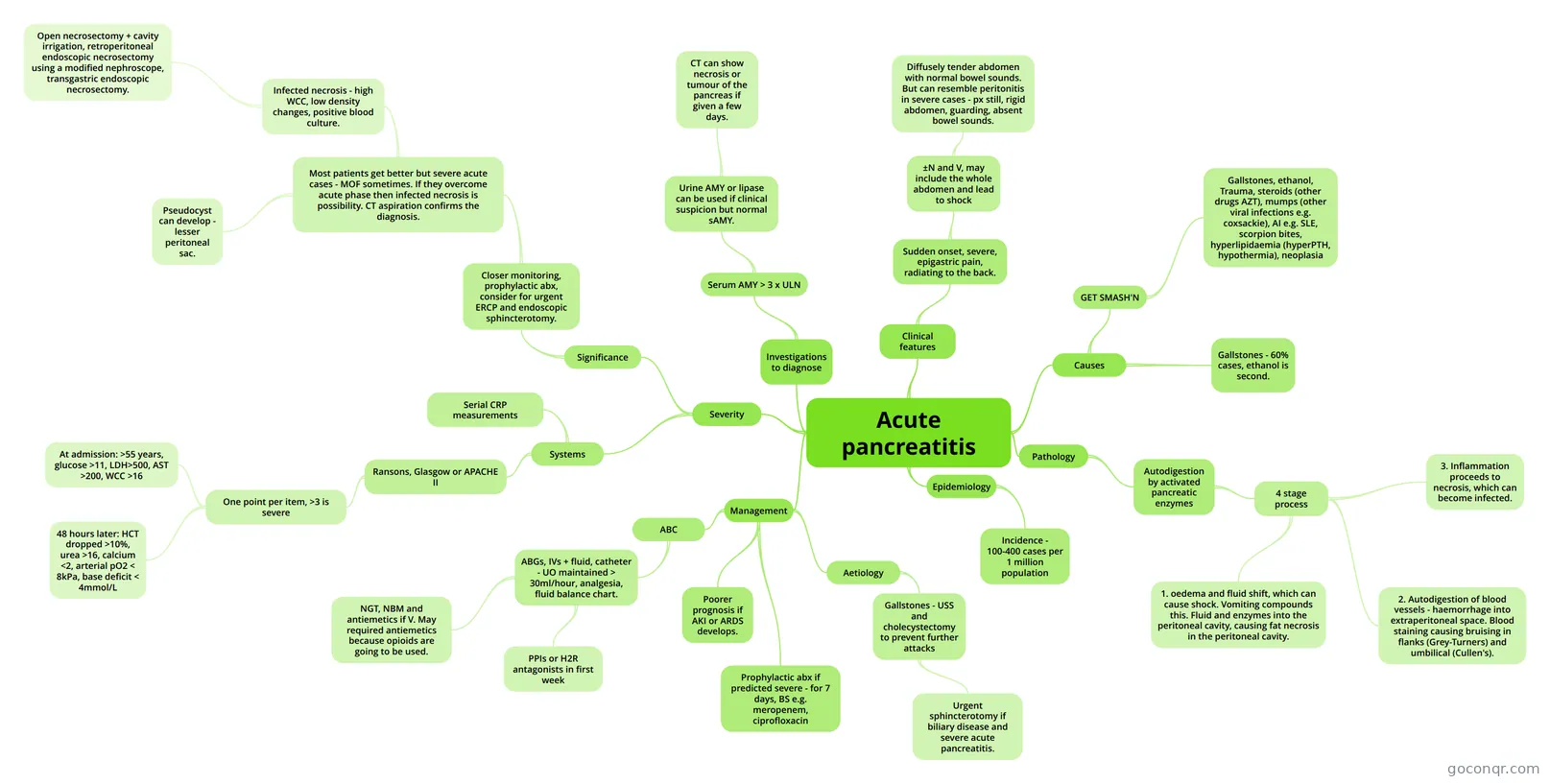
Mind map: Acute pancreatitis
Map content
Acute pancreatitis
Epidemiology
- Incidence - 100-400 cases per 1 million population
Pathology
- Autodigestion by activated pancreatic enzymes
- 4 stage process
- 1. oedema and fluid shift, which can cause shock. Vomiting compounds this. Fluid and enzymes into the peritoneal cavity, causing fat necrosis in the peritoneal cavity.
- 2. Autodigestion of blood vessels - haemorrhage into extraperitoneal space. Blood staining causing bruising in flanks (Grey-Turners) and umbilical (Cullen's).
- 3. Inflammation proceeds to necrosis, which can become infected.
- 4 stage process
- Autodigestion by activated pancreatic enzymes
Causes
- Gallstones - 60% cases, ethanol is second.
- GET SMASH'N
- Gallstones, ethanol, Trauma, steroids (other drugs AZT), mumps (other viral infections e.g. coxsackie), AI e.g. SLE, scorpion bites, hyperlipidaemia (hyperPTH, hypothermia), neoplasia
Clinical features
- Sudden onset, severe, epigastric pain, radiating to the back.
- ±N and V, may include the whole abdomen and lead to shock
- Diffusely tender abdomen with normal bowel sounds. But can resemble peritonitis in severe cases - px still, rigid abdomen, guarding, absent bowel sounds.
- ±N and V, may include the whole abdomen and lead to shock
- Sudden onset, severe, epigastric pain, radiating to the back.
Investigations to diagnose
- Serum AMY > 3 x ULN
- Urine AMY or lipase can be used if clinical suspicion but normal sAMY.
- uAMY elevated for 24-48 hours longer. Degree of elevation not related to the severity of the condition.
- CT can show necrosis or tumour of the pancreas if given a few days.
- Urine AMY or lipase can be used if clinical suspicion but normal sAMY.
- Serum AMY > 3 x ULN
Severity
- Significance
- Closer monitoring, prophylactic abx, consider for urgent ERCP and endoscopic sphincterotomy.
- Most patients get better but severe acute cases - MOF sometimes. If they overcome acute phase then infected necrosis is possibility. CT aspiration confirms the diagnosis.
- Infected necrosis most common cause of death in acute pancreatitis.
- Infected necrosis - high WCC, low density changes, positive blood culture.
- Open necrosectomy + cavity irrigation, retroperitoneal endoscopic necrosectomy using a modified nephroscope, transgastric endoscopic necrosectomy.
- Pseudocyst can develop - lesser peritoneal sac.
- Most patients get better but severe acute cases - MOF sometimes. If they overcome acute phase then infected necrosis is possibility. CT aspiration confirms the diagnosis.
- Closer monitoring, prophylactic abx, consider for urgent ERCP and endoscopic sphincterotomy.
- Systems
- Serial CRP measurements
- Ransons, Glasgow or APACHE II
- One point per item, >3 is severe
- At admission: >55 years, glucose >11, LDH>500, AST >200, WCC >16
- 48 hours later: HCT dropped >10%, urea >16, calcium <2, arterial pO2 < 8kPa, base deficit < 4mmol/L
- One point per item, >3 is severe
- Significance
Management
- ABC
- ABGs, IVs + fluid, catheter - UO maintained > 30ml/hour, analgesia, fluid balance chart.
- NGT, NBM and antiemetics if V. May required antiemetics because opioids are going to be used.
- PPIs or H2R antagonists in first week
- ABGs, IVs + fluid, catheter - UO maintained > 30ml/hour, analgesia, fluid balance chart.
- Poorer prognosis if AKI or ARDS develops.
- Prophylactic abx if predicted severe - for 7 days, BS e.g. meropenem, ciprofloxacin
- Aetiology
- Gallstones - USS and cholecystectomy to prevent further attacks
- Urgent sphincterotomy if biliary disease and severe acute pancreatitis.
- Gallstones - USS and cholecystectomy to prevent further attacks
- ABC
Information
- Description
- Surgical Talk Mind Map on Acute pancreatitis, created by kavi on 08/09/2013.
- Created by
- kavi
- Views
- 184
- Tags
- Rating