
197759
Description

Mind Map by pwincess_sana97, updated more than 1 year ago

|
Created by pwincess_sana97
over 12 years ago
|
|
More on enzymes
- changing the temperature changes the
rate of an enzyme- catalysed reaction
- a higher temperature increases the rate at first
- more heat means the enzymes
and the substrate particles have
more energy - making the
enzymes and the substrate
particles move about more -
more likely to meet up and react
- higher collison rate
- low temperatures have the opposite
effect - lower collision rate and slower
reaction
- low temperatures have the opposite
effect - lower collision rate and slower
reaction
- more heat means the enzymes
and the substrate particles have
more energy - making the
enzymes and the substrate
particles move about more -
more likely to meet up and react
- higher collison rate
- a higher temperature increases the rate at first
- if it gets too hot, some of the bonds holding the
enzyme together will break
- making the enzyme lose its shape - active site
doesn't fit with the substrate
- reaction can't catalysed and stops - enzyme
doesn't function
- reaction can't catalysed and stops - enzyme
doesn't function
- making the enzyme lose its shape - active site
doesn't fit with the substrate
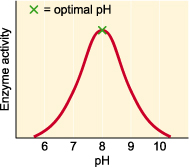
- enzymes like the right pH too
- pH has an effect on the enzymes
- pH is too high or too low - interferes
with the bonds holding the enzymes
together
- changing the shape of the active site and
substrate
- enzyme = denatured = irreversible
- all enzymes have an optimum pH that they work best at
- often neutral pH7
- often neutral pH7
- all enzymes have an optimum pH that they work best at
- enzyme = denatured = irreversible
- changing the shape of the active site and
substrate
- pH is too high or too low - interferes
with the bonds holding the enzymes
together
- pH has an effect on the enzymes
- each enzyme has its own optimum
temperature when the reaction is fastest
- temp before it gets too hot and starts to denature
- uman optimum temp = 37
- uman optimum temp = 37
- temp before it gets too hot and starts to denature
- Q10 values show how rate of reaction changes with temp
- how much the rate changes when the temp is raised by 10`c
- rate at higher temp/rate at lower temp
- rate at higher temp/rate at lower temp
- how much the rate changes when the temp is raised by 10`c
Media attachments
Want to create your own Mind Maps for free with GoConqr? Learn more.