
Mind map
Sociology G671
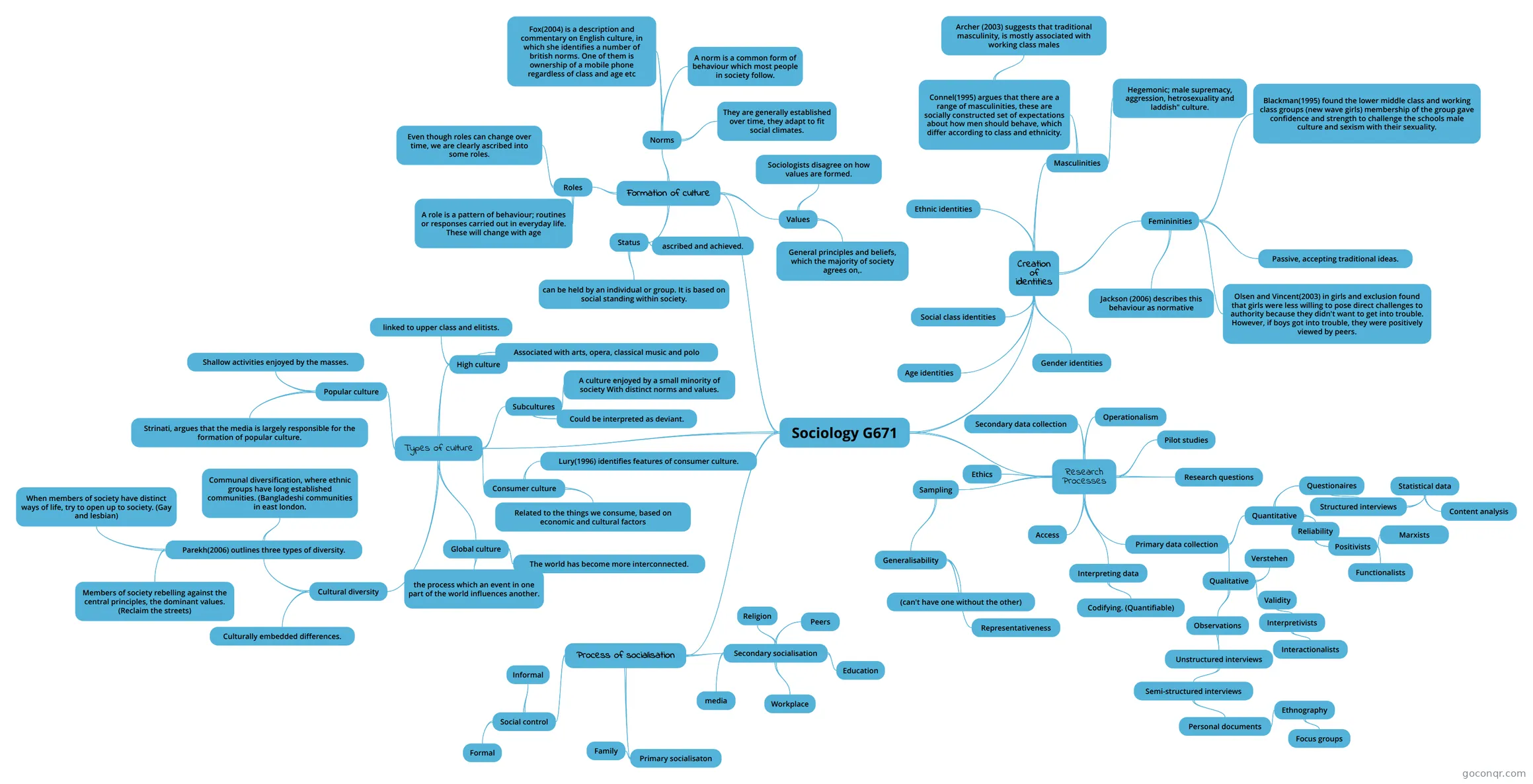
Mind map: Sociology G671
Map content
Sociology G671
Research Processes
- Research questions
- Operationalism
- Primary data collection
- Qualitative
- Validity
- Interpretivists
- Interactionalists
- Interpretivists
- Observations
- Unstructured interviews
- Semi-structured interviews
- Personal documents
- Ethnography
- Focus groups
- Ethnography
- Personal documents
- Semi-structured interviews
- Unstructured interviews
- Verstehen
- Validity
- Quantitative
- Reliability
- Positivists
- Marxists
- Functionalists
- Positivists
- Questionaires
- Structured interviews
- Statistical data
- Content analysis
- Statistical data
- Structured interviews
- Reliability
- Qualitative
- Secondary data collection
- Sampling
- Generalisability
- Representativeness
- (can't have one without the other)
- Generalisability
- Access
- Ethics
- Pilot studies
- Interpreting data
- Codifying. (Quantifiable)
Formation of culture
- Norms
- Fox(2004) is a description and commentary on English culture, in which she identifies a number of british norms. One of them is ownership of a mobile phone regardless of class and age etc
- A norm is a common form of behaviour which most people in society follow.
- They are generally established over time, they adapt to fit social climates.
- Values
- General principles and beliefs, which the majority of society agrees on,.
- Sociologists disagree on how values are formed.
- Status
- can be held by an individual or group. It is based on social standing within society.
- ascribed and achieved.
- Roles
- A role is a pattern of behaviour; routines or responses carried out in everyday life. These will change with age
- Even though roles can change over time, we are clearly ascribed into some roles.
- Norms
Process of socialisation
- Primary socialisaton
- Family
- Secondary socialisation
- Religion
- media
- Education
- Peers
- Workplace
- Social control
- Formal
- Informal
- Primary socialisaton
Types of culture
- High culture
- linked to upper class and elitists.
- Associated with arts, opera, classical music and polo
- Popular culture
- Shallow activities enjoyed by the masses.
- Strinati, argues that the media is largely responsible for the formation of popular culture.
- Cultural diversity
- Culturally embedded differences.
- Parekh(2006) outlines three types of diversity.
- When members of society have distinct ways of life, try to open up to society. (Gay and lesbian)
- Members of society rebelling against the central principles, the dominant values. (Reclaim the streets)
- Communal diversification, where ethnic groups have long established communities. (Bangladeshi communities in east london.
- Subcultures
- A culture enjoyed by a small minority of society With distinct norms and values.
- Could be interpreted as deviant.
- Global culture
- the process which an event in one part of the world influences another.
- The world has become more interconnected.
- Consumer culture
- Related to the things we consume, based on economic and cultural factors
- Lury(1996) identifies features of consumer culture.
- High culture
Creation of identities
- Gender identities
- Femininities
- Passive, accepting traditional ideas.
- Jackson (2006) describes this behaviour as normative
- Olsen and Vincent(2003) in girls and exclusion found that girls were less willing to pose direct challenges to authority because they didn't want to get into trouble. However, if boys got into trouble, they were positively viewed by peers.
- Blackman(1995) found the lower middle class and working class groups (new wave girls) membership of the group gave confidence and strength to challenge the schools male culture and sexism with their sexuality.
- Ethnic identities
- Age identities
- Masculinities
- Hegemonic; male supremacy, aggression, hetrosexuality and laddish" culture.
- Connel(1995) argues that there are a range of masculinities, these are socially constructed set of expectations about how men should behave, which differ according to class and ethnicity.
- Archer (2003) suggests that traditional masculinity, is mostly associated with working class males
- Social class identities
Information
- Description
- Mind Map on Sociology G671, created by barnescharis on 09/02/2015.
- Created by
- barnescharis
- Views
- 35
- Rating
More on Socialisation and Identity