
Mind map
Future of Policing
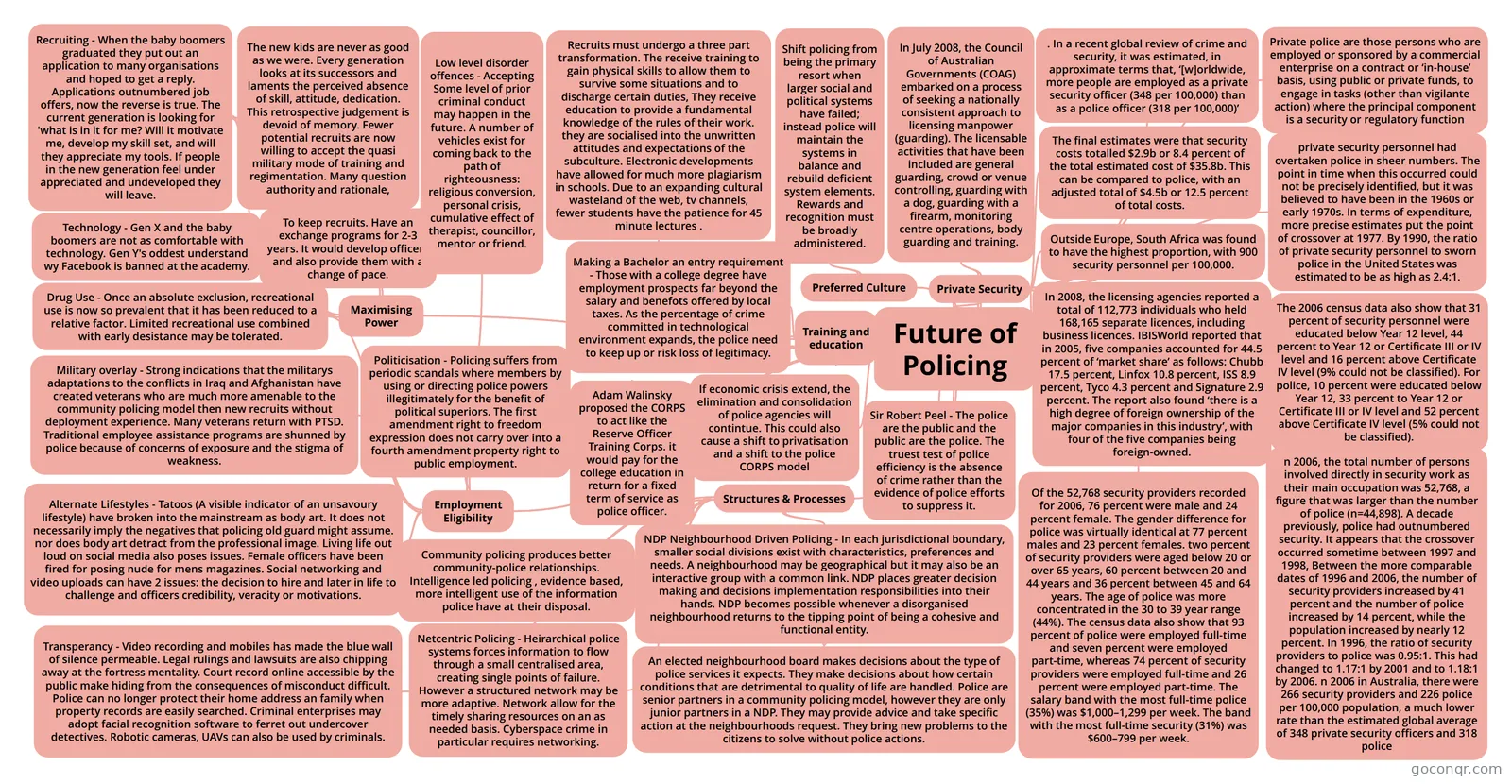
Mind map: Future of policing
Map content
Future of Policing
Private Security
- Private police are those persons who are employed or sponsored by a commercial enterprise on a contract or ‘in-house’ basis, using public or private funds, to engage in tasks (other than vigilante action) where the principal component is a security or regulatory function
- private security personnel had overtaken police in sheer numbers. The point in time when this occurred could not be precisely identified, but it was believed to have been in the 1960s or early 1970s. In terms of expenditure, more precise estimates put the point of crossover at 1977. By 1990, the ratio of private security personnel to sworn police in the United States was estimated to be as high as 2.4:1.
- Outside Europe, South Africa was found to have the highest proportion, with 900 security personnel per 100,000.
- . In a recent global review of crime and security, it was estimated, in approximate terms that, ‘[w]orldwide, more people are employed as a private security officer (348 per 100,000) than as a police officer (318 per 100,000)’
- The final estimates were that security costs totalled $2.9b or 8.4 percent of the total estimated cost of $35.8b. This can be compared to police, with an adjusted total of $4.5b or 12.5 percent of total costs.
- In July 2008, the Council of Australian Governments (COAG) embarked on a process of seeking a nationally consistent approach to licensing manpower (guarding). The licensable activities that have been included are general guarding, crowd or venue controlling, guarding with a dog, guarding with a firearm, monitoring centre operations, body guarding and training.
- n 2006, the total number of persons involved directly in security work as their main occupation was 52,768, a figure that was larger than the number of police (n=44,898). A decade previously, police had outnumbered security. It appears that the crossover occurred sometime between 1997 and 1998, Between the more comparable dates of 1996 and 2006, the number of security providers increased by 41 percent and the number of police increased by 14 percent, while the population increased by nearly 12 percent. In 1996, the ratio of security providers to police was 0.95:1. This had changed to 1.17:1 by 2001 and to 1.18:1 by 2006. n 2006 in Australia, there were 266 security providers and 226 police per 100,000 population, a much lower rate than the estimated global average of 348 private security officers and 318 police
- Of the 52,768 security providers recorded for 2006, 76 percent were male and 24 percent female. The gender difference for police was virtually identical at 77 percent males and 23 percent females. two percent of security providers were aged below 20 or over 65 years, 60 percent between 20 and 44 years and 36 percent between 45 and 64 years. The age of police was more concentrated in the 30 to 39 year range (44%). The census data also show that 93 percent of police were employed full-time and seven percent were employed part-time, whereas 74 percent of security providers were employed full-time and 26 percent were employed part-time. The salary band with the most full-time police (35%) was $1,000–1,299 per week. The band with the most full-time security (31%) was $600–799 per week.
- The 2006 census data also show that 31 percent of security personnel were educated below Year 12 level, 44 percent to Year 12 or Certificate III or IV level and 16 percent above Certificate IV level (9% could not be classified). For police, 10 percent were educated below Year 12, 33 percent to Year 12 or Certificate III or IV level and 52 percent above Certificate IV level (5% could not be classified).
- In 2008, the licensing agencies reported a total of 112,773 individuals who held 168,165 separate licences, including business licences. IBISWorld reported that in 2005, five companies accounted for 44.5 percent of ‘market share’ as follows: Chubb 17.5 percent, Linfox 10.8 percent, ISS 8.9 percent, Tyco 4.3 percent and Signature 2.9 percent. The report also found ‘there is a high degree of foreign ownership of the major companies in this industry’, with four of the five companies being foreign-owned.
- Sir Robert Peel - The police are the public and the public are the police. The truest test of police efficiency is the absence of crime rather than the evidence of police efforts to suppress it.
Structures & Processes
- Community policing produces better community-police relationships. Intelligence led policing , evidence based, more intelligent use of the information police have at their disposal.
- NDP Neighbourhood Driven Policing - In each jurisdictional boundary, smaller social divisions exist with characteristics, preferences and needs. A neighbourhood may be geographical but it may also be an interactive group with a common link. NDP places greater decision making and decisions implementation responsibilities into their hands. NDP becomes possible whenever a disorganised neighbourhood returns to the tipping point of being a cohesive and functional entity.
- An elected neighbourhood board makes decisions about the type of police services it expects. They make decisions about how certain conditions that are detrimental to quality of life are handled. Police are senior partners in a community policing model, however they are only junior partners in a NDP. They may provide advice and take specific action at the neighbourhoods request. They bring new problems to the citizens to solve without police actions.
- Netcentric Policing - Heirarchical police systems forces information to flow through a small centralised area, creating single points of failure. However a structured network may be more adaptive. Network allow for the timely sharing resources on an as needed basis. Cyberspace crime in particular requires networking.
- Transperancy - Video recording and mobiles has made the blue wall of silence permeable. Legal rulings and lawsuits are also chipping away at the fortress mentality. Court record online accessible by the public make hiding from the consequences of misconduct difficult. Police can no longer protect their home address an family when property records are easily searched. Criminal enterprises may adopt facial recognition software to ferret out undercover detectives. Robotic cameras, UAVs can also be used by criminals.
Maximising Power
- The new kids are never as good as we were. Every generation looks at its successors and laments the perceived absence of skill, attitude, dedication. This retrospective judgement is devoid of memory. Fewer potential recruits are now willing to accept the quasi military mode of training and regimentation. Many question authority and rationale,
- Recruiting - When the baby boomers graduated they put out an application to many organisations and hoped to get a reply. Applications outnumbered job offers, now the reverse is true. The current generation is looking for 'what is in it for me? Will it motivate me, develop my skill set, and will they appreciate my tools. If people in the new generation feel under appreciated and undeveloped they will leave.
- To keep recruits. Have an exchange programs for 2-3 years. It would develop officers and also provide them with a change of pace.
- Technology - Gen X and the baby boomers are not as comfortable with technology. Gen Y's oddest understand wy Facebook is banned at the academy.
Employment Eligibility
- Drug Use - Once an absolute exclusion, recreational use is now so prevalent that it has been reduced to a relative factor. Limited recreational use combined with early desistance may be tolerated.
- Low level disorder offences - Accepting Some level of prior criminal conduct may happen in the future. A number of vehicles exist for coming back to the path of righteousness: religious conversion, personal crisis, cumulative effect of therapist, councillor, mentor or friend.
- Alternate Lifestyles - Tatoos (A visible indicator of an unsavoury lifestyle) have broken into the mainstream as body art. It does not necessarily imply the negatives that policing old guard might assume. nor does body art detract from the professional image. Living life out loud on social media also poses issues. Female officers have been fired for posing nude for mens magazines. Social networking and video uploads can have 2 issues: the decision to hire and later in life to challenge and officers credibility, veracity or motivations.
- Politicisation - Policing suffers from periodic scandals where members by using or directing police powers illegitimately for the benefit of political superiors. The first amendment right to freedom expression does not carry over into a fourth amendment property right to public employment.
- Military overlay - Strong indications that the militarys adaptations to the conflicts in Iraq and Afghanistan have created veterans who are much more amenable to the community policing model then new recruits without deployment experience. Many veterans return with PTSD. Traditional employee assistance programs are shunned by police because of concerns of exposure and the stigma of weakness.
Preferred Culture
- Shift policing from being the primary resort when larger social and political systems have failed; instead police will maintain the systems in balance and rebuild deficient system elements. Rewards and recognition must be broadly administered.
Training and education
- Recruits must undergo a three part transformation. The receive training to gain physical skills to allow them to survive some situations and to discharge certain duties, They receive education to provide a fundamental knowledge of the rules of their work. they are socialised into the unwritten attitudes and expectations of the subculture. Electronic developments have allowed for much more plagiarism in schools. Due to an expanding cultural wasteland of the web, tv channels, fewer students have the patience for 45 minute lectures .
- Making a Bachelor an entry requirement - Those with a college degree have employment prospects far beyond the salary and benefots offered by local taxes. As the percentage of crime committed in technological environment expands, the police need to keep up or risk loss of legitimacy.
If economic crisis extend, the elimination and consolidation of police agencies will contintue. This could also cause a shift to privatisation and a shift to the police CORPS model
- Adam Walinsky proposed the CORPS to act like the Reserve Officer Training Corps. it would pay for the college education in return for a fixed term of service as police officer.
Information
- Description
- Bachelor Policing Systems & Practice Mind Map on Future of Policing, created by caramelcarl on 15/02/2015.
- Created by
- caramelcarl
- Views
- 2
- Rating
More on Police organizations and governance