
Mind map
Walden - Jessica Pineda
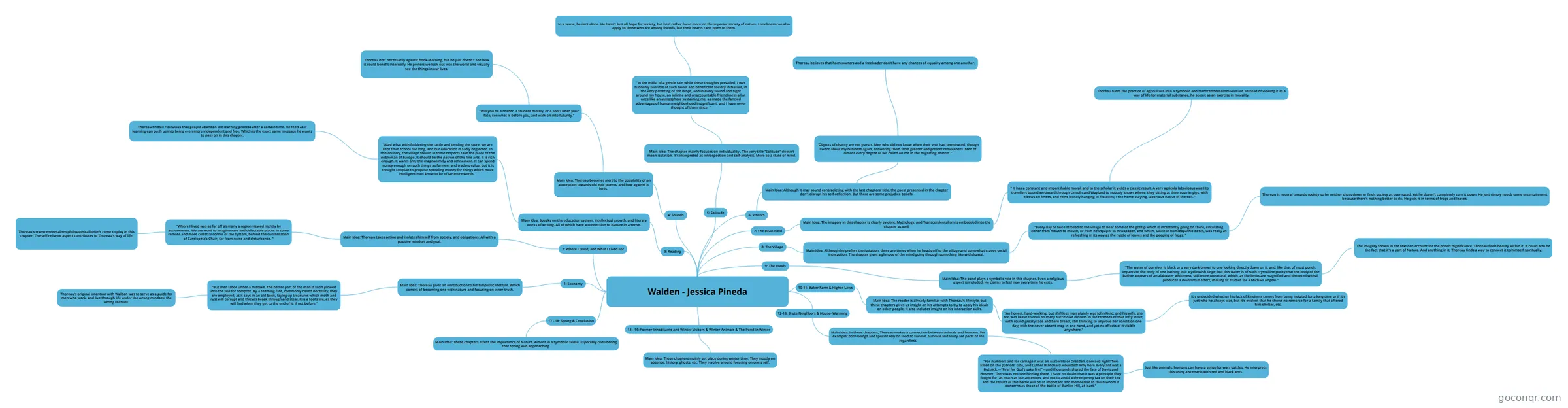
Mind map: Walden chapters summary
Map content
Walden - Jessica Pineda
1: Economy
- Main Idea: Thoreau gives an introduction to his simplistic lifestyle. Which consist of becoming one with nature and focusing on inner truth.
- "But men labor under a mistake. The better part of the man is soon plowed into the soil for compost. By a seeming fate, commonly called necessity, they are employed, as it says in an old book, laying up treasures which moth and rust will corrupt and thieves break through and steal. It is a fool’s life, as they will find when they get to the end of it, if not before."
- Thoreau's original intention with Walden was to serve as a guide for men who work, and live through life under the wrong mindset/ the wrong reasons.
- "But men labor under a mistake. The better part of the man is soon plowed into the soil for compost. By a seeming fate, commonly called necessity, they are employed, as it says in an old book, laying up treasures which moth and rust will corrupt and thieves break through and steal. It is a fool’s life, as they will find when they get to the end of it, if not before."
- Main Idea: Thoreau gives an introduction to his simplistic lifestyle. Which consist of becoming one with nature and focusing on inner truth.
2: Where I Lived, and What I Lived For
- Main Idea: Thoreau takes action and isolates himself from society, and obligations. All with a positive mindset and goal.
- "Where I lived was as far off as many a region viewed nightly by astronomers. We are wont to imagine rare and delectable places in some remote and more celestial corner of the system, behind the constellation of Cassiopeia’s Chair, far from noise and disturbance. "
- Thoreau's transcendentalism philosophical beliefs come to play in this chapter. The self-reliance aspect contributes to Thoreau's way of life.
- "Where I lived was as far off as many a region viewed nightly by astronomers. We are wont to imagine rare and delectable places in some remote and more celestial corner of the system, behind the constellation of Cassiopeia’s Chair, far from noise and disturbance. "
- Main Idea: Thoreau takes action and isolates himself from society, and obligations. All with a positive mindset and goal.
3: Reading
- Main Idea: Speaks on the education system, intellectual growth, and literary works of writing. All of which have a connection to Nature in a sense.
- "Alas! what with foddering the cattle and tending the store, we are kept from school too long, and our education is sadly neglected. In this country, the village should in some respects take the place of the nobleman of Europe. It should be the patron of the fine arts. It is rich enough. It wants only the magnanimity and refinement. It can spend money enough on such things as farmers and traders value, but it is thought Utopian to propose spending money for things which more intelligent men know to be of far more worth. "
- Thoreau finds it ridiculous that people abandon the learning process after a certain time. He feels as if learning can push us into being even more independent and free. Which is the exact same message he wants to pass on in this chapter.
- "Alas! what with foddering the cattle and tending the store, we are kept from school too long, and our education is sadly neglected. In this country, the village should in some respects take the place of the nobleman of Europe. It should be the patron of the fine arts. It is rich enough. It wants only the magnanimity and refinement. It can spend money enough on such things as farmers and traders value, but it is thought Utopian to propose spending money for things which more intelligent men know to be of far more worth. "
- Main Idea: Speaks on the education system, intellectual growth, and literary works of writing. All of which have a connection to Nature in a sense.
4: Sounds
- Main Idea: Thoreau becomes alert to the possibility of an absorption towards old epic poems, and how against it he is.
- "Will you be a reader, a student merely, or a seer? Read your fate, see what is before you, and walk on into futurity."
- Thoreau isn't necessarily against book-learning, but he just doesn't see how it could benefit internally. He prefers we look out into the world and visually see the things in our lives.
- "Will you be a reader, a student merely, or a seer? Read your fate, see what is before you, and walk on into futurity."
- Main Idea: Thoreau becomes alert to the possibility of an absorption towards old epic poems, and how against it he is.
5: Solitude
- Main Idea: The chapter mainly focuses on individuality . The very title "Solitude" doesn't mean isolation. It's interpreted as introspection and self-analysis. More so a state of mind.
- "In the midst of a gentle rain while these thoughts prevailed, I was suddenly sensible of such sweet and beneficent society in Nature, in the very pattering of the drops, and in every sound and sight around my house, an infinite and unaccountable friendliness all at once like an atmosphere sustaining me, as made the fancied advantages of human neighborhood insignificant, and I have never thought of them since. "
- In a sense, he isn't alone. He hasn't lost all hope for society, but he'd rather focus more on the superior society of nature. Loneliness can also apply to those who are among friends, but their hearts can't open to them.
- "In the midst of a gentle rain while these thoughts prevailed, I was suddenly sensible of such sweet and beneficent society in Nature, in the very pattering of the drops, and in every sound and sight around my house, an infinite and unaccountable friendliness all at once like an atmosphere sustaining me, as made the fancied advantages of human neighborhood insignificant, and I have never thought of them since. "
- Main Idea: The chapter mainly focuses on individuality . The very title "Solitude" doesn't mean isolation. It's interpreted as introspection and self-analysis. More so a state of mind.
6: Visitors
- Main Idea: Although it may sound contradicting with the last chapters' title, the guest presented in the chapter don't disrupt his self-reflection. But there are some prejudice beliefs.
- "Objects of charity are not guests. Men who did not know when their visit had terminated, though I went about my business again, answering them from greater and greater remoteness. Men of almost every degree of wit called on me in the migrating season. "
- Thoreau believes that homeowners and a freeloader don't have any chances of equality among one another.
- "Objects of charity are not guests. Men who did not know when their visit had terminated, though I went about my business again, answering them from greater and greater remoteness. Men of almost every degree of wit called on me in the migrating season. "
- Main Idea: Although it may sound contradicting with the last chapters' title, the guest presented in the chapter don't disrupt his self-reflection. But there are some prejudice beliefs.
7: The Bean-Field
- Main Idea: The imagery in this chapter is clearly evident. Mythology, and Transcendentalism is embedded into the chapter as well.
- " It has a constant and imperishable moral, and to the scholar it yields a classic result. A very agricola laboriosus was I to travellers bound westward through Lincoln and Wayland to nobody knows where; they sitting at their ease in gigs, with elbows on knees, and reins loosely hanging in festoons; I the home-staying, laborious native of the soil. "
- Thoreau turns the practice of agriculture into a symbolic and transcendentalism venture. Instead of viewing it as a way of life for material substance, he sees it as an exercise in morality.
- " It has a constant and imperishable moral, and to the scholar it yields a classic result. A very agricola laboriosus was I to travellers bound westward through Lincoln and Wayland to nobody knows where; they sitting at their ease in gigs, with elbows on knees, and reins loosely hanging in festoons; I the home-staying, laborious native of the soil. "
- Main Idea: The imagery in this chapter is clearly evident. Mythology, and Transcendentalism is embedded into the chapter as well.
8: The Village
- Main Idea: Although he prefers the isolation, there are times when he heads off to the village and somewhat craves social interaction. The chapter gives a glimpse of the mind going through something like withdrawal.
- "Every day or two I strolled to the village to hear some of the gossip which is incessantly going on there, circulating either from mouth to mouth, or from newspaper to newspaper, and which, taken in homœopathic doses, was really as refreshing in its way as the rustle of leaves and the peeping of frogs. "
- Thoreau is neutral towards society so he neither shuts down or finds society as over-rated. Yet he doesn't completely turn it down. He just simply needs some entertainment because there's nothing better to do. He puts it in terms of frogs and leaves.
- "Every day or two I strolled to the village to hear some of the gossip which is incessantly going on there, circulating either from mouth to mouth, or from newspaper to newspaper, and which, taken in homœopathic doses, was really as refreshing in its way as the rustle of leaves and the peeping of frogs. "
- Main Idea: Although he prefers the isolation, there are times when he heads off to the village and somewhat craves social interaction. The chapter gives a glimpse of the mind going through something like withdrawal.
9: The Ponds
- Main Idea: The pond plays a symbolic role in this chapter. Even a religious aspect is included. He claims to feel new every time he exits.
- "The water of our river is black or a very dark brown to one looking directly down on it, and, like that of most ponds, imparts to the body of one bathing in it a yellowish tinge; but this water is of such crystalline purity that the body of the bather appears of an alabaster whiteness, still more unnatural, which, as the limbs are magnified and distorted withal, produces a monstrous effect, making fit studies for a Michael Angelo."
- The imagery shown in the text can account for the ponds' significance. Thoreau finds beauty within it. It could also be the fact that it's a part of Nature. And anything in it, Thoreau finds a way to connect it to himself spiritually.
- "The water of our river is black or a very dark brown to one looking directly down on it, and, like that of most ponds, imparts to the body of one bathing in it a yellowish tinge; but this water is of such crystalline purity that the body of the bather appears of an alabaster whiteness, still more unnatural, which, as the limbs are magnified and distorted withal, produces a monstrous effect, making fit studies for a Michael Angelo."
- Main Idea: The pond plays a symbolic role in this chapter. Even a religious aspect is included. He claims to feel new every time he exits.
10-11: Baker Farm & Higher Laws
- Main Idea: The reader is already familiar with Thoreau's lifestyle, but these chapters gives us insight on his attempts to try to apply his ideals on other people. It also includes insight on his interaction skills.
- "An honest, hard-working, but shiftless man plainly was John Field; and his wife, she too was brave to cook so many successive dinners in the recesses of that lofty stove; with round greasy face and bare breast, still thinking to improve her condition one day; with the never absent mop in one hand, and yet no effects of it visible anywhere."
- It's undecided whether his lack of kindness comes from being isolated for a long time or if it's just who he always was, but it's evident that he shows no remorse for a family that offered him shelter, etc.
- "An honest, hard-working, but shiftless man plainly was John Field; and his wife, she too was brave to cook so many successive dinners in the recesses of that lofty stove; with round greasy face and bare breast, still thinking to improve her condition one day; with the never absent mop in one hand, and yet no effects of it visible anywhere."
- Main Idea: The reader is already familiar with Thoreau's lifestyle, but these chapters gives us insight on his attempts to try to apply his ideals on other people. It also includes insight on his interaction skills.
12-13: Brute Neighbors & House- Warming
- Main Idea: In these chapters, Thoreau makes a connection between animals and humans. For example: both beings and species rely on food to survive. Survival and levity are parts of life regardless.
- "For numbers and for carnage it was an Austerlitz or Dresden. Concord Fight! Two killed on the patriots’ side, and Luther Blanchard wounded! Why here every ant was a Buttrick,—“Fire! for God’s sake fire!”—and thousands shared the fate of Davis and Hosmer. There was not one hireling there. I have no doubt that it was a principle they fought for, as much as our ancestors, and not to avoid a three-penny tax on their tea; and the results of this battle will be as important and memorable to those whom it concerns as those of the battle of Bunker Hill, at least."
- Just like animals, humans can have a sense for war/ battles. He interprets this using a scenario with red and black ants.
- "For numbers and for carnage it was an Austerlitz or Dresden. Concord Fight! Two killed on the patriots’ side, and Luther Blanchard wounded! Why here every ant was a Buttrick,—“Fire! for God’s sake fire!”—and thousands shared the fate of Davis and Hosmer. There was not one hireling there. I have no doubt that it was a principle they fought for, as much as our ancestors, and not to avoid a three-penny tax on their tea; and the results of this battle will be as important and memorable to those whom it concerns as those of the battle of Bunker Hill, at least."
- Main Idea: In these chapters, Thoreau makes a connection between animals and humans. For example: both beings and species rely on food to survive. Survival and levity are parts of life regardless.
14 - 16: Former Inhabitants and Winter Visitors & Winter Animals & The Pond in Winter
- Main Idea: These chapters mainly set place during winter time. They mostly on absence, history, ghosts, etc. They revolve around focusing on one's self.
17 - 18: Spring & Conclusion
- Main Idea: These chapters stress the importance of Nature. Almost in a symbolic sense. Especially considering that spring was approaching.
Information
- Description
- Mind Map on Walden - Jessica Pineda, created by Jessica Pineda on 10/02/2020.
- Created by
- Jessica Pineda
- Views
- 12
- Rating