
Mind map
Walden by Henry David Thoreau part 2
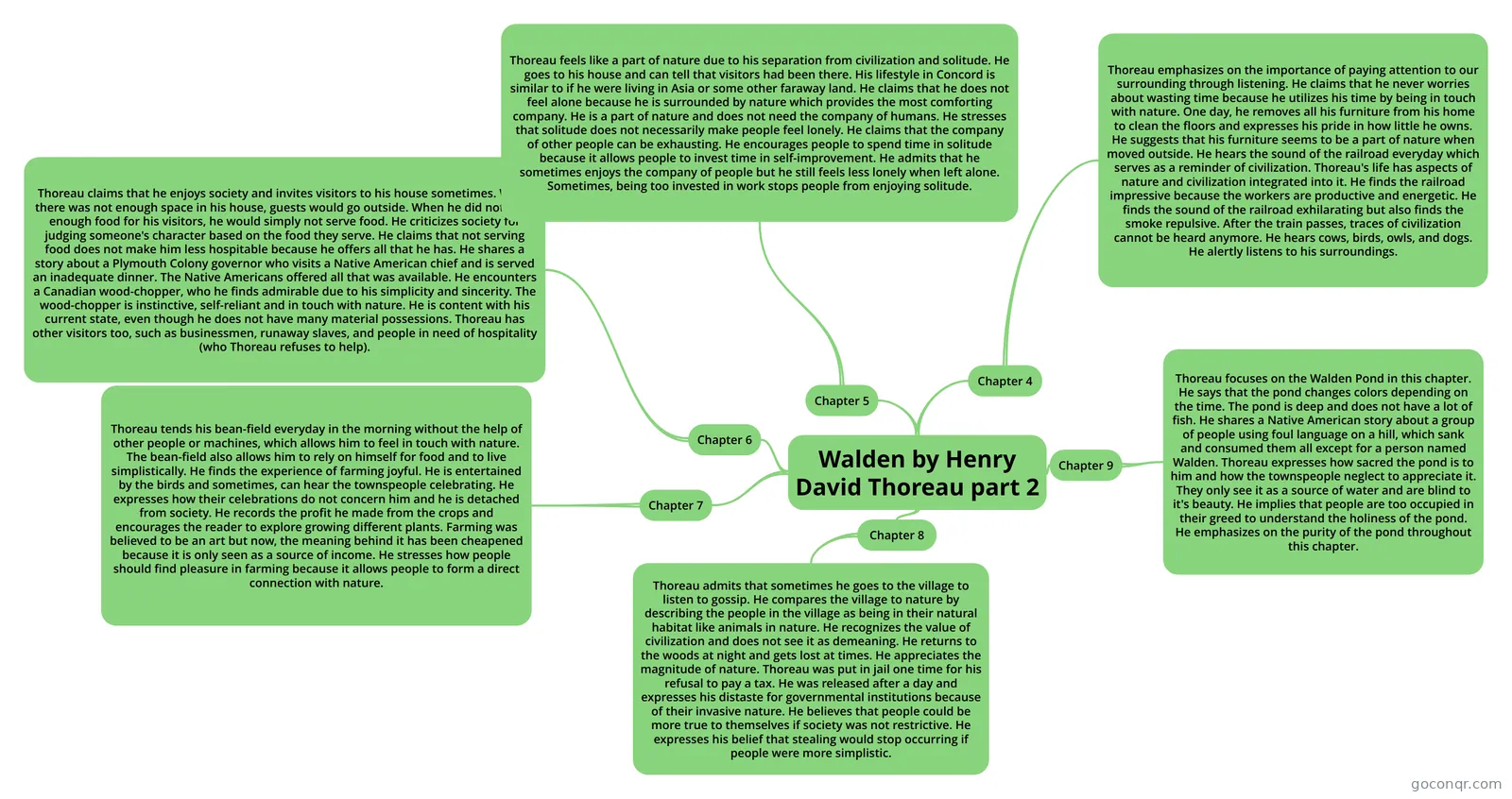
Mind map: Walden by Henry David Thoreau part 2
Map content
Walden by Henry David Thoreau part 2
Chapter 4
- Thoreau emphasizes on the importance of paying attention to our surrounding through listening. He claims that he never worries about wasting time because he utilizes his time by being in touch with nature. One day, he removes all his furniture from his home to clean the floors and expresses his pride in how little he owns. He suggests that his furniture seems to be a part of nature when moved outside. He hears the sound of the railroad everyday which serves as a reminder of civilization. Thoreau's life has aspects of nature and civilization integrated into it. He finds the railroad impressive because the workers are productive and energetic. He finds the sound of the railroad exhilarating but also finds the smoke repulsive. After the train passes, traces of civilization cannot be heard anymore. He hears cows, birds, owls, and dogs. He alertly listens to his surroundings.
Chapter 5
- Thoreau feels like a part of nature due to his separation from civilization and solitude. He goes to his house and can tell that visitors had been there. His lifestyle in Concord is similar to if he were living in Asia or some other faraway land. He claims that he does not feel alone because he is surrounded by nature which provides the most comforting company. He is a part of nature and does not need the company of humans. He stresses that solitude does not necessarily make people feel lonely. He claims that the company of other people can be exhausting. He encourages people to spend time in solitude because it allows people to invest time in self-improvement. He admits that he sometimes enjoys the company of people but he still feels less lonely when left alone. Sometimes, being too invested in work stops people from enjoying solitude.
Chapter 6
- Thoreau claims that he enjoys society and invites visitors to his house sometimes. When there was not enough space in his house, guests would go outside. When he did not have enough food for his visitors, he would simply not serve food. He criticizes society for judging someone's character based on the food they serve. He claims that not serving food does not make him less hospitable because he offers all that he has. He shares a story about a Plymouth Colony governor who visits a Native American chief and is served an inadequate dinner. The Native Americans offered all that was available. He encounters a Canadian wood-chopper, who he finds admirable due to his simplicity and sincerity. The wood-chopper is instinctive, self-reliant and in touch with nature. He is content with his current state, even though he does not have many material possessions. Thoreau has other visitors too, such as businessmen, runaway slaves, and people in need of hospitality (who Thoreau refuses to help).
Chapter 7
- Thoreau tends his bean-field everyday in the morning without the help of other people or machines, which allows him to feel in touch with nature. The bean-field also allows him to rely on himself for food and to live simplistically. He finds the experience of farming joyful. He is entertained by the birds and sometimes, can hear the townspeople celebrating. He expresses how their celebrations do not concern him and he is detached from society. He records the profit he made from the crops and encourages the reader to explore growing different plants. Farming was believed to be an art but now, the meaning behind it has been cheapened because it is only seen as a source of income. He stresses how people should find pleasure in farming because it allows people to form a direct connection with nature.
Chapter 8
- Thoreau admits that sometimes he goes to the village to listen to gossip. He compares the village to nature by describing the people in the village as being in their natural habitat like animals in nature. He recognizes the value of civilization and does not see it as demeaning. He returns to the woods at night and gets lost at times. He appreciates the magnitude of nature. Thoreau was put in jail one time for his refusal to pay a tax. He was released after a day and expresses his distaste for governmental institutions because of their invasive nature. He believes that people could be more true to themselves if society was not restrictive. He expresses his belief that stealing would stop occurring if people were more simplistic.
Chapter 9
- Thoreau focuses on the Walden Pond in this chapter. He says that the pond changes colors depending on the time. The pond is deep and does not have a lot of fish. He shares a Native American story about a group of people using foul language on a hill, which sank and consumed them all except for a person named Walden. Thoreau expresses how sacred the pond is to him and how the townspeople neglect to appreciate it. They only see it as a source of water and are blind to it's beauty. He implies that people are too occupied in their greed to understand the holiness of the pond. He emphasizes on the purity of the pond throughout this chapter.
Information
- Description
- Mind Map on Walden by Henry David Thoreau part 2, created by Sidrah Rafaqat on 28/03/2020.
- Created by
- Sidrah Rafaqat
- Views
- 4
- Rating