
Mind map
Brain Mechanisms in Early Language Acquisition
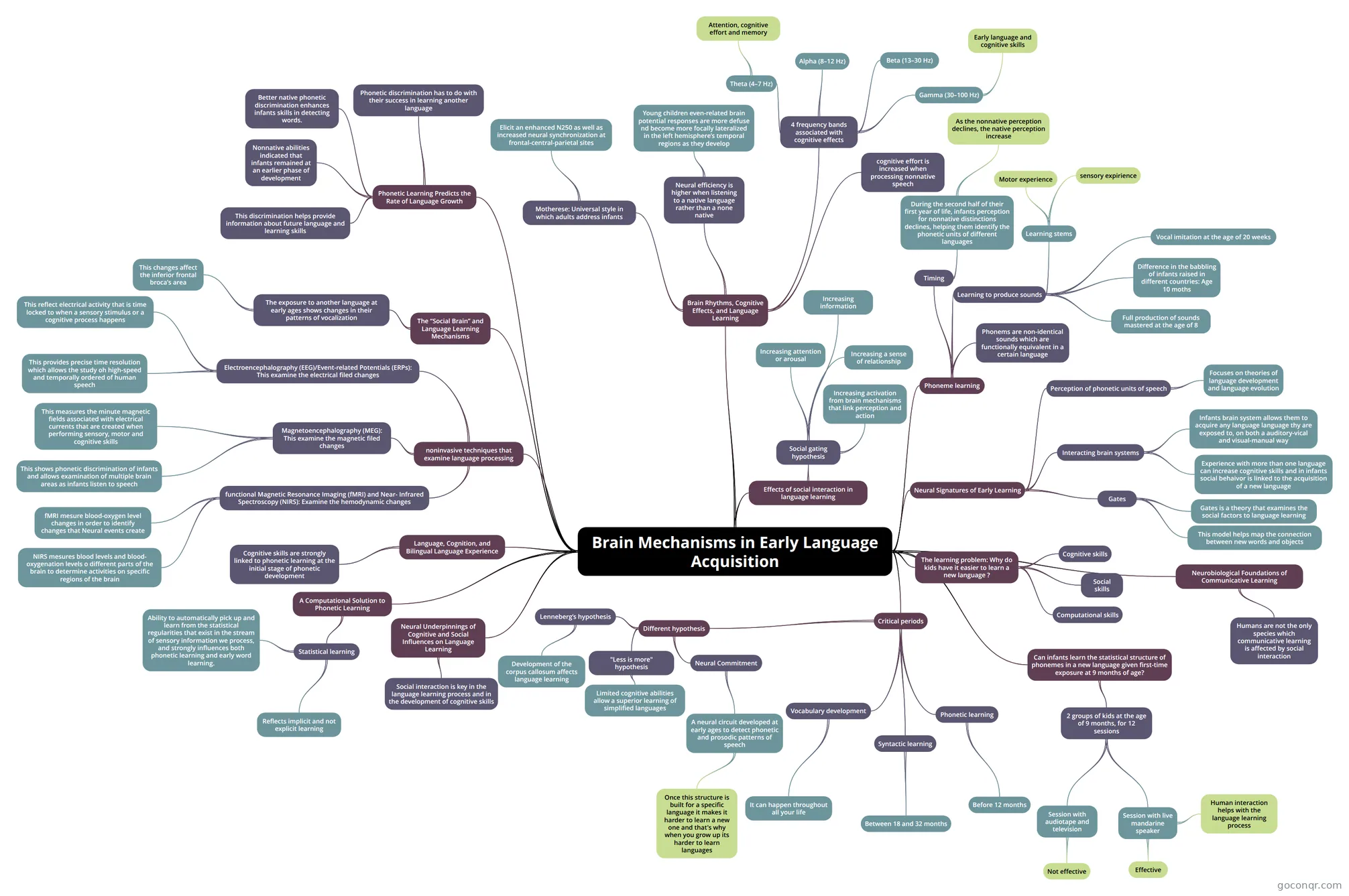
Mind map: Brain mechanisms in early language acquisition
Map content
Brain Mechanisms in Early Language Acquisition
noninvasive techniques that examine language processing
- Electroencephalography (EEG)/Event-related Potentials (ERPs): This examine the electrical filed changes
- This reflect electrical activity that is time locked to when a sensory stimulus or a cognitive process happens
- This provides precise time resolution which allows the study oh high-speed and temporally ordered of human speech
- Magnetoencephalography (MEG): This examine the magnetic filed changes
- This measures the minute magnetic fields associated with electrical currents that are created when performing sensory, motor and cognitive skills
- This shows phonetic discrimination of infants and allows examination of multiple brain areas as infants listen to speech
- functional Magnetic Resonance Imaging (fMRI) and Near- Infrared Spectroscopy (NIRS): Examine the hemodynamic changes
- fMRI mesure blood-oxygen level changes in order to identify changes that Neural events create
- NIRS mesures blood levels and blood- oxygenation levels o different parts of the brain to determine activities on specific regions of the brain
- Electroencephalography (EEG)/Event-related Potentials (ERPs): This examine the electrical filed changes
Neural Signatures of Early Learning
- Perception of phonetic units of speech
- Focuses on theories of language development and language evolution
- Interacting brain systems
- Infants brain system allows them to acquire any language language thy are exposed to, on both a auditory-vical and visual-manual way
- Experience with more than one language can increase cognitive skills and in infants social behaivor is linked to the acquisition of a new language
- Gates
- Gates is a theory that examines the social factors to language learning
- This model helps map the connection between new words and objects
- Perception of phonetic units of speech
The learning problem: Why do kids have it easier to learn a new language ?
- Cognitive skills
- Social skills
- Computational skills
Critical periods
- Phonetic learning
- Before 12 months
- Syntactic learning
- Between 18 and 32 months
- Vocabulary development
- It can happen throughout all your life
- Different hypothesis
- Lenneberg’s hypothesis
- Development of the corpus callosum affects language learning
- "Less is more" hypothesis
- Limited cognitive abilities allow a superior learning of simplified languages
- Neural Commitment
- A neural circuit developed at early ages to detect phonetic and prosodic patterns of speech
- Once this structure is built for a specific language it makes it harder to learn a new one and that's why when you grow up its harder to learn languages
- A neural circuit developed at early ages to detect phonetic and prosodic patterns of speech
- Lenneberg’s hypothesis
- Phonetic learning
Phoneme learning
- Phonems are non-identical sounds which are functionally equivalent in a certain language
- Learning to produce sounds
- Vocal imitation at the age of 20 weeks
- Difference in the babbling of infants raised in different countries: Age 10 moths
- Full production of sounds mastered at the age of 8
- Learning stems
- Motor experience
- sensory expirience
- Timing
- During the second half of their first year of life, infants perception for nonnative distinctions declines, helping them identify the phonetic units of different languages
- As the nonnative perception declines, the native perception increase
- During the second half of their first year of life, infants perception for nonnative distinctions declines, helping them identify the phonetic units of different languages
Can infants learn the statistical structure of phonemes in a new language given first-time exposure at 9 months of age?
- 2 groups of kids at the age of 9 months, for 12 sessions
- Session with live mandarine speaker
- Effective
- Human interaction helps with the language learning process
- Session with audiotape and television
- Not effective
- Session with live mandarine speaker
- 2 groups of kids at the age of 9 months, for 12 sessions
Effects of social interaction in language learning
- Social gating hypothesis
- Increasing attention or arousal
- Increasing information
- Increasing a sense of relationship
- Increasing activation from brain mechanisms that link perception and action
- Social gating hypothesis
Language, Cognition, and Bilingual Language Experience
- Cognitive skills are strongly linked to phonetic learning at the initial stage of phonetic development
The “Social Brain” and Language Learning Mechanisms
- The exposure to another language at early ages shows changes in their patterns of vocalization
- This changes affect the inferior frontal broca's area
- The exposure to another language at early ages shows changes in their patterns of vocalization
Brain Rhythms, Cognitive Effects, and Language Learning
- cognitive effort is increased when processing nonnative speech
- Neural efficiency is higher when listening to a native language rather than a none native
- Young children even-related brain potential responses are more defuse nd become more focally lateralized in the left hemisphere’s temporal regions as they develop
- 4 frequency bands associated with cognitive effects
- Theta (4–7 Hz)
- Attention, cognitive effort and memory
- Alpha (8–12 Hz)
- Beta (13–30 Hz)
- Gamma (30–100 Hz)
- Early language and cognitive skills
- Theta (4–7 Hz)
- Motherese: Universal style in which adults address infants
- Elicit an enhanced N250 as well as increased neural synchronization at frontal-central-parietal sites
Neurobiological Foundations of Communicative Learning
- Humans are not the only species which communicative learning is affected by social interaction
Neural Underpinnings of Cognitive and Social Influences on Language Learning
- Social interaction is key in the language learning process and in the development of cognitive skills
A Computational Solution to Phonetic Learning
- Statistical learning
- Reflects implicit and not explicit learning
- Ability to automatically pick up and learn from the statistical regularities that exist in the stream of sensory information we process, and strongly influences both phonetic learning and early word learning.
- Statistical learning
Phonetic Learning Predicts the Rate of Language Growth
- Phonetic discrimination has to do with their success in learning another language
- Better native phonetic discrimination enhances infants skills in detecting words.
- Nonnative abilities indicated that infants remained at an earlier phase of development
- This discrimination helps provide information about future language and learning skills
Information
- Description
- Mind Map on Brain Mechanisms in Early Language Acquisition, created by Ravid Vaknin on 12/04/2020.
- Created by
- Ravid Vaknin
- Views
- 0
- Rating