
2228389
Description

Mind Map by Isaac Franks, updated more than 1 year ago

|
Created by Isaac Franks
almost 11 years ago
|
|
Forces and
motion
- UNITS NEEDED TO KNOW
- Weight (Kg)
- Distance (m)
- Speed (m/s)
- Acceleration (m/s^2)
- Force (n)
- Time (s)
- Force for every Kg of weight (N/kg)
- FORMULAE NEEDED TO KNOW
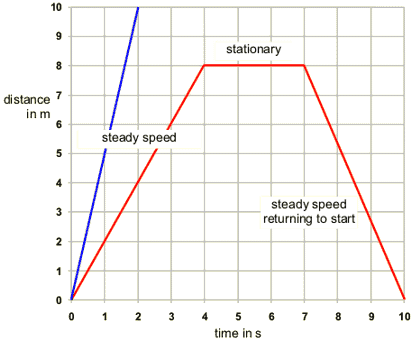
- Average speed = distance moved/time taken
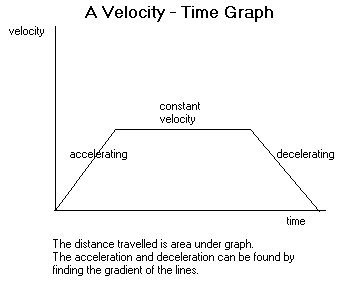
- Acceleration = change in velocity/time taken
- a = (v - u)/t
- a = (v - u)/t
- Gradient (VTG) = rise/run
- Force = mass x acceleration
- Weight = mass x g (g = 9.8/10)
- Average speed = distance moved/time taken
- Weight (Kg)
- EXPERIMENTS
- Toy cars/tennis ball
Annotations:
- You could plot the time it takes for a toy car to travel and then plot a distance time graph. Then repeat at different speeds and compare the different graphs. Alternatively, you could use a ticker tape; this makes a mark every second on the tape. If you attach the car to the end of the tape, its speed will be recorded: distance/dots = speed. For example, if you has 50 dots on a meter tape then it traveled at an average speed of (1/50) 0.02 meters per second.
- Terminal velocity
Annotations:
- Dropping parachutes from a given height; this shows us that gravity is acting on them. By increasing the size of the parachute and recording the results we can see that air resistance also has an effect on falling objects; plotting a graph should reveal that bigger surface area takes more time, from which we can infer that air resistance acts on the falling objects.
- Extension
Annotations:
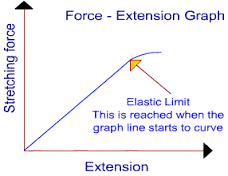
- The most common experiment for this goes like so: Attach a spring to a newton meter and measure its length. Add a 50g weight and measure again. continue to add another weight and take another measurement. Do this up to 400g. By plotting a graph from the results from this you can see the extension increases with force; as each time a weight is added the spring gets longer.
- Toy cars/tennis ball
- Changes in speed/ direction/ or shape
Annotations:
- Changes in speed When an object is stationary it has an equal force pushing down and up. The downward force being gravity and the upward force being the surface the object is on. The object is not floating but it is not going into the ground. When an object is accelerating it has the upwards and downwards forces but it also has forwards and backwards forces (drag and friction). The forward force is larger than the backward force when an object is accelerating. When an object is going at a constant speed it has downward and upward forces as well as forward and backward forces. The forward and backward forces are equal, so the speed doesn't change even though the object is moving. When an object is decelerating it has the equal upward and downward forces as well as forward and backward forces, but the backward force is larger than the forward one, slowing the object down. Changes in shape changes in shape affect momentum. Force= change in momentum/ time taken. An example of this is crumple zones in car decrease the force on the passengers. Changes in direction Which ever direction the force is greatest in will be the direction the object travels in.
- FORCES TO KNOW
- Gravity: acting downwards
- Up thrust: acting upwards
- Drag: acting against the movement
- Electrostatic: field of electricity
- Gravity: acting downwards
- Vector: has magnitude and direction Eg. velocity is speed in a direction
- Force is a vector: it always has a direction
- Eg. 3 Newtons, drag, amount of force acting backwards
- Eg. 3 Newtons, drag, amount of force acting backwards
- Force is a vector: it always has a direction
- Scalar: has only a magnitude Eg. Speed
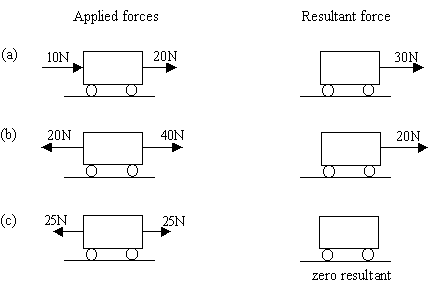
- Resultant force: overall force acting in a direction of an object
- Friction: a force that acts in opposite direction to motion
- Forces of falling objects and terminal velocity
Annotations:
- When first an object is falling it is accelerating- the force acting downward (gravity) is larger than the fore acting upwards (air resistance.) But when air resistance and gravity become equal the object will have reached its maximum speed; its terminal velocity.
- Vehicles (with momentum)
- Factors affecting stopping distance
- Drugs/tiredness
- Worn out brakes/tyred
- Poor weather (icy road/wet road, etc.)
- Car weight
- Speed of car
- Drugs/tiredness
- Force felt = change in momentum/time
Annotations:
- If the time taken for momentum to change is increased, the overall force felt is decreased. Crumple zones in cars increase the time it takes for the cars momentum to reach zero, meaning passengers feel less of the force. Air bags do the same thing; increasing the time till momentum of a body reaches zero reduces the force felt.
- Factors affecting stopping distance
- Momentum = mass x velocity (p = mv)
- Newton's 3rd law: each action (force) has an equal and opposite reaction
- Newton's 3rd law: each action (force) has an equal and opposite reaction
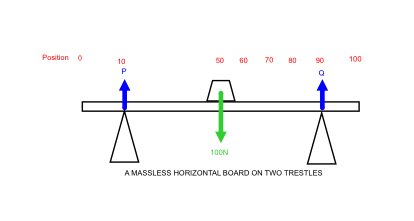
- Moment = force x perpendicular distance from pivot
- An objects centre of gravity is where allof its weight acts through
- An objects centre of gravity is where allof its weight acts through
- Hooke's law
- The strain in a solid is proportional to the applied stress within the elastic limit of that solid.
- The strain in a solid is proportional to the applied stress within the elastic limit of that solid.
- Astronomy
- Earth: g = 9.8/10; it is different on other planets
- Earth has more mass = bigger G. field strength
- Earth has more mass = bigger G. field strength
- G. field strength pulls in objects to travel round them (orbit)
- Moons (natural satellite) orbit planets
- Planets orbit sun (stars)
- Artificial satellites orbit Earth
- Comets orbit sun
- Planets orbit in circles, comets orbit in ovals
- Planets orbit in circles, comets orbit in ovals
- Orbital speed = 2 x pi x radius/time
- Moons (natural satellite) orbit planets
- Earth: g = 9.8/10; it is different on other planets
Media attachments
Want to create your own Mind Maps for free with GoConqr? Learn more.