
Mind map
Chpt. 23: Bisocial Development: Late Adulthood
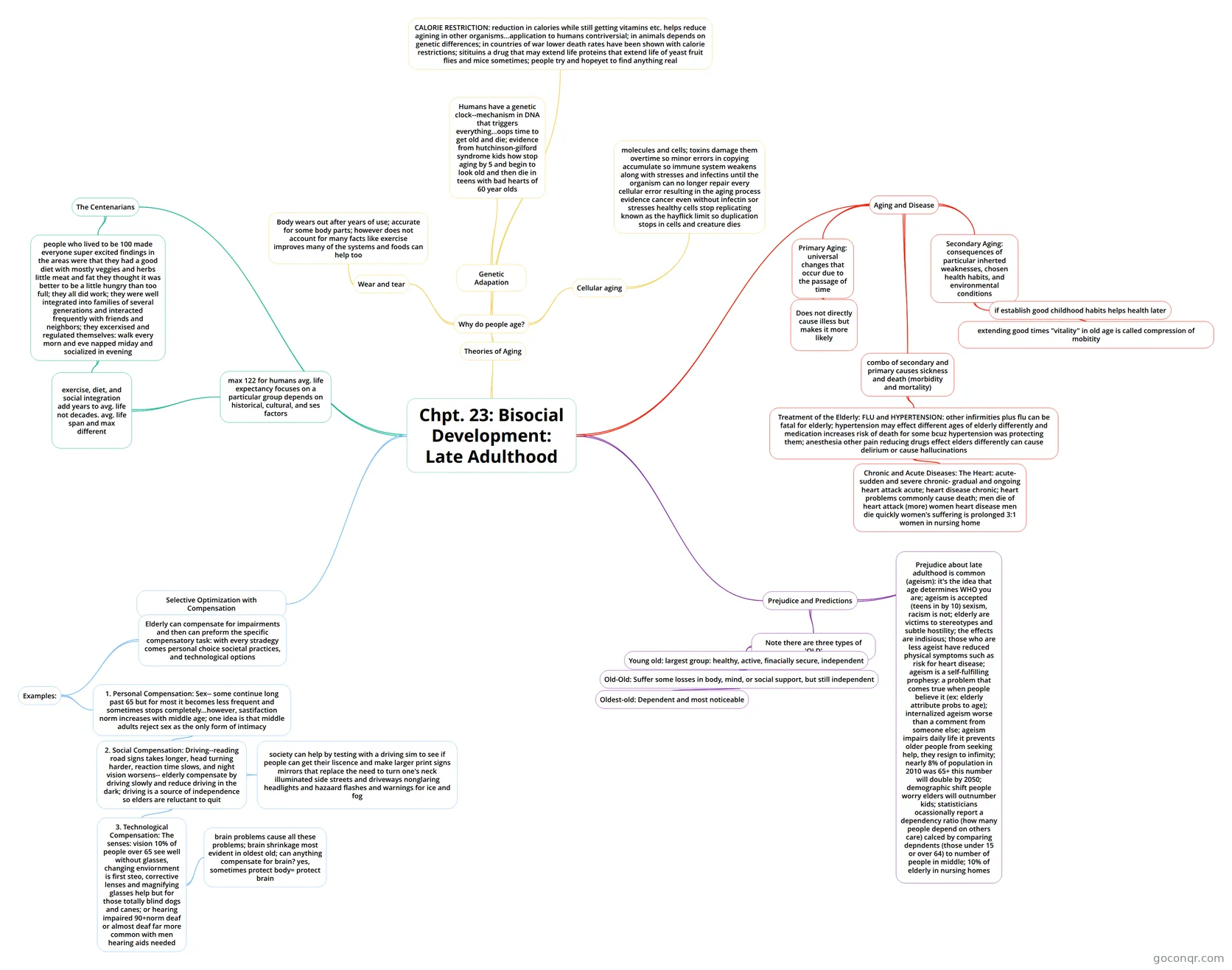
Mind map: bisocial development late adulthood
Map content
Chpt. 23: Bisocial Development: Late Adulthood
Selective Optimization with Compensation
- Elderly can compensate for impairments and then can preform the specific compensatory task: with every stradegy comes personal choice societal practices, and technological options
- Examples:
- 1. Personal Compensation: Sex-- some continue long past 65 but for most it becomes less frequent and sometimes stops completely...however, sastifaction norm increases with middle age; one idea is that middle adults reject sex as the only form of intimacy
- 2. Social Compensation: Driving--reading road signs takes longer, head turning harder, reaction time slows, and night vision worsens-- elderly compensate by driving slowly and reduce driving in the dark; driving is a source of independence so elders are reluctant to quit
- society can help by testing with a driving sim to see if people can get their liscence and make larger print signs mirrors that replace the need to turn one's neck illuminated side streets and driveways nonglaring headlights and hazaard flashes and warnings for ice and fog
- 3. Technological Compensation: The senses: vision 10% of people over 65 see well without glasses, changing enviornment is first steo, corrective lenses and magnifying glasses help but for those totally blind dogs and canes; or hearing impaired 90+norm deaf or almost deaf far more common with men hearing aids needed
- brain problems cause all these problems; brain shrinkage most evident in oldest old; can anything compensate for brain? yes, sometimes protect body= protect brain
- 2. Social Compensation: Driving--reading road signs takes longer, head turning harder, reaction time slows, and night vision worsens-- elderly compensate by driving slowly and reduce driving in the dark; driving is a source of independence so elders are reluctant to quit
- 1. Personal Compensation: Sex-- some continue long past 65 but for most it becomes less frequent and sometimes stops completely...however, sastifaction norm increases with middle age; one idea is that middle adults reject sex as the only form of intimacy
- Examples:
- Elderly can compensate for impairments and then can preform the specific compensatory task: with every stradegy comes personal choice societal practices, and technological options
Aging and Disease
- Primary Aging: universal changes that occur due to the passage of time
- Does not directly cause illess but makes it more likely
- Secondary Aging: consequences of particular inherted weaknesses, chosen health habits, and environmental conditions
- if establish good childhood habits helps health later
- extending good times "vitality" in old age is called compression of mobitity
- if establish good childhood habits helps health later
- combo of secondary and primary causes sickness and death (morbidity and mortality)
- Treatment of the Elderly: FLU and HYPERTENSION: other infirmities plus flu can be fatal for elderly; hypertension may effect different ages of elderly differently and medication increases risk of death for some bcuz hypertension was protecting them; anesthesia other pain reducing drugs effect elders differently can cause delirium or cause hallucinations
- Chronic and Acute Diseases: The Heart: acute- sudden and severe chronic- gradual and ongoing heart attack acute; heart disease chronic; heart problems commonly cause death; men die of heart attack (more) women heart disease men die quickly women's suffering is prolonged 3:1 women in nursing home
- Treatment of the Elderly: FLU and HYPERTENSION: other infirmities plus flu can be fatal for elderly; hypertension may effect different ages of elderly differently and medication increases risk of death for some bcuz hypertension was protecting them; anesthesia other pain reducing drugs effect elders differently can cause delirium or cause hallucinations
- Primary Aging: universal changes that occur due to the passage of time
Theories of Aging
- Why do people age?
- Wear and tear
- Body wears out after years of use; accurate for some body parts; however does not account for many facts like exercise improves many of the systems and foods can help too
- Genetic Adapation
- Humans have a genetic clock--mechanism in DNA that triggers everything...oops time to get old and die; evidence from hutchinson-gilford syndrome kids how stop aging by 5 and begin to look old and then die in teens with bad hearts of 60 year olds
- Cellular aging
- molecules and cells; toxins damage them overtime so minor errors in copying accumulate so immune system weakens along with stresses and infectins until the organism can no longer repair every cellular error resulting in the aging process evidence cancer even without infectin sor stresses healthy cells stop replicating known as the hayflick limit so duplication stops in cells and creature dies
- CALORIE RESTRICTION: reduction in calories while still getting vitamins etc. helps reduce agining in other organisms...application to humans contriversial; in animals depends on genetic differences; in countries of war lower death rates have been shown with calorie restrictions; sitituins a drug that may extend life proteins that extend life of yeast fruit flies and mice sometimes; people try and hopeyet to find anything real
- Wear and tear
- Why do people age?
The Centenarians
- people who lived to be 100 made everyone super excited findings in the areas were that they had a good diet with mostly veggies and herbs little meat and fat they thought it was better to be a little hungry than too full; they all did work; they were well integrated into families of several generations and interacted frequently with friends and neighbors; they excerxised and regulated themselves: walk every morn and eve napped miday and socialized in evening
- exercise, diet, and social integration add years to avg. life not decades. avg. life span and max different
- max 122 for humans avg. life expectancy focuses on a particular group depends on historical, cultural, and ses factors
- exercise, diet, and social integration add years to avg. life not decades. avg. life span and max different
- people who lived to be 100 made everyone super excited findings in the areas were that they had a good diet with mostly veggies and herbs little meat and fat they thought it was better to be a little hungry than too full; they all did work; they were well integrated into families of several generations and interacted frequently with friends and neighbors; they excerxised and regulated themselves: walk every morn and eve napped miday and socialized in evening
Prejudice and Predictions
- Prejudice about late adulthood is common (ageism): it's the idea that age determines WHO you are; ageism is accepted (teens in by 10) sexism, racism is not; elderly are victims to stereotypes and subtle hostility; the effects are indisious; those who are less ageist have reduced physical symptoms such as risk for heart disease; ageism is a self-fulfilling prophesy: a problem that comes true when people believe it (ex: elderly attribute probs to age); internalized ageism worse than a comment from someone else; ageism impairs daily life it prevents older people from seeking help, they resign to infimity; nearly 8% of population in 2010 was 65+ this number will double by 2050; demographic shift people worry elders will outnumber kids; statisticians ocassionally report a dependency ratio (how many people depend on others care) calced by comparing depndents (those under 15 or over 64) to number of people in middle; 10% of elderly in nursing homes
- Note there are three types of 'OLD'
- Young old: largest group: healthy, active, finacially secure, independent
- Old-Old: Suffer some losses in body, mind, or social support, but still independent
- Oldest-old: Dependent and most noticeable
- Old-Old: Suffer some losses in body, mind, or social support, but still independent
- Young old: largest group: healthy, active, finacially secure, independent
Information
- Description
- Mind Map on Chpt. 23: Bisocial Development: Late Adulthood, created by Aria Crimson on 11/03/2015.
- Created by
- Aria Crimson
- Views
- 1
- Rating
More on Development in late adulthood and ageing