
Mind map
English Language Section A
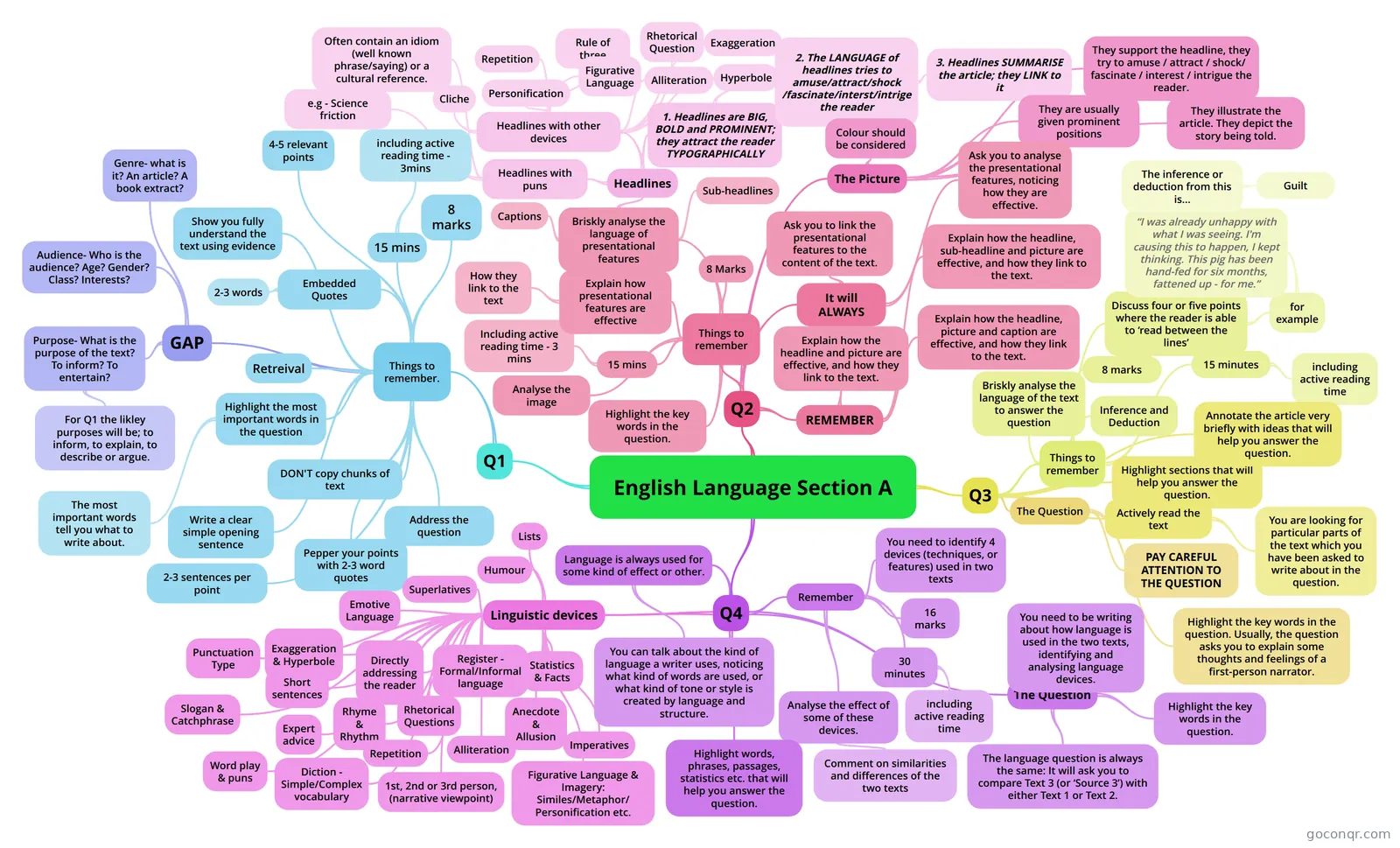
Mind map: English language Section A
Map content
English Language Section A
Q1
- Things to remember.
- 8 marks
- Retreival
- Embedded Quotes
- 2-3 words
- 15 mins
- including active reading time - 3mins
- 4-5 relevant points
- Show you fully understand the text using evidence
- Highlight the most important words in the question
- The most important words tell you what to write about.
- GAP
- Genre- what is it? An article? A book extract?
- Audience- Who is the audience? Age? Gender? Class? Interests?
- Purpose- What is the purpose of the text? To inform? To entertain?
- For Q1 the likley purposes will be; to inform, to explain, to describe or argue.
- Address the question
- DON'T copy chunks of text
- Pepper your points with 2-3 word quotes
- Write a clear simple opening sentence
- 2-3 sentences per point
- Things to remember.
Q2
- Things to remember
- 8 Marks
- 15 mins
- Including active reading time - 3 mins
- Briskly analyse the language of presentational features
- Headlines
- 1. Headlines are BIG, BOLD and PROMINENT; they attract the reader TYPOGRAPHICALLY
- 2. The LANGUAGE of headlines tries to amuse/attract/shock /fascinate/interst/intrige the reader
- 3. Headlines SUMMARISE the article; they LINK to it
- 2. The LANGUAGE of headlines tries to amuse/attract/shock /fascinate/interst/intrige the reader
- Headlines with puns
- e.g - Science friction
- Often contain an idiom (well known phrase/saying) or a cultural reference.
- Headlines with other devices
- Alliteration
- Rule of three
- Repetition
- Personification
- Cliche
- Exaggeration
- Hyperbole
- Rhetorical Question
- Figurative Language
- 1. Headlines are BIG, BOLD and PROMINENT; they attract the reader TYPOGRAPHICALLY
- Sub-headlines
- Captions
- Headlines
- Analyse the image
- Explain how presentational features are effective
- How they link to the text
- Highlight the key words in the question.
- The Picture
- They are usually given prominent positions
- They support the headline, they try to amuse / attract / shock/ fascinate / interest / intrigue the reader.
- They illustrate the article. They depict the story being told.
- Colour should be considered
- It will ALWAYS
- Ask you to link the presentational features to the content of the text.
- Ask you to analyse the presentational features, noticing how they are effective.
- REMEMBER
- Explain how the headline and picture are effective, and how they link to the text.
- Explain how the headline, sub-headline and picture are effective, and how they link to the text.
- Explain how the headline, picture and caption are effective, and how they link to the text.
- Things to remember
Q3
- Things to remember
- Inference and Deduction
- 8 marks
- 15 minutes
- including active reading time
- Briskly analyse the language of the text to answer the question
- Discuss four or five points where the reader is able to ‘read between the lines’
- for example
- “I was already unhappy with what I was seeing. I'm causing this to happen, I kept thinking. This pig has been hand-fed for six months, fattened up - for me.”
- The inference or deduction from this is...
- Guilt
- The inference or deduction from this is...
- “I was already unhappy with what I was seeing. I'm causing this to happen, I kept thinking. This pig has been hand-fed for six months, fattened up - for me.”
- for example
- The Question
- Highlight the key words in the question. Usually, the question asks you to explain some thoughts and feelings of a first-person narrator.
- PAY CAREFUL ATTENTION TO THE QUESTION
- Actively read the text
- You are looking for particular parts of the text which you have been asked to write about in the question.
- Highlight sections that will help you answer the question.
- Annotate the article very briefly with ideas that will help you answer the question.
- Things to remember
Q4
- Remember
- 16 marks
- 30 minutes
- including active reading time
- You need to identify 4 devices (techniques, or features) used in two texts
- Analyse the effect of some of these devices.
- Comment on similarities and differences of the two texts
- Language is always used for some kind of effect or other.
- You can talk about the kind of language a writer uses, noticing what kind of words are used, or what kind of tone or style is created by language and structure.
- Linguistic devices
- 1st, 2nd or 3rd person, (narrative viewpoint)
- Directly addressing the reader
- Imperatives
- Rhetorical Questions
- Register - Formal/Informal language
- Diction - Simple/Complex vocabulary
- Figurative Language & Imagery: Similes/Metaphor/ Personification etc.
- Word play & puns
- Alliteration
- Rhyme & Rhythm
- Slogan & Catchphrase
- Anecdote & Allusion
- Statistics & Facts
- Exaggeration & Hyperbole
- Repetition
- Humour
- Lists
- Emotive Language
- Punctuation Type
- Expert advice
- Short sentences
- Superlatives
- The Question
- The language question is always the same: It will ask you to compare Text 3 (or ‘Source 3’) with either Text 1 or Text 2.
- You need to be writing about how language is used in the two texts, identifying and analysing language devices.
- Highlight the key words in the question.
- Highlight words, phrases, passages, statistics etc. that will help you answer the question.
- Remember
Information
- Description
- AS levels English Mind Map on English Language Section A, created by edible wallpaper on 24/09/2013.
- Created by
- edible wallpaper
- Views
- 288
- Tags
- Rating