
Mind map
STATE OF ART: MATERIALS DEVELOPMENT
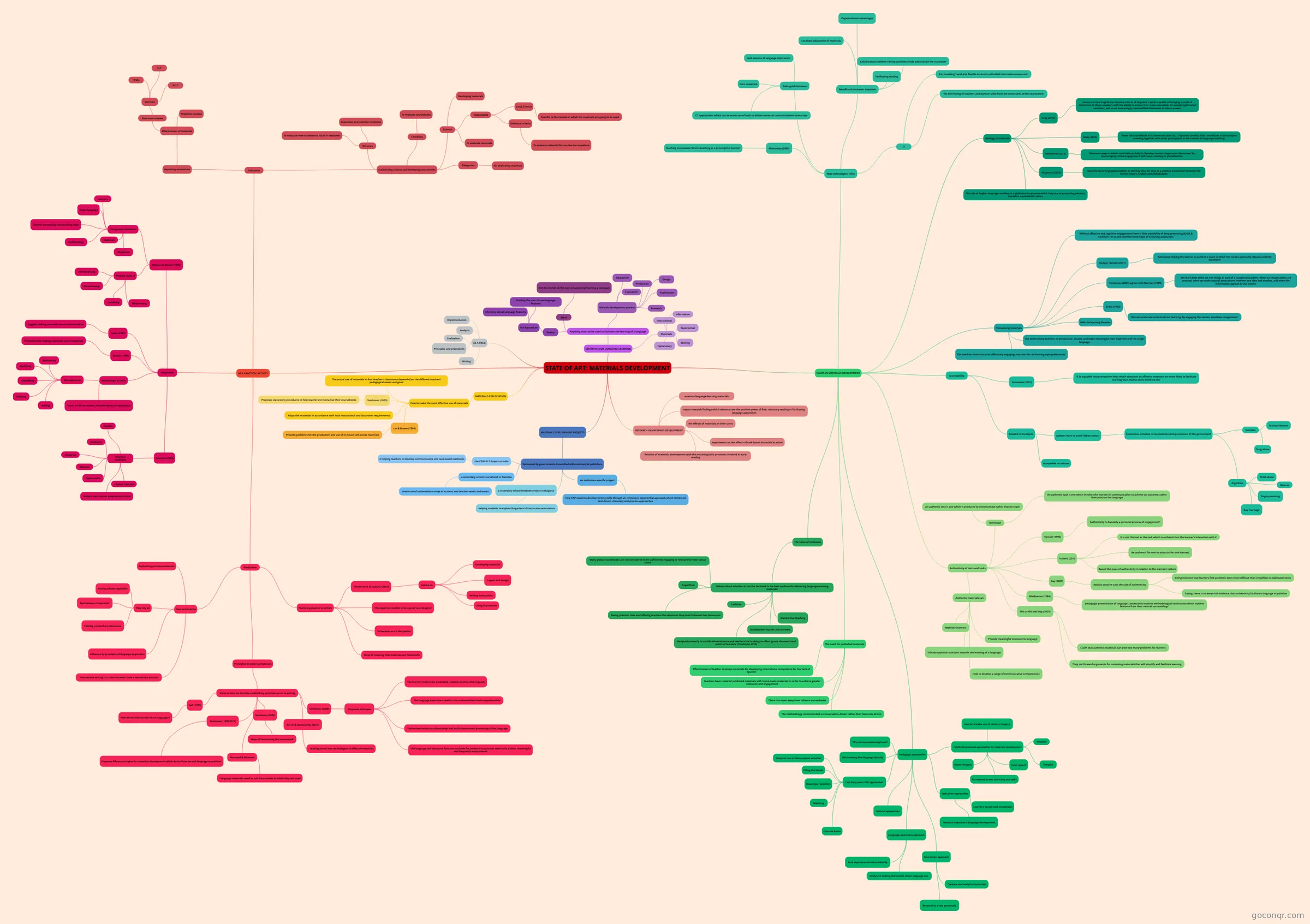
Mind map: Materials development in language learning
Map content
STATE OF ART: MATERIALS DEVELOPMENT
MATERIALS FOR LANGUAGE LEARNING
- Anything that can be used to facilitate the learning of a language
- Ideal
- Aim to provide all the ways of acquiring/learning a language
- Reality
- Are focused on
- Informing about language features
- Guiding the user to use language features
- Are focused on
- Matrials development process
- Evaluation
- Adaptation
- Design
- Production
- Exploitation
- Research
- Ideal
- Materials
- Informative
- Instructional
- Experiential
- Eliciting
- Explanatory
- Anything that can be used to facilitate the learning of a language
AS A PRACTICAL ACTIVITY
- Production
- How writer write
- They rely on
- Retrieval from repertoire
- Cloning successful publications
- Spontaneous ‘inspiration’
- Influence by principles of language acquisition
- Replicating previous materials
- 'Coursebook writing is a creative rather than a mechanical process'
- They rely on
- Principled developing materials
- Some writers do describe establishing principles prior to writing
- Hall (1995)
- ‘How do we think people learn languages?’
- Tomlinson (1998;2011)
- Proposes fifteen principles for materials development which derive from second language acquisition.
- Tomlinson (2003)
- Ways of humanising the coursebook
- Harwood & Richards
- language materials need to suit the contexts in which they are used
- Kervin & Derewianka (2011)
- making use of new technologies in effective materials
- Tomlinson (2008)
- Proposed principles
- The language experience needs to be contextualised and comprehensible
- The learner needs to be motivated, relaxed, positive and engaged
- The language and discourse features available for potential acquisition need to be salient, meaningful and frequently encountered
- The learner needs to achieve deep and multi-dimensional processing of the language
- Proposed principles
- Hall (1995)
- Some writers do describe establishing principles prior to writing
- Practical guidance to writers
- The expertise needed to be a good task designer
- To become an L2 storywriter
- Ways of ensuring that materials are humanistic
- Tomlinson & Masuhara (2004)
- Advice on
- Developing materials
- Writing instructions
- Using illustrations
- Layout and design
- Advice on
- How writer write
- Evaluation
- Establisihng criteria and developing instruments
- Schemes
- To measure internal/external value in textbooks
- Evaluation and selection texbooks
- Checklists
- To evaluate coursebooks
- Criteria
- To evaluate materials
- Developing materials
- TOMLINSON
- Universal criteria
- To evaluate materials for any learner anywhere
- Local Criteria
- Specific to the context in which the materials are going to be used
- Universal criteria
- Categories
- For evaluating materials
- Schemes
- Reporting evaluations
- Effectiveness of materials
- Predictive reviews
- Post-used reviews
- Journals
- ELT
- RELC
- TESOL
- Journals
- Effectiveness of materials
- Establisihng criteria and developing instruments
- Adaptation
- Madsen & Bowen (1978)
- Congruence between
- Materials
- Methodology
- Learners
- Objectives
- Target language
- Teacher personality and teaching style
- Propose ways of
- Personalising
- Individualising
- Localising
- Modernising
- Congruence between
- Grant (1987)
- Suggest making materials more communicative
- Nunan (1999)
- Procedures for making materials more interactive
- McDonough & Shaw
- Focus on the principles and procedures of adaptation
- Give advice on
- Adding
- Deleting
- Modifying
- Simplifying
- Reordering
- Saraceni (2003)
- Proposes materials
- Written with learner adaptation in mind
- Learner-centred
- Flexible
- Open-ended
- Relevant
- Universal
- Authentic
- Proposes materials
- Madsen & Bowen (1978)
- Production
AS A FIELD
- Principles and procedures
- Writing
- Implementation
- Evaluation
- Analysis
MATERIALS EXPLOITATION
- How to make the most effective use of materials
- Lin & Brown (1994)
- Provide guidelines for the production and use of in-house self-access materials
- Tomlinson (2003)
- Proposes classroom procedures to help teachers to humanise their coursebooks
- The actual use of materials in four teachers’ classrooms depended on the different teachers’ pedagogical needs and goals
- Adapt the materials in accordance with local institutional and classroom requirements
- Lin & Brown (1994)
- How to make the most effective use of materials
ISSUES IN MATERIALS DEVELOPMENT
- The value of textbooks
- Debate about whether or not the textbook is the best medium for delivering language-learning materials
- Saving precious time and offering teachers the resources they need to basset heir lessons on
- Standardise teaching
- Disempower teacher and learners
- Superficial
- Uniform
- ‘designed primarily to satisfy administrators and teachers but in doing so often ignore the needs and wants of learners’ (Tomlinson 2010)
- Many global coursebooks are not considered to be sufficiently engaging or relevant for their actual users
- Debate about whether or not the textbook is the best medium for delivering language-learning materials
- The need for published materials
- Teachers have replaced published materials with home-made materials in order to achieve greater relevance and engagement
- Effectiveness of teacher develops materials for developing intercultural competence for learners of Spanish
- There is a move away from reliance on textbooks
- The methodology recommended is conversation-driven rather than materials-driven
- Pedagogic approaches
- 60’s teaching the language directly
- 70’s communicative approach
- Natural approaches
- Last forty years PPP approaches
- Discrete forms
- Frequent use of listen-repeat activities
- Dioalogue repetition
- Matching
- Filling the blanks
- Language awareness approach
- First experience a text holistically
- Analyse it making discoveries about language use.
- Text-driven approach
- Respond to a text personally
- Creative and analytical activities
- Task given approaches
- Learners' target: task completion
- Teachers’ objective is language development
- - Multi-dimensional approaches to materials development
- Learners make use of sensory imagery
- Motor imagery
- Inner speech
- Emotion
- Thought
- To respond to text and carry out tasks
- Authenticity of texts and tasks
- Authentic materials can
- Provide meaningful exposure to language
- Motivate learners
- Help to develop a range of communicative competencies
- Enhance positive attitudes towards the learning of a language
- Ellis (1999) and Day (2003)
- Claim that authentic materials can pose too many problems for learners
- They put forward arguments for contriving materials that will simplify and facilitate learning
- Widdowson (1984)
- ‘pedagogic presentation of language...necessarily involves methodological contrivance which isolates features from their natural surroundings’
- Day (2003)
- Attacks what he calls the cult of authenticity
- Saying: there is no empirical evidence that authenticity facilitates language acquisition
- Citing evidence that learners find authentic texts more difficult than simplified or elaborated texts
- Attacks what he calls the cult of authenticity
- Trabelsi (2010
- Raised the issue of authenticity in relation to the learners’ culture
- Be authentic for one location (or for one learner)
- It is not the text or the task which is authentic but the learner’s interaction with it
- VanLier (1996)
- Authenticity ‘is basically a personal process of engagement’
- Tomlinson
- An authentic text is one which is produced to communicate rather than to teach
- An authentic task is one which involves the learners in communication to achieve an outcome, rather than practice the language
- Authentic materials can
- Acceptability
- Related to the topics
- Acceptable in cultures
- Authors have to avoid (Taboo topics)
- Sometimes included in coursebooks with permission of the government
- Namibia
- Marital violence
- Drug abuse
- Argentina
- Gay marriage
- Child abuse
- Divorse
- Single parenting
- Namibia
- Sometimes included in coursebooks with permission of the government
- Tomlinson (2001)
- ‘it is arguable that provocative texts which stimulate an affective response are more likely to facilitate learning than neutral texts which do not’
- Related to the topics
- Humanising materials
- Refer to learning theories
- The need to help learners to personalise, localise and make meaningful their experience of the target language
- The need for materials to be affectively engaging and cater for all learning style preferences.
- Gross (1992)
- We can accelerate and enrich our learning, by engaging the senses, emotions, imagination’
- Tomlinson (2003) agrees with Berman (1999)
- ‘We learn best when we see things as part of a recognised pattern, when our imaginations are aroused, when we make natural associations between one idea and another, and when the information appeals to our senses’
- Hooper Hansen (2011)
- Advocates helping the learner to achieve ‘a state in which the mind is optimally relaxed and fully expanded’
- Without affective and cognitive engagement there is little possibility of deep processing (Craik & Lockhart 1972) and therefore little hope of enduring acquisition.
- Ideology in materials
- The role of English language teaching in a globalisation process which they see as promoting western, capitalist, materialistic values
- Ferguson (2003)
- Uses the term ‘Angloglobalisation’ to identify what he sees as a positive connection between the British Empire, English and globalisation
- Whitehead (2011)
- Discusses ways in which materials can help to ‘develop counter-hegemonic discourses’ by encouraging critical engagement with issues relating to globalisation.
- Gray (2010)
- Points out how English has become ‘a form of linguistic capital, capable of bringing a profit of distinction to those speakers with the ability to access it (or more accurately, its socially legitimated varieties), and as an increasingly commodified dimension of labour-power’
- Wala (2003)
- Views the coursebook as a communicative act, ‘a dynamic artefact that contributes to and creates meaning together with other participants in the context of language teaching’
- New technologies' roles
- Mukundan (2008)
- Teaching courseware ‘directs teaching in a prescriptive manner’
- IT
- ‘for the freeing of teachers and learners alike from the constraints of the coursebook’
- For providing ‘rapid and flexible access to unlimited information resources’.
- Distinguish between
- CALL materials
- web sources of language experience
- CT applications which can be made use of both to deliver materials and to facilitate interaction
- Benefits of electronic materials
- Facilitating reading
- Organisational advantages
- Localised adaptation of materials
- Collaborative problem-solving activities inside and outside the classroom
- Mukundan (2008)
- The value of textbooks
MATERIALS DEVELOPMENT PROJECTS
- Sponsored by governments dissatisfied with commercial publishers
- the CBSE-ELT Project in India
- o helping teachers to develop communicative and task-based textbooks
- a secondary school coursebook in Namibia
- made use of nationwide surveys of student and teacher needs and wants
- a secondary school textbook project in Bulgaria
- helping students to explain Bulgarian culture to overseas visitors
- an institution-specific project
- help EAP students develop writing skills through an innovative experiential approach which combined text-driven, discovery and process approaches
- the CBSE-ELT Project in India
- Sponsored by governments dissatisfied with commercial publishers
RESEARCH IN MATERIALS DEVELOPMENT
- the effects of materials on their users
- report research findings which demonstrate the positive power of free, voluntary reading in facilitating language acquisition
- evaluate language-learning materials
- experiments on the effects of task-based materials in action
- Relation of materials development with the neurolinguistic processes involved in early reading
Information
- Description
- Mind Map on STATE OF ART: MATERIALS DEVELOPMENT, created by LAURA CATHERIN BOHORQUEZ GONZALEZ on 24/05/2020.
- Created by
- LAURA CATHERIN BOHORQUEZ GONZALEZ
- Views
- 1
- Rating
More on Language Teaching Materials