
Mind map
Motivating Students
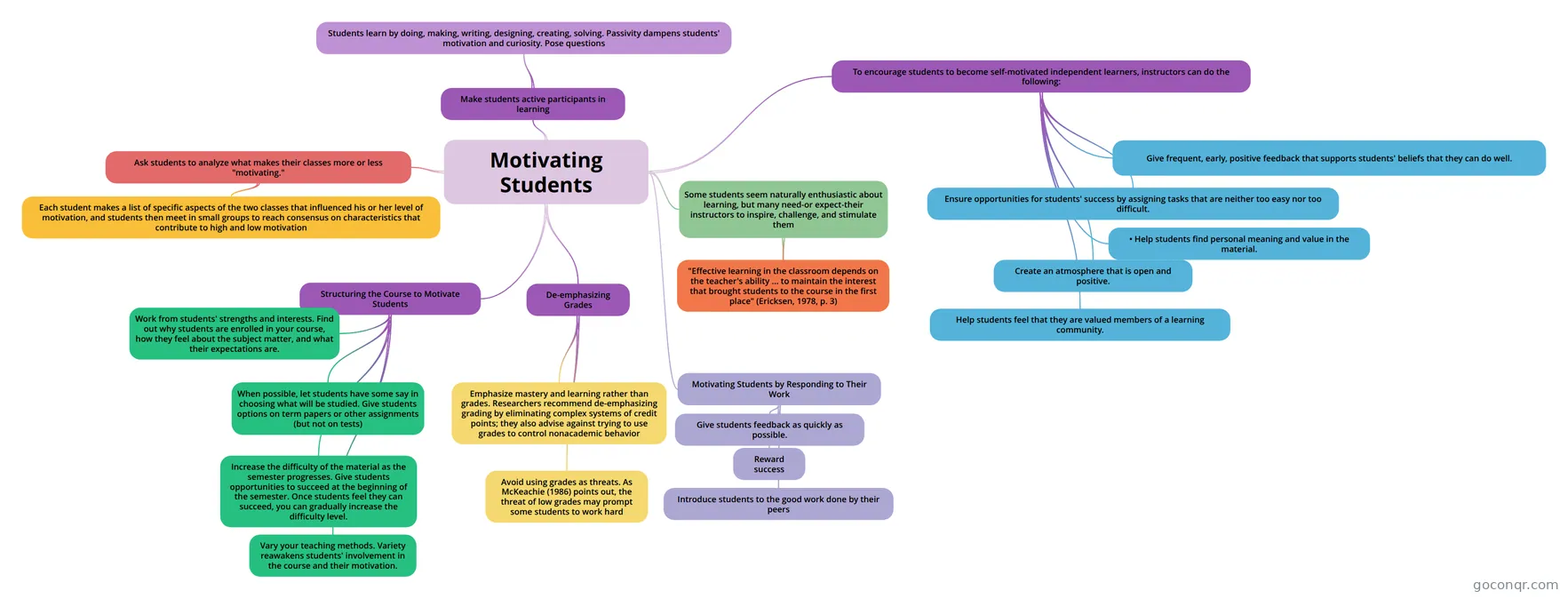
Mind map: Motivating students
Map content
Motivating Students
Some students seem naturally enthusiastic about learning, but many need-or expect-their instructors to inspire, challenge, and stimulate them
- "Effective learning in the classroom depends on the teacher's ability ... to maintain the interest that brought students to the course in the first place" (Ericksen, 1978, p. 3)
To encourage students to become self-motivated independent learners, instructors can do the following:
- Give frequent, early, positive feedback that supports students' beliefs that they can do well.
- Ensure opportunities for students' success by assigning tasks that are neither too easy nor too difficult.
- • Help students find personal meaning and value in the material.
- Create an atmosphere that is open and positive.
- Help students feel that they are valued members of a learning community.
Make students active participants in learning
- Students learn by doing, making, writing, designing, creating, solving. Passivity dampens students' motivation and curiosity. Pose questions
Ask students to analyze what makes their classes more or less "motivating."
- Each student makes a list of specific aspects of the two classes that influenced his or her level of motivation, and students then meet in small groups to reach consensus on characteristics that contribute to high and low motivation
Structuring the Course to Motivate Students
- Work from students' strengths and interests. Find out why students are enrolled in your course, how they feel about the subject matter, and what their expectations are.
- When possible, let students have some say in choosing what will be studied. Give students options on term papers or other assignments (but not on tests)
- Increase the difficulty of the material as the semester progresses. Give students opportunities to succeed at the beginning of the semester. Once students feel they can succeed, you can gradually increase the difficulty level.
- Vary your teaching methods. Variety reawakens students' involvement in the course and their motivation.
De-emphasizing Grades
- Emphasize mastery and learning rather than grades. Researchers recommend de-emphasizing grading by eliminating complex systems of credit points; they also advise against trying to use grades to control nonacademic behavior
- Avoid using grades as threats. As McKeachie (1986) points out, the threat of low grades may prompt some students to work hard
Motivating Students by Responding to Their Work
- Give students feedback as quickly as possible.
- Reward success
- Introduce students to the good work done by their peers
Information
- Description
- Mind Map on Motivating Students, created by Steven Tubón on 29/05/2020.
- Created by
- Steven Tubón
- Views
- 2
- Rating