
Mind map
Vibration, Shock, and Acceleration
Map content
Vibration, Shock, and Acceleration
Kinematic Quantities
- Displacement, velocity, and acceleration are products of motion, and they are related to each other by time. Because of case in measurements, acceleration is particularly an important section of kinematic quantities. Other quantities are the position, velocity, acceleration, and jerk, which bear linear relationships with the neighboring ones. This indicates that all the kinematic quantities can be derived from a single known quantity. For example, acceleration can be obtained by differentiating the corresponding velocity or by integral ing the jerk. Likewise, velocity can be obtained by differ entiating the position or by integrating the acceleration. In practice, only the integration is widely used since it provides better noise characteristics and attenuation.
Detector Desings
- The acceleration detectors can be direct or indirect. The measurement is indirect, when acceleration is obtained by differentiating velocity. Accelerometers that measure the acceleration of an object can be classified in a number of ways, including mechanical or electrical types, active or pas sive types, deflection or null-balance types, and others. In the next paragraphs a number of them will be discussed.
Piezoelectric
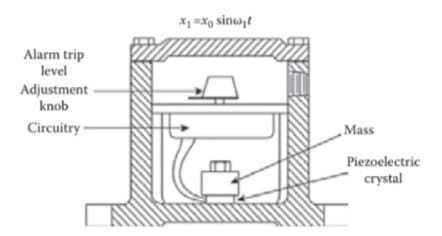
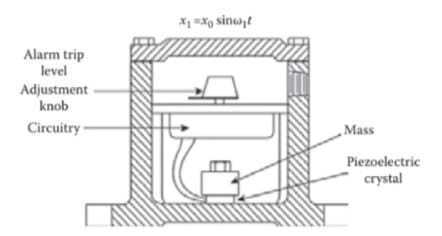
- The piezoelectric sensor is a self-generating device that is ideal for the measurement of such dynamic events as shock and vibration. They are basically motion transducers with large output signals and comparatively small sizes. They are available with very high natural frequencies and are suitable Mathematically, their transfer function approximates to a for high-frequency applications and shock measurements.third-order system that can be expressed as Their sensing element is sandwiched between the transducer body and a seismic mass (usually tungsten). Because the seis mic mass is constant, the force acting on the sensing element (F = ma) is proportional to acceleration. If the sensing ele ment is a quartz crystal or lead-zirconate-titanate (PZT), an electric charge is generated (150 times more for PZT than for quartz) that is in proportion to the experienced force and therefore to acceleration
- These devices utilize a mass in direct contact with the piezoelectric component or crystal. A separation of charge is produced on the opposite faces of the crystal when it is subjected to acceleration forces. The magnitude of the voltage produced is in proportion to mechanical deforma tion and hence, acceleration.
Piezoresistive
- Piezoresistive sensors are essentially semiconductor strain gauges with large gauge factors. High gauge factors are obtained since the material resistivity is dependent primarily on the stress not only on the dimensions. This effect can be greatly enhanced by appropriate doping of semiconductors such as silicon. Most piezoresistive accelerometers use two or four active gauges arranged in a Wheatstone bridge. Extra precision resistors are used, as part of the circuit, in series with the input to control the sensitivity, for balancing, and for offsetting temperature effects.
- Piezoresistive sensors are not self-generating, and they do require a source of excitation power. They are superior to piezoelectric crystals when low-frequency (under 10 Hz) vibrations, long-duration shocks (over 10 ms), or constant accelerations are to be measured. In the wire strain design, the spring wires are usually Nichrome, and the frequency range is under 1000 Hz.
Capacitive
- There are various types of capacitive accelerometers. The differential-capacitance accelerometers are based on the principle of the change of capacitance in proportion to applied acceleration. In one type, the seismic mass of the accelerom eter is made as the movable element of an electrical oscillator as shown in Figure.
- There are various types of capacitive accelerometers. The differential-capacitance accelerometers are based on the principle of the change of capacitance in proportion to applied acceleration. In one type, the seismic mass of the accelerom eter is made as the movable element of an electrical oscillator as shown in Figure.
Micro- and Nanosensor
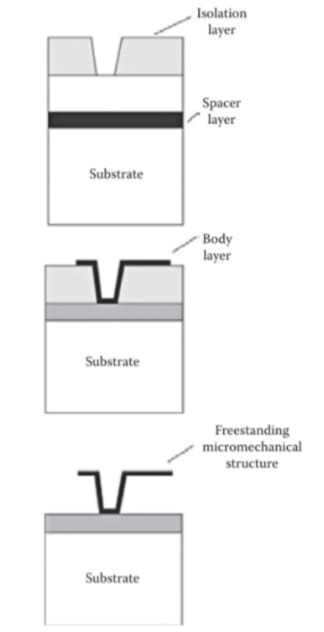
- The selective etching of multiple layers of deposited thin films, or surface micromachining, allows movable micro structures to be fabricated on silicon wafers. With surface micromachining, layers of structure material are disposed and patterned as shown in Figure. These structures are formed by polysilicons and sacrificial materials such as sili con dioxides. The sacrificial material acts as an intermediate spacer layer and is etched away to produce a freestanding structure.
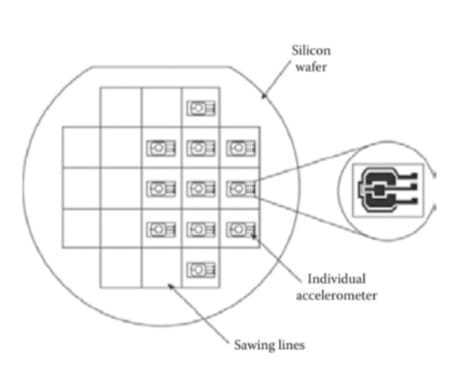
- Surface machining technology also allows smaller and more complex structures to be built in multiple layers on a single substrate. A typical example of a modern micro machined accelerometer is given in Figure. Multiple accelerometers can be mounted on a single chip, sensing accelerations in x, y, and z directions. The primary signal conditioning is also provided in the same chip. The output from the chip is usually read in the digital form.
- The selective etching of multiple layers of deposited thin films, or surface micromachining, allows movable micro structures to be fabricated on silicon wafers. With surface micromachining, layers of structure material are disposed and patterned as shown in Figure. These structures are formed by polysilicons and sacrificial materials such as sili con dioxides. The sacrificial material acts as an intermediate spacer layer and is etched away to produce a freestanding structure.
Images and files in the map
Information
- Description
- Mind Map on Vibration, Shock, and Acceleration, created by Oscar Luis on 29/05/2020.
- Created by
- Oscar Luis
- Views
- 0
- Rating