
Mind map
GCSE Citizenship
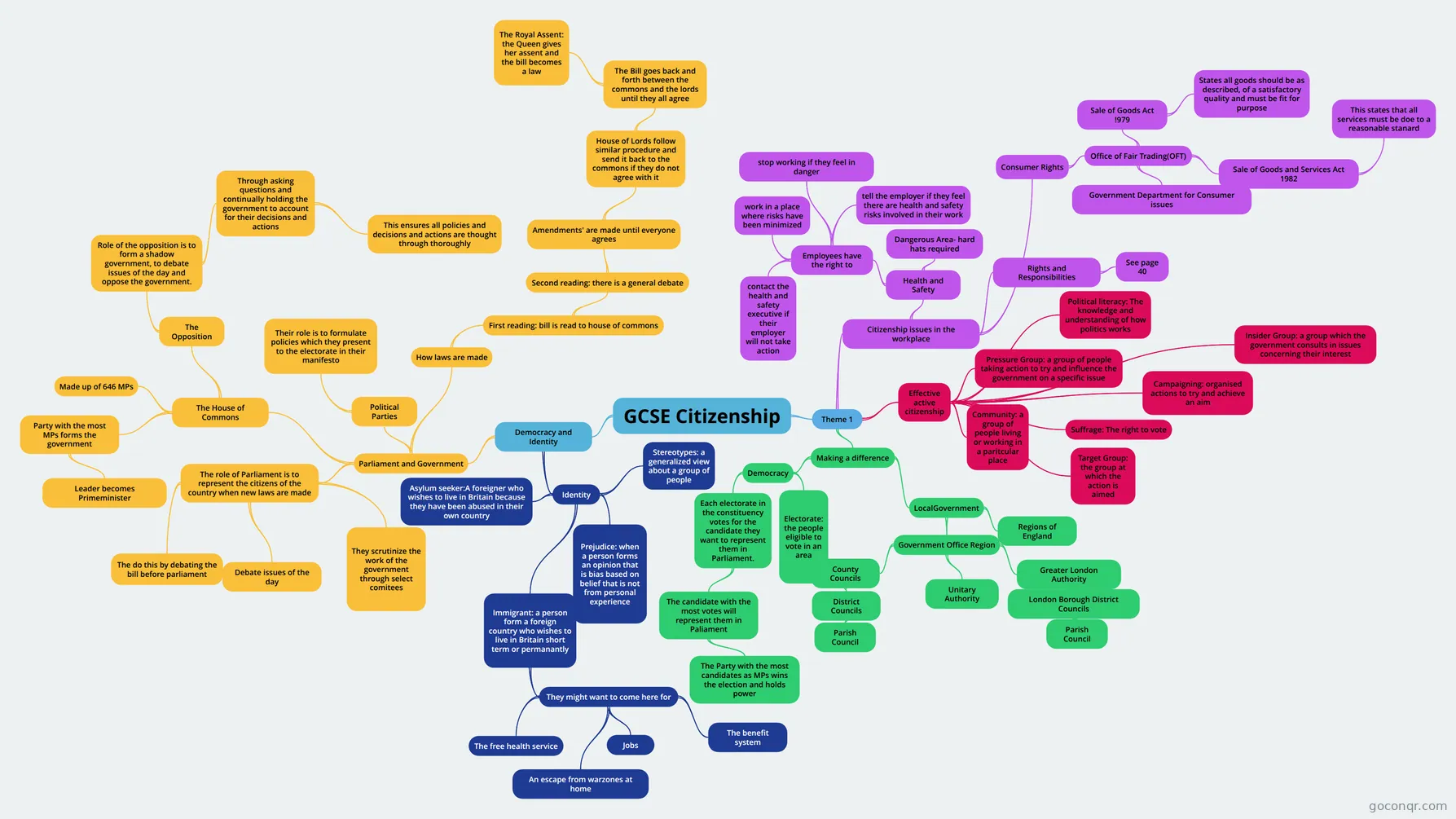
Mind map: GCSE Citizenship
Map content
GCSE Citizenship
Theme 1
- Effective active citizenship
- Community: a group of people living or working in a paritcular place
- Pressure Group: a group of people taking action to try and influence the government on a specific issue
- Campaigning: organised actions to try and achieve an aim
- Target Group: the group at which the action is aimed
- Political literacy: The knowledge and understanding of how politics works
- Suffrage: The right to vote
- Insider Group: a group which the government consults in issues concerning their interest
- Making a difference
- LocalGovernment
- Regions of England
- North East North West Yorkshire and Humberside West Midlands East Midlands East of England London South East South West
- Government Office Region
- Greater London Authority
- Council of London Responsible for transport emergency services planning developments
- London Borough District Councils
- Provide services such as housing social services waste disposal and leisure
- Parish Council
- Very small- over see leisure and recreation
- Unitary Authority
- Provides all services
- County Councils
- Responsible for; trading standards, transport, waste disposal, education and social services
- District Councils
- Responsible for: planning permissions, housing, recycling, planning, waste collection, environmental health and leisure and recreation.
- Parish Council
- Very small- over see leisure and recreation
- Greater London Authority
- Regions of England
- Democracy
- rule by the majority of the people
- Electorate: the people eligible to vote in an area
- Each electorate in the constituency votes for the candidate they want to represent them in Parliament.
- The candidate with the most votes will represent them in Paliament
- The Party with the most candidates as MPs wins the election and holds power
- The candidate with the most votes will represent them in Paliament
- LocalGovernment
- Citizenship issues in the workplace
- Rights and Responsibilities
- See page 40
- Health and Safety
- Dangerous Area- hard hats required
- Employees have the right to
- work in a place where risks have been minimized
- tell the employer if they feel there are health and safety risks involved in their work
- contact the health and safety executive if their employer will not take action
- stop working if they feel in danger
- Consumer Rights
- Office of Fair Trading(OFT)
- Government Department for Consumer issues
- Sale of Goods Act !979
- States all goods should be as described, of a satisfactory quality and must be fit for purpose
- Sale of Goods and Services Act 1982
- This states that all services must be doe to a reasonable stanard
- Office of Fair Trading(OFT)
- Rights and Responsibilities
- Effective active citizenship
Democracy and Identity
- Parliament and Government
- The role of Parliament is to represent the citizens of the country when new laws are made
- The do this by debating the bill before parliament
- They scrutinize the work of the government through select comitees
- Debate issues of the day
- Political Parties
- Their role is to formulate policies which they present to the electorate in their manifesto
- The House of Commons
- Made up of 646 MPs
- Party with the most MPs forms the government
- Leader becomes Primeminister
- The Opposition
- Role of the opposition is to form a shadow government, to debate issues of the day and oppose the government.
- Through asking questions and continually holding the government to account for their decisions and actions
- This ensures all policies and decisions and actions are thought through thoroughly
- Through asking questions and continually holding the government to account for their decisions and actions
- Role of the opposition is to form a shadow government, to debate issues of the day and oppose the government.
- How laws are made
- First reading: bill is read to house of commons
- Second reading: there is a general debate
- Amendments' are made until everyone agrees
- House of Lords follow similar procedure and send it back to the commons if they do not agree with it
- The Bill goes back and forth between the commons and the lords until they all agree
- The Royal Assent: the Queen gives her assent and the bill becomes a law
- The Bill goes back and forth between the commons and the lords until they all agree
- House of Lords follow similar procedure and send it back to the commons if they do not agree with it
- Amendments' are made until everyone agrees
- Second reading: there is a general debate
- First reading: bill is read to house of commons
- The role of Parliament is to represent the citizens of the country when new laws are made
- Identity
- Prejudice: when a person forms an opinion that is bias based on belief that is not from personal experience
- Asylum seeker:A foreigner who wishes to live in Britain because they have been abused in their own country
- Immigrant: a person form a foreign country who wishes to live in Britain short term or permanantly
- They might want to come here for
- The free health service
- The benefit system
- An escape from warzones at home
- Jobs
- They might want to come here for
- Stereotypes: a generalized view about a group of people
- Parliament and Government
Information
- Description
- Mind Map on GCSE Citizenship, created by 12lstevens on 22/03/2015.
- Created by
- 12lstevens
- Views
- 162
- Rating