
Mind map
Romanticism
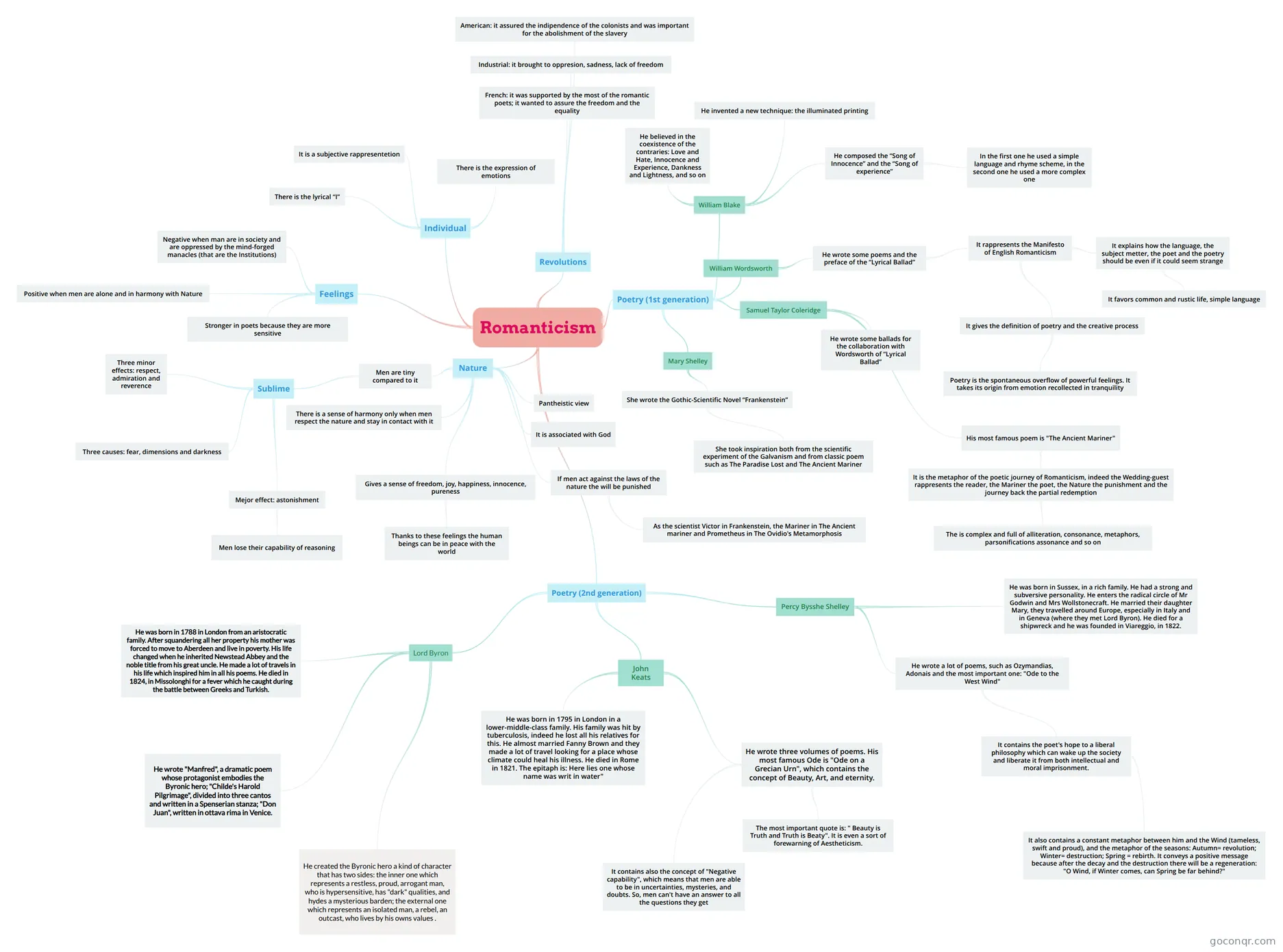
Mind map: Romanticism
Map content
Romanticism
Revolutions
- Industrial: it brought to oppresion, sadness, lack of freedom
- French: it was supported by the most of the romantic poets; it wanted to assure the freedom and the equality
- American: it assured the indipendence of the colonists and was important for the abolishment of the slavery
Individual
- It is a subjective rappresentetion
- There is the lyrical “I”
- There is the expression of emotions
Feelings
- Positive when men are alone and in harmony with Nature
- Negative when man are in society and are oppressed by the mind-forged manacles (that are the Institutions)
- Stronger in poets because they are more sensitive
Poetry (1st generation)
- William Blake
- He invented a new technique: the illuminated printing
- He composed the “Song of Innocence” and the “Song of experience”
- In the first one he used a simple language and rhyme scheme, in the second one he used a more complex one
- He believed in the coexistence of the contraries: Love and Hate, Innocence and Experience, Dankness and Lightness, and so on
- William Wordsworth
- He wrote some poems and the preface of the “Lyrical Ballad”
- It rappresents the Manifesto of English Romanticism
- It explains how the language, the subject metter, the poet and the poetry should be even if it could seem strange
- It favors common and rustic life, simple language
- It gives the definition of poetry and the creative process
- Poetry is the spontaneous overflow of powerful feelings. It takes its origin from emotion recollected in tranquility
- It explains how the language, the subject metter, the poet and the poetry should be even if it could seem strange
- It rappresents the Manifesto of English Romanticism
- He wrote some poems and the preface of the “Lyrical Ballad”
- Mary Shelley
- She wrote the Gothic-Scientific Novel “Frankenstein”
- She took inspiration both from the scientific experiment of the Galvanism and from classic poem such as The Paradise Lost and The Ancient Mariner
- She wrote the Gothic-Scientific Novel “Frankenstein”
- Samuel Taylor Coleridge
- He wrote some ballads for the collaboration with Wordsworth of “Lyrical Ballad”
- His most famous poem is "The Ancient Mariner"
- It is the metaphor of the poetic journey of Romanticism, indeed the Wedding-guest rappresents the reader, the Mariner the poet, the Nature the punishment and the journey back the partial redemption
- The is complex and full of alliteration, consonance, metaphors, parsonifications assonance and so on
- It is the metaphor of the poetic journey of Romanticism, indeed the Wedding-guest rappresents the reader, the Mariner the poet, the Nature the punishment and the journey back the partial redemption
- William Blake
Nature
- Gives a sense of freedom, joy, happiness, innocence, pureness
- Thanks to these feelings the human beings can be in peace with the world
- Pantheistic view
- Men are tiny compared to it
- Sublime
- Three minor effects: respect, admiration and reverence
- Mejor effect: astonishment
- Men lose their capability of reasoning
- Three causes: fear, dimensions and darkness
- Sublime
- There is a sense of harmony only when men respect the nature and stay in contact with it
- If men act against the laws of the nature the will be punished
- As the scientist Victor in Frankenstein, the Mariner in The Ancient mariner and Prometheus in The Ovidio's Metamorphosis
- It is associated with God
- Gives a sense of freedom, joy, happiness, innocence, pureness
Poetry (2nd generation)
- Lord Byron
- He was born in 1788 in London from an aristocratic family. After squandering all her property his mother was forced to move to Aberdeen and live in poverty. His life changed when he inherited Newstead Abbey and the noble title from his great uncle. He made a lot of travels in his life which inspired him in all his poems. He died in 1824, in Missolonghi for a fever which he caught during the battle between Greeks and Turkish.
- He wrote "Manfred", a dramatic poem whose protagonist embodies the Byronic hero; "Childe's Harold Pilgrimage", divided into three cantos and written in a Spenserian stanza; "Don Juan", written in ottava rima in Venice.
- He created the Byronic hero a kind of character that has two sides: the inner one which represents a restless, proud, arrogant man, who is hypersensitive, has "dark" qualities, and hydes a mysterious barden; the external one which represents an isolated man, a rebel, an outcast, who lives by his owns values .
- John Keats
- He was born in 1795 in London in a lower-middle-class family. His family was hit by tuberculosis, indeed he lost all his relatives for this. He almost married Fanny Brown and they made a lot of travel looking for a place whose climate could heal his illness. He died in Rome in 1821. The epitaph is: Here lies one whose name was writ in water"
- He wrote three volumes of poems. His most famous Ode is "Ode on a Grecian Urn", which contains the concept of Beauty, Art, and eternity.
- The most important quote is: " Beauty is Truth and Truth is Beaty". It is even a sort of forewarning of Aestheticism.
- It contains also the concept of "Negative capability", which means that men are able to be in uncertainties, mysteries, and doubts. So, men can't have an answer to all the questions they get
- Percy Bysshe Shelley
- He was born in Sussex, in a rich family. He had a strong and subversive personality. He enters the radical circle of Mr Godwin and Mrs Wollstonecraft. He married their daughter Mary, they travelled around Europe, especially in Italy and in Geneva (where they met Lord Byron). He died for a shipwreck and he was founded in Viareggio, in 1822.
- He wrote a lot of poems, such as Ozymandias, Adonais and the most important one: "Ode to the West Wind"
- It contains the poet's hope to a liberal philosophy which can wake up the society and liberate it from both intellectual and moral imprisonment.
- It also contains a constant metaphor between him and the Wind (tameless, swift and proud), and the metaphor of the seasons: Autumn= revolution; Winter= destruction; Spring = rebirth. It conveys a positive message because after the decay and the destruction there will be a regeneration: "O Wind, if Winter comes, can Spring be far behind?"
- It contains the poet's hope to a liberal philosophy which can wake up the society and liberate it from both intellectual and moral imprisonment.
- Lord Byron
Information
- Description
- Mind Map on Romanticism, created by Giorgia Bianchi on 16/06/2020.
- Created by
- Giorgia Bianchi
- Views
- 7
- Rating