
Mind map
Chapter 2: Language Fundamentals
Map content
Chapter 2: Language Fundamentals
Primitives
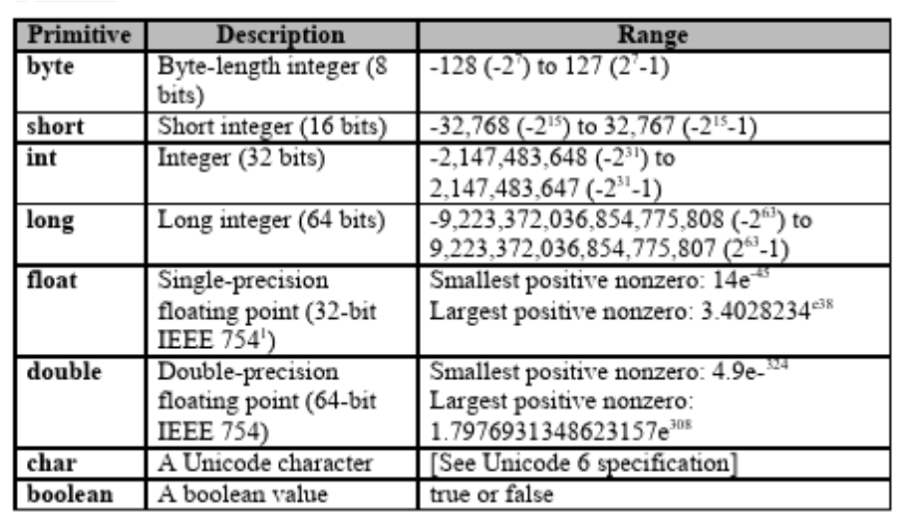
- Non-object data type that represent numbers and simple values (8 total)
- 6 Primitives Represent Numbers and each has a different size
- to save space you want to use the primitive with the smallest data size
- char
- contains a single Unicode character like 'a', '9', and '&' that allows chars to contain characters that do not exist in the English alphabet
- boolean
- Can only contain 2 states: true/false
- 6 Primitives Represent Numbers and each has a different size
- Non-object data type that represent numbers and simple values (8 total)
Variables
- Data placeholders
- 1) Must have a declared type
- 2) Has a name or an identifier
- Constants
- variables that once assigned cannot be changed
- declare a constant using the word final and the constant names are all in upper case with words separated by underscores
- final int ROW_Count = 50;
- declare a constant using the word final and the constant names are all in upper case with words separated by underscores
- variables that once assigned cannot be changed
- unlimited-length sequence of Java letters and digits
- Java Letters
- ASCII Latin letters A-Z, a-z, underscore, and dollar sign
- *dollar sign only should be used in mechanically generated source code or to access preexisting names on legacy systems
- ASCII Latin letters A-Z, a-z, underscore, and dollar sign
- JAVA Digits
- ASCII 0-9
- Java Letters
- must begin with a Java letter
- Case sensitive
- must not be a JAVA keyword , a boolean literal or the null literal
- Must be unique within its scope
- Constants
- reference type
- a reference of an object
- primitive type
- holds a primitive
- 2) Has a name or an identifier
- 1) Must have a declared type
- Declare a variable by writing type first followed by name with semicolon.
- can declare multiple of the same type using a comma
- Can assign a value at the same time as declaring
- can declare multiple of the same type using a comma
- Data placeholders
Literals
- source code representation of a value
- Literals of primitive types
- Integre literals
- Floating Literals
- Boolean Literals
- Character Literals
- Unicode Character or escape sequence enclosed in a single quote
- escape sequence is representation of a Unicode character that cannot be inputed by a keyboard
- Examples:
- 'a' , 'Z' , '0'
- Escape sequence examples:
- '\b'
- Examples:
- escape sequence is representation of a Unicode character that cannot be inputed by a keyboard
- Unicode Character or escape sequence enclosed in a single quote
- only two variables: True and False
- Character Literals
- has a whole number part, a decimal point, a fractional part, and an optional exponent
- float
- 32 bits in size
- double
- 64 bits in size
- float
- Boolean Literals
- used to assign values to variable s of type byte, short, int, and long
- Cannot assign a value that exceeds value of capacity of a variable
- highest for a byte is 127
- assign value to a long by suffixing the number with L/l
- Cannot assign a value that exceeds value of capacity of a variable
- Floating Literals
- Integre literals
- Literals of primitive types
- source code representation of a value
Encoding Sets
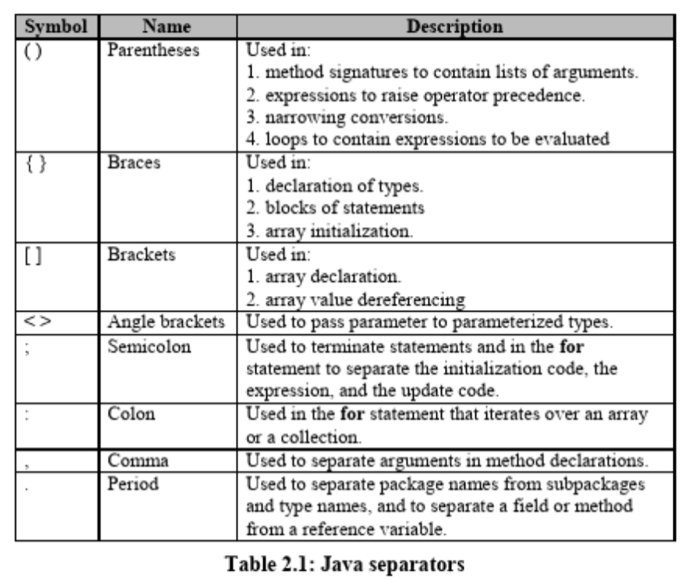
- Separators
- Special Characters
- JAVA supports Unicode character encoding set and program element names are not restricted to ASCII characters
- Each character in the ASCII is represented by 7 bits. There are 128 characters in this set
- lowercase & uppercase latin letters, number and punctuation marks
- 128 more added in extended ASCII
- lowercase & uppercase latin letters, number and punctuation marks
- Unicode is a character set that includes all characters in all languages. Different levels of bit storage per character are seen in these encodings
- UTF - 8
- UTF-16
- UTF-32
- UTF-16
- UTF - 8
- Each character in the ASCII is represented by 7 bits. There are 128 characters in this set
- Separators
Images and files in the map
Information
- Description
- Mind Map on Chapter 2: Language Fundamentals, created by Amanda Dischinger on 19/06/2020.
- Created by
- Amanda Dischinger
- Views
- 0
- Rating