
Mind map
Plant Disease Epidemiology
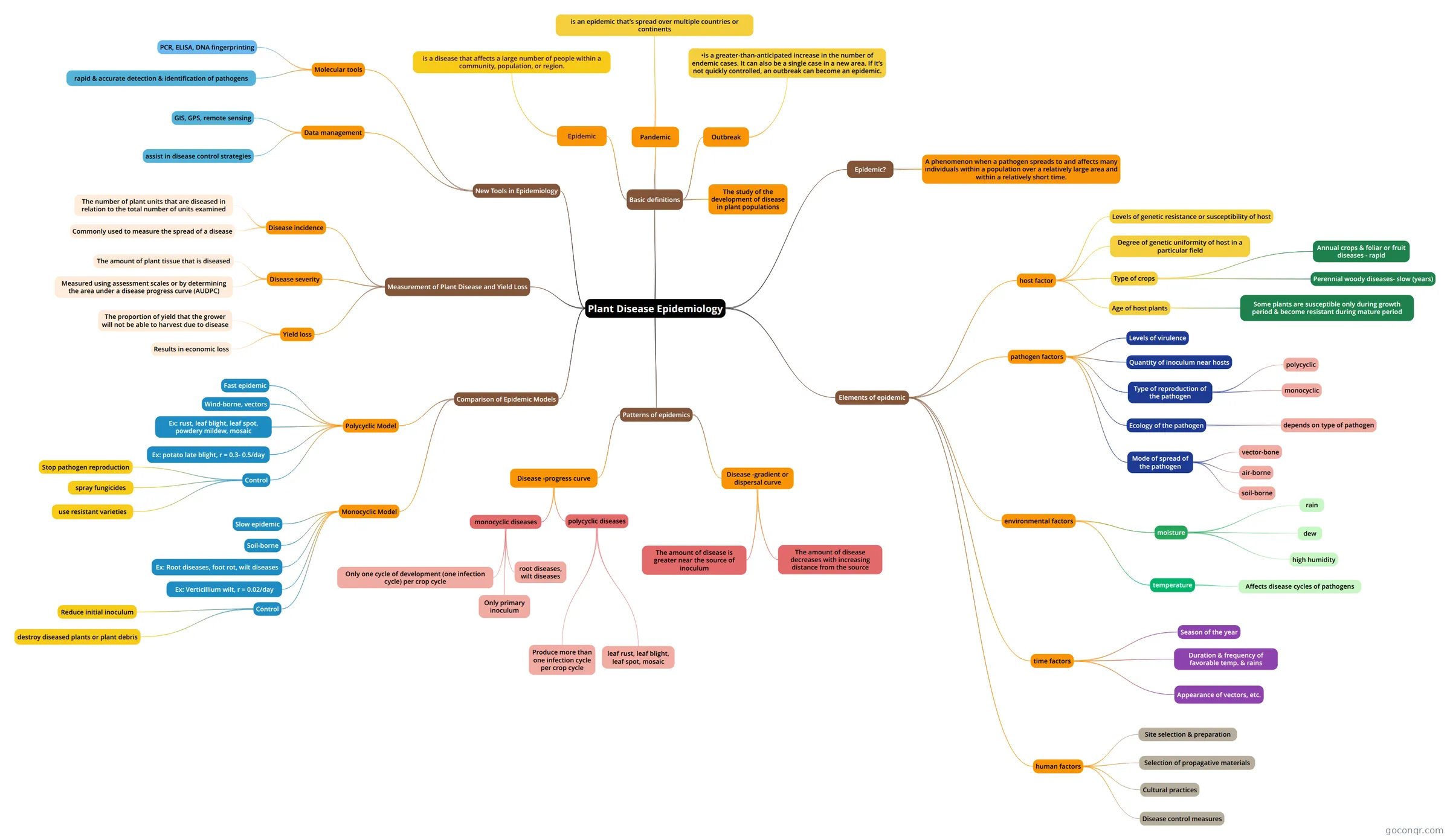
Mind map: Plant disease epidemiology
Map content
Plant Disease Epidemiology
Basic definitions
- Epidemic
- is a disease that affects a large number of people within a community, population, or region.
- Pandemic
- is an epidemic that’s spread over multiple countries or continents
- Outbreak
- •is a greater-than-anticipated increase in the number of endemic cases. It can also be a single case in a new area. If it’s not quickly controlled, an outbreak can become an epidemic.
- The study of the development of disease in plant populations
- Epidemic
Epidemic?
- A phenomenon when a pathogen spreads to and affects many individuals within a population over a relatively large area and within a relatively short time.
Elements of epidemic
- host factor
- Levels of genetic resistance or susceptibility of host
- Degree of genetic uniformity of host in a particular field
- Type of crops
- Annual crops & foliar or fruit diseases - rapid
- Perennial woody diseases- slow (years)
- Age of host plants
- Some plants are susceptible only during growth period & become resistant during mature period
- pathogen factors
- Levels of virulence
- Quantity of inoculum near hosts
- Type of reproduction of the pathogen
- polycyclic
- monocyclic
- Ecology of the pathogen
- depends on type of pathogen
- Mode of spread of the pathogen
- vector-bone
- air-borne
- soil-borne
- time factors
- Season of the year
- Duration & frequency of favorable temp. & rains
- Appearance of vectors, etc.
- human factors
- Site selection & preparation
- Selection of propagative materials
- Cultural practices
- Disease control measures
- environmental factors
- moisture
- rain
- dew
- high humidity
- temperature
- Affects disease cycles of pathogens
- moisture
- host factor
Patterns of epidemics
- Disease -progress curve
- monocyclic diseases
- Only one cycle of development (one infection cycle) per crop cycle
- Only primary inoculum
- root diseases, wilt diseases
- polycyclic diseases
- Produce more than one infection cycle per crop cycle
- leaf rust, leaf blight, leaf spot, mosaic
- monocyclic diseases
- Disease -gradient or dispersal curve
- The amount of disease is greater near the source of inoculum
- The amount of disease decreases with increasing distance from the source
- Disease -progress curve
Comparison of Epidemic Models
- Polycyclic Model
- Fast epidemic
- Wind-borne, vectors
- Ex: rust, leaf blight, leaf spot, powdery mildew, mosaic
- Control
- Stop pathogen reproduction
- spray fungicides
- use resistant varieties
- Ex: potato late blight, r = 0.3- 0.5/day
- Monocyclic Model
- Slow epidemic
- Ex: Root diseases, foot rot, wilt diseases
- Soil-borne
- Ex: Verticillium wilt, r = 0.02/day
- Control
- Reduce initial inoculum
- destroy diseased plants or plant debris
- Polycyclic Model
Measurement of Plant Disease and Yield Loss
- Disease incidence
- The number of plant units that are diseased in relation to the total number of units examined
- Commonly used to measure the spread of a disease
- Disease severity
- The amount of plant tissue that is diseased
- Measured using assessment scales or by determining the area under a disease progress curve (AUDPC)
- Yield loss
- The proportion of yield that the grower will not be able to harvest due to disease
- Results in economic loss
- Disease incidence
New Tools in Epidemiology
- Molecular tools
- PCR, ELISA, DNA fingerprinting
- rapid & accurate detection & identification of pathogens
- Data management
- GIS, GPS, remote sensing
- assist in disease control strategies
- Molecular tools
Information
- Description
- Mind Map on Plant Disease Epidemiology, created by Amin Hamzah on 30/06/2020.
- Created by
- Amin Hamzah
- Views
- 3
- Rating