
Mind map
Weimar Germany 1918-23: Creation and crisis
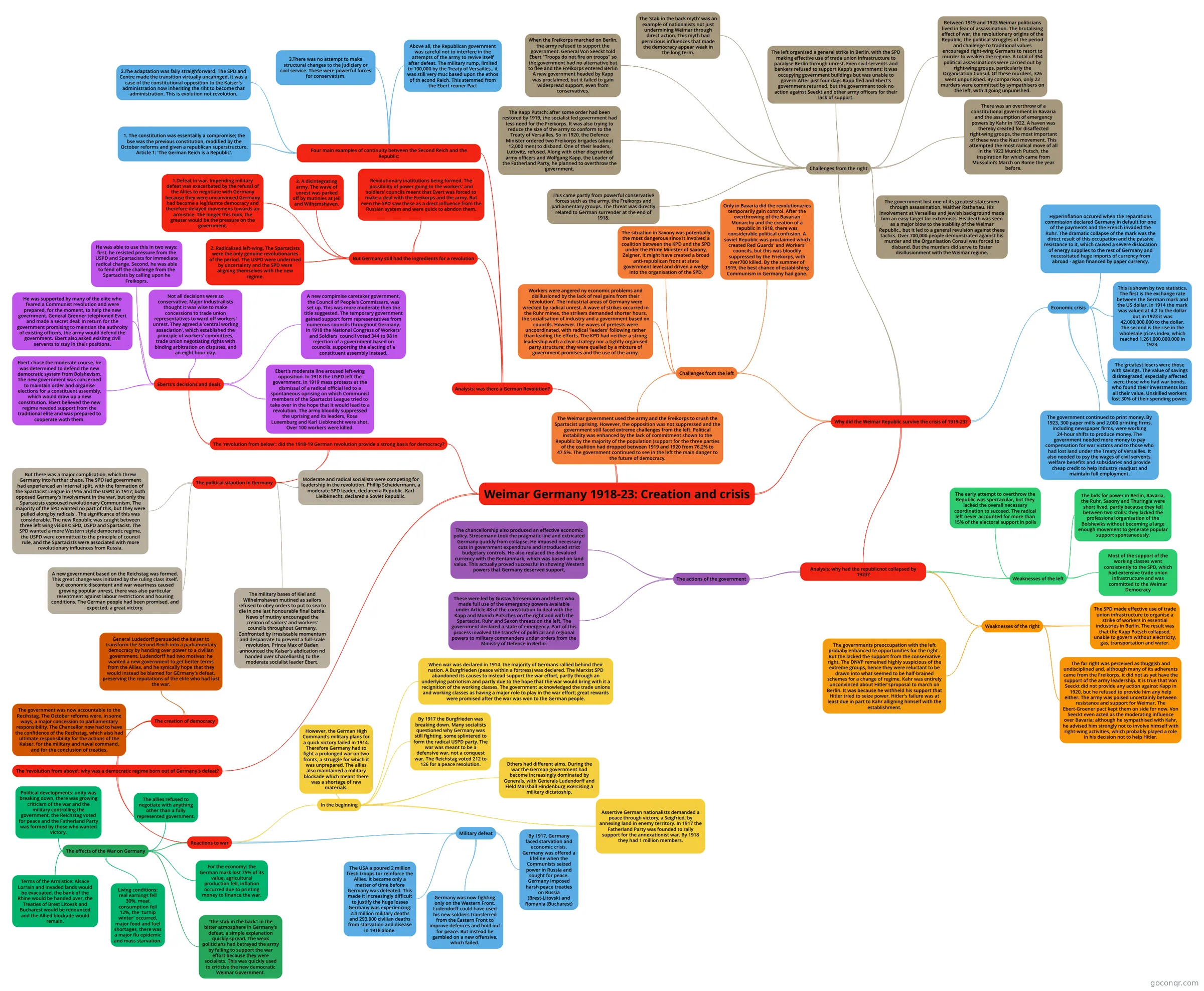
Mind map: Weimar Germany Creation and Crisis
Map content
Weimar Germany 1918-23: Creation and crisis
The 'revolution from above': why was a democratic regime born out of Germany's defeat?
- Reactions to war
- Military defeat
- By 1917, Germany faced starvation and economic crisis. Germany was offered a lifeline when the Communists seized power in Russia and sought for peace. Germany imposed harsh peace treaties on Russia (Brest-Litovsk) and Romania (Bucharest)
- Germany was now fighting only on the Western Front. Ludendorff could have used his new soldiers transferred from the Eastern Front to improve defences and hold out for peace. But instead he gambled on a new offensive, which failed.
- The USA a poured 2 million fresh troops tor reinforce the Allies. It became only a matter of time before Germany was defeated. This made it increasingly difficult to justify the huge losses Germany was experiencing: 2.4 million military deaths and 293,000 civilian deaths from starvation and disease in 1918 alone.
- The effects of the War on Germany
- For the economy: the German mark lost 75% of its value, agricultural production fell, inflation occurred due to printing money to finance the war.
- Political developments: unity was breaking down, there was growing criticism of the war and the military controlling the government. the Reichstag voted for peace and the Fatherland Party was formed by those who wanted victory.
- Living conditions: real earnings fell 30%, meat consumption fell 12%, the 'turnip winter' occurred, major food and fuel shortages, there was a major flu epidemic and mass starvation.
- The allies refused to negotiate with anything other than a fully represented government.
- Terms of the Armistice: Alsace Lorrain and invaded lands would be evacuated, the bank of the Rhine would be handed over, the Treaties of Brest Litovsk and Bucharest would be renounced and the Allied blockade would remain.
- 'The stab in the back': in the bitter atmosphere in Germany's defeat, a simple explanation quickly spread. The weak politicians had betrayed the army by failing to support the war effort because they were socialists. This was quickly used to criticise the new democratic Weimar Government.
- In the beginning
- When war was declared in 1914. the majority of Germans rallied behind their nation. A Burgfrieden (peace within a fortress) was declared. The Marxist SPD abandoned its causes to instead support the war effort, partly through an underlying patriotism and partly due to the hope that the war would bring with it a recignition of the working classes. The government acknowledged the trade unions and working classes as having a major role to play in the war effort; great rewards were promised after the war was won to the German people.
- However, the German High Command's military plans for a quick victory failed in 1914. Therefore Germany had to fight a prolonged war on two fronts, a struggle for which it was unprepared. The allies also maintained a military blockade which meant there was a shortage of raw materials.
- By 1917 the Burgfrieden was breaking down. Many socialists questioned why Germany was still fighting. some splintered to form the radical USPD party. The war was meant to be a defensive war, not a conquest war. The Reichstag voted 212 to 126 for a peace resolution.
- Others had different aims. During the war the German government had become increasingly dominated by Generals, with Generals Ludendorff and Field Marshall Hindenburg exercising a military dictatoship.
- Assertive German nationalists demanded a peace through victory, a Seigfried, by annexing land in enemy territory. In 1917 the Fatherland Party was founded to rally support for the annexationist war. By 1918 they had 1 million members.
- Military defeat
- The creation of democracy
- General Ludedorff persuaded the kaiser to transform the Second Reich into a parliamentary democracy by handing over power to a civilian government. Ludendorff had two motives: he wanted a new government to get better terms from the Allies, and he synically hope that they would instead be blamed for GErmany's defeat, preserving the reputations of the elite who had lost the war.
- The government was now accountable to the Recihstag. The October reforms were. in some ways, a major concession to parliamentary responsibility. The Chancellor now had to have the confidence of the Recihstag, which also had ultimate responsibility for the actions of the Kaiser, for the military and naval command, and for the conclusion of treaties.
- Reactions to war
The 'revolution from below': did the 1918-19 German revolution provide a strong basis for democracy?
- The political sitaution in Germany
- A new government based on the Reichstag was formed. This great change was initiated by the ruling class itself. but economic discontent and war weariness caused growing popular unrest, there was also particular resentment against labour restrictions and housing conditions. The German people had been promised, and expected, a great victory.
- The military bases of Kiel and Wilhelmshaven mutined as sailors refused to obey orders to put to sea to die in one last honourable final battle. News of mutiny encouraged the creaton of sailors' and workers' councils throughout Germany. Confronted by irresistable momentum and desparrate to prevent a full-scale revolution, Prince Max of Baden announced the Kaiser's abdication nd handed over Chacellorshi[ to the moderate socialist leader Ebert.
- Moderate and radical socialists were competing for leadership in the revolution. Phillip Scheidermann, a moderate SPD leader, declared a Republic. Karl Lleibknecht, declared a Soviet Republic.
- But there was a major complication, which threw Germany into further chaos. The SPD led government had experienced an internal split, with the formation of the Spartacist League in 1916 and the USPD in 1917; both opposed Germany's involvement in the war, but only the Spartacists espoused revolutionary Communism. The majority of the SPD wanted no part of this, but they were pulled along by radicals . The significance of this was considerable. The new Republic was caught between three left wing visions: SPD, USPD and Spartacist. The SPD wanted a more Western style democratic regime, the USPD were committed to the principle of council rule, and the Spartacists were associated with more revolutionary influences from Russia.
- Eberts's decisions and deals
- Ebert chose the moderate course. he was determined to defend the new democratic system from Bolshevism. The new government was concerned to maintain order and organise elections for a constituent assembly, which would draw up a new constitution. Ebert believed the new regime needed support from the traditional elite and was prepared to cooperate woth them.
- He was supported by many of the elite who feared a Communist revolution and were prepared, for the moment, to help the new government. General Greoner telephoned Evert and made a secret deal: in return for the government promising to maintian the authroity of existing officers, the army would defend the government. Ebert also asked exisitng civil servents to stay in their positions.
- He was able to use this in two ways: first, he resisted pressure from the USPD and Spartacists for immediate radical change. Second, he was able to fend off the challenge from the Spartacists by calling upon he Freikoprs.
- Not all decisions were so conservative. Major industrailists thought it was wise to make concessions to trade union representatives to ward off workers' unrest. They agreed a 'central workng assaciation', which established the principle of workers' committees, trade union negotiating rights with binding arbitration on disputes, and an eight hour day.
- A new compimise caretaker government, the Council of People's Commissars, was set up. This was more moderate then the title suggested. The temporary government gained support form representatives from numerous councils throughout Germany. In 1918 the National Congress of Workers' and Soldiers' council voted 344 to 98 in rejection of a government based on councils, supporting the electing of a constituent assembly instead.
- Ebert's moderate line aroused left-wing opposition. In 1918 the USPD left the government. In 1919 mass protests at the dismissal of a radical official led to a spontaneous uprising on which Communist members of the Spartacist League tried to take over in the hope that it would lead to a revolution. The army bloodily suppressed the uprising and its leaders, Rosa Luxemburg and Karl Liebknecht were shot. Over 100 workers were killed.
- The political sitaution in Germany
Analysis: was there a German Revolution?
- Four main examples of continuity between the Second Reich and the Republic:
- 1. The constitution was essentailly a compromise; the bse was the previous constitution, modified by the October reforms and given a republican superstructure. Article 1: 'The German Reich is a Republic'.
- 2.The adaptation was faily straighforward. The SPD and Centre made the transition virtually uncahnged. it was a case of the constitutional opposition to the Kaiser's administration now inheriting the riht to become that administration. This is evolution not revolution.
- 3.There was no attempt to make structural changes to the judiciary or civil service. These were powerful forces for conservatism.
- Above all, the Republican government was careful not to interfere in the attempts of the army to revive itself after defeat. The military rump, limited to 100,000 by the Treaty of Versailles.. it was still very muc based upon the ethos of th econd Reich. This stemmed from the Ebert reoner Pact
- But Germany still had the ingredients for a revolution
- 1.Defeat in war. Impending military defeat was exacerbated by the refusal of the Allies to negotiate with Germany because they were unconvinced Germany had become a legitiamte democracy and therefore delayed movemens towards an armistice. The longer this took, the greater would be the pressure on the government.
- 2. Radicalised left-wing. The Spartacists were the only genuine revolutionaries of the period. The USPD were undermed by uncertainty and the SPD were aligning themselves with the new regime.
- 3. A disintegrating army. The wave of unrest was parked off by mutinies at Jeil and Wilhemshaven.
- Revolutionary inatitutions being formed. The possibility of power going to the workers' and soldiers' councils meant that Evert was forced to make a deal with the Freikorps and the army. But even the SPD saw these as a drect influence from the Russian system and were quick to abndon them.
- Four main examples of continuity between the Second Reich and the Republic:
Why did the Weimar Republic survive the crisis of 1919-23?
- Challenges from the left
- The Weimar government used the army and the Freikorps to crush the Spartacist uprising. However, the opposition was not suppressed and the government still faced extreme challenges from the left. Political instability was enhanced by the lack of commitment shown to the Republic by the majority of the population (support for the three parties of the coalition had dropped between 1919 and 1920 from 76.2% to 47.5%. The government continued to see in the left the main danger to the future of democracy.
- Workers were angered ny economic problems and disillusioned by the lack of real gains from their 'revolution'. The industrial areas of Germany were wrecked by radical unrest. A wave of strikes occurred in the Ruhr mines, the strikers demanded shorter hours, the socialisation of industry and a government based on councils. However. the waves of pretests were uncoordinated, with radical 'leaders' following rather than leading the efforts. The KPD had neither a strong leadership with a clear strategy nor a tightly organised party structure; they were quelled by a mixture of government promises and the use of the army.
- The situation in Saxony was potentially the most dangerous since it involved a coalition between the KPD and the SPD under the Prime Minister of Saxony, Zeigner. It might have created a broad anti-republican front at state government level and driven a wedge into the organisation of the SPD.
- Only in Bavaria did the revolutionaries temporarily gain control. After the overthrowing of the Bavarian Monarchy and the creation of a republic in 1918, there was considerable political confusion. A soviet Republic was proclaimed which created Red Guards' and Workers' councils, but this was bloodily suppressed by the Friekorps, with over700 killed. By the summer of 1919, the best chance of establishing Communism in Germany had gone.
- Challenges from the right
- This came partly from powerful conservative forces such as the army, the Freikorps and parliamentary groups. The threat was directly related to German surrender at the end of 1918.
- The Kapp Putsch: after some order had been restored by 1919, the socialist led government had less need for the Freikorps. It was also trying to reduce the size of the army to conform to the Treaty of Versailles. So in 1920, the Defence Minister ordered two Freikorps brigades (about 12,000 men) to disband. One of their leaders, Luttwitz, refused. Along with other disgruntled army officers and Wolfgang Kapp, the Leader of the Fatherland Party, he planned to overthrow the government.
- When the Freikorps marched on Berlin, the army refused to support the government. General Von Seeckt told Ebert "Troops do not fire on troops" so the government had no alternative but to flee and the Freikorps entered Berlin A new government headed by Kapp was proclaimed, but it failed to gain widespread support, even from conservatives.
- The left organised a general strike in Berlin, with the SPD making effective use of trade union infrastructure to paralyse Berlin through unrest. Even civil servents and bankers refused to support Kapp's government; it was occupying government buildings but was unable to govern.After just four days Kapp fled and Ebert's government returned, but the government took no action against Seeckt and other army officers for their lack of support.
- Between 1919 and 1923 Weimar politicians lived in fear of assassination. The brutalising effect of war, the revolutionary origins of the Republic, the political struggles of the period and challenge to traditional values encouraged right-wing Germans to resort to murder to weaken the regime. A total of 354 political assassinations were carried out by right-wing groups, particularly the Organisation Consul. Of these murders, 326 went unpunished. By comparison, only 22 murders were committed by sympathisers on the left, with 4 going unpunished.
- There was an overthrow of a constitutional government in Bavaria and the assumption of emergency powers by Kahr in 1922. A haven was thereby created for disaffected right-wing groups, the most important of these was the Nazi movement. This attempted the most radical move of all in the 1923 Munich Putsch, the inspiration for which came from Mussolini's March on Rome the year before.
- The government lost one of its greatest statesmen through assassination, Walther Rathenau. His involvement at Versailles and Jewish background made him an easy target for extremists. His death was seen as a major blow to the stability of the Weimar Republic., but it led to a general revulsion against these tactics. Over 700,000 people demonstrated against his murder and the Organisation Consul was forced to disband. But the murders did serve to foster disillusionment with the Weimar regime.
- The 'stab in the back myth' was an example of nationalists not just undermining Weimar through direct action. This myth had pernicious influences that made the democracy appear weak in the long term.
- Economic crisis
- Hyperinflation occured when the reparations commission declared Germany in default for one of the payments and the French invaded the Ruhr. The dramatic collapse of the mark was the direct result of this occupation and the passive resistance to it, which caused a severe dislocation of energy supplies to the rest of Germany and necessitated huge imports of currency from abroad - agian financed by paper currency.
- This is shown by two statistics. The first is the exchange rate between the German mark and the US dollar. in 1914 the mark was valued at 4.2 to the dollar but in 1923 it was 42,000,000,000 to the dollar. The second is the rise in the wholesale [rices index, which reached 1,261,000,000,000 in 1923.
- The greatest losers were those with savings. The value of savings disintegrated, especially affected were those who had war bonds, who found their investments lost all their value. Unskilled workers lost 30% of their spending power.
- The government continued to print money. By 1923, 300 paper mills and 2,000 printing firms, including newspaper firms, were working 24-hour shifts to produce money. The government needed more money to pay compensation for war victims and to those who had lost land under the Treaty of Versailles. It also needed to psy the wages of civil servents, welfare benefits and subsidaries and provide cheap credit to help industry readjust and maintain full employment.
- Analysis: why had the republicnot collapsed by 1923?
- Weaknesses of the left
- The early attempt to overthrow the Republic was spectacular, but they lacked the overall necessary coordination to succeed. The radical left never accounted for more than 15% of the electoral support in polls
- The bids for power in Berlin, Bavaria, the Ruhr, Saxony and Thuringia were short lived, partly because they fell between two stolls: they lacked the professional organisation of the Bolsheviks without becoming a large enough movement to generate popular support spontaneously.
- Most of the support of the working classes went consistently to the SPD, which had extensive trade union infrastructure and was committed to the Weimar Democracy
- Weaknesses of the right
- The governments preoccupation with the left probaby enhanced te opportunities for the right . But the lacked the support from the conservative right. The DNVP remained highly suspicious of the extreme groups, hence they were reluctant to be drawn into what seemed to be half-brained schemes for a change of regime. Kahr was entirely unconvinced about Hitler'sproposal to march on Berlin. It was because he withheld his support that Hitler tried to seize power. Hitler's failure was at least due in part to Kahr alligning himself with the establishment.
- The far right was perceived as thuggish and undisciplined and, although many of its adherents came from the Freikorps, it did not as yet have the support of the army leadership. It is true that Von Seeckt did not provide any action against Kapp in 1920, but he refused to provide him any help either. The army was poised uncertainly between resistance and support for Weimar. The Ebert-Groener pact kept them on side for now. Von Seeckt even acted as the moderating influence over Bavaria; although he sympathised with Kahr, he advised him strongly not to involve himself with right-wing activities, which probably played a role in his decision not to help Hitler.
- The SPD made effective use of trade union infrastructure to organise a strike of workers in essential industries in Berlin. The result was that the Kapp Putsch collapsed, unable to govern without electricity, gas, transportation and water.
- The actions of the government
- These were led by Gustav Stresemann and Ebert who made full use of the emergency powers available under Article 48 of the constitution to deal with the Kapp and Munich Putsches on the right and with the Spartacist, Ruhr and Saxon threats on the left. The government declared a state of emergency. Part of this process involved the transfer of political and regional powers to military commanders under orders from the Ministry of Defence in Berlin.
- The chancellorship also produced an effective economic policy. Stresemann took the pragmatic line and extricated Germany quickly from collapse. He imposed necessary cuts in government expenditure and introduced strict budgetary controls. He also replaced the devalued currency with the Rentanmark, which was based on land value. This actually proved successful in showing Western powers that Germany deserved support.
- Weaknesses of the left
- Challenges from the left
Information
- Description
- Mind Map on Weimar Germany 1918-23: Creation and crisis, created by willo118_murphy on 02/04/2015.
- Created by
- willo118_murphy
- Views
- 24
- Rating