
Mind map
Polymer Revolution
Map content
Polymer Revolution
Addition Reactions of Alkenes
- Alkenes are UNSATURATED HYDROCARBONS
- Cn H2n
- Double bond
- Two double bonds = -diene
- Test for unsaturation = Bromine water - red/brown to colourless (dibromoalkane)
- Example of electrophillic addition
- Producing alkanes
- Add Hydrogen
- Nickel catalyst at 150C and high pressure OR platinum catalyst at room temperature and pressure
- Double bonds opens up to hold Hydorgen
- Electrophillic Addition
- Electrophiles - electron pair acceptors
- Positively charged ions
- Polar molecules
- Electrophiles - electron pair acceptors
- Alkenes are UNSATURATED HYDROCARBONS
Alcohols and Other Organic Coumpouds
Hydrogen Bonding
- Strongest intermolecular force
- Higher melting and boiling points
- More energy needed to overcome bonds
- Higher melting and boiling points
- Only happens when H bonds to F,O,N
- As they are very ELECTRONEGATIVE
- Bond is so POLARISED + hydrogen has such a high charge density as it is so small
- Hydrogen forms strong bonds with lone pairs on F,O,N
- Examples
- -OH
- Ammonia + water
- -NH
- Ice is less dense than water
- Ice - max no. of Hydrogen bonds
- Lattice structure 'wastes' space
- Ice melts - bonds break - lattice breaks down - molecules fill space
- Causes some polymers to dissolve in water
- Polym
- Strongest intermolecular force
Polymers
- Addition Polymerisation
- Double bond in alkenes opens up and joins with other alkenes to form a long chain
- Poly(ethene) from ethene
- Copolymers
- Made from more than one type of monomer
- Join together in a random order
- Monomers
- Always have double bonds
- Poly(alkanes) - unreactive
- Cross-linking
- Thermoplastic polymers
- no cross-linking
- weak intermolecular forces
- easy to melt
- can be melted and remoulded as many times as you want
- cools and hardens to form a shape
- Thermosetting polymers
- 3D giant covalent structures
- don't soften when heated
- strong
- covalent cross-links
- hard
- rigid
- insoluble
- Thermoplastic polymers
- Uses
- Poly(chloroethene) - flexible, durable, water pipes, insulation
- Polystyrene - cheap, light, good insulator, crash helmets
- Perspex - transparent, strong, used in place of glass
- Poly(tetrafluoroethene) PTFE - chemically inert, non stick frying pans
- Addition Polymerisation
E/Z Isomerism
- Stereoisomerism
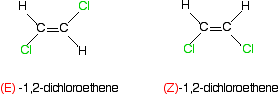
- Def: Same structural formula but different arrangement in space
- Single bond - atoms can rotate freely
- Double bond - Atoms can't rotate or bend
- Is rigid
- Cis-Trans Isomers
- Cis = E Isomers
- Trans = Z Isomers
- Each group linked to carbon has different priority
- Br has a higher priority than F
- CH3 has a higher priority than H
- If two carbons have their higher priority groups on OPPOSITE sides, it is an E isomer
- If two carbons have their higher priority groups on SAME sides, it is an Z isomer
- Stereoisomerism
Infrared Spectroscopy
Images and files in the map
Information
- Description
- Chemistry (F332) Mind Map on Polymer Revolution, created by htrsarup on 06/04/2015.
- Created by
- htrsarup · Apr 2015
- Updated
- Mar 7, 2018
- Views
- 10
- Rating