
Mind map
Near-Earth Objects (NEOs)
Map content
Near-Earth Objects (NEOs)
=Solar system object whose orbit brings it into proximity with Earth
- include:
- Comets
- 1. shows coma (due to sublimation of near surface ices by solar radiation)
- 2. Elliptical orbit
- 1. shows coma (due to sublimation of near surface ices by solar radiation)
- Asteroids (Near-Earth Asteroids)
- 1. doesn't show coma
- 2. less eccentric orbit than comet
- 1. doesn't show coma
- Comets
- include:
Meteor
- Meteoroids
- when large meteoroids enter Earth's atmosphere
- produce bright streaks in the sky
- such meteors = Fire balls
- Eg) Peekskill Fireball
- Eg) 2013 Russian Meteor
- brilliant fireball over Russia (15 Feb 2013)
- the meteoroid was an asteroid, with an estimated initial diameter of 20m
- the object exploded in an ai burst over Chelyabinsk Oblast, generating a bright flash
- the explosion generated a powerful shock wave
- about 1500 people were injured, all of which were due to indirect effects
- mainly from broken glass from winodws that were blown in when the shock wave arrived
- about 1500 people were injured, all of which were due to indirect effects
- The Tungska Event
- the object is also believed to have burst in the air
- the bursting object's size is estimated to be on the order of 60m~190m
- the object is also believed to have burst in the air
- the explosion generated a powerful shock wave
- the object exploded in an ai burst over Chelyabinsk Oblast, generating a bright flash
- the meteoroid was an asteroid, with an estimated initial diameter of 20m
- brilliant fireball over Russia (15 Feb 2013)
- a piece of a large meteoroid may survive its passage through the atmosphere & finds its way to the ground
- =meteorite
- the more massive meteoroids do make it to Earth's surface
- => craters
- Eg) Barringer Crater
- named in honour of Daniel Barringer (1903) - first to suggest that it was produced by meteoritic impact
- the best preserved impact crater on Earth
- created about 50,000 years ago
- the crater is about 1200m in diameter
- the meteorite that excavated the crater was a nickel-iron meteorite, about 50m across
- Eg) Carancas Crater
- the Caracncas impact (2007) near the village of Carancas in Peru
- crater = 13m wide
- impacting meteorite was probably around 1m in diameter
- crater = 13m wide
- the Caracncas impact (2007) near the village of Carancas in Peru
- Eg) Barringer Crater
- => craters
- when large meteoroids enter Earth's atmosphere
- Meteoroids
It is now generally believed that the mass extinction of the dinosaurs was triggered by a massive impact
- The meteoroid was 10~15km
- hurtled into Earth @ Chicxulub on Mexico's Yucatan Peninsula
- the impact generated a dust cloud that blocked sunlight for a year or less
- also injected sulfuric acid aerosols into the stratosphere, which reduced sunlight reaching the Earth's surface
- It would take at least 10 years for those aerosols to dissipate
- the dust & aerosols inhibited pohotosynthesis
- causing food chains to collapse both on land & at sea
- the dinosaurs need a lot of foods to sustain their fast metabolism
- food chain disruption => they died
- the dinosaurs need a lot of foods to sustain their fast metabolism
- causing food chains to collapse both on land & at sea
- also injected sulfuric acid aerosols into the stratosphere, which reduced sunlight reaching the Earth's surface
- The meteoroid was 10~15km
Frequency of Impacts
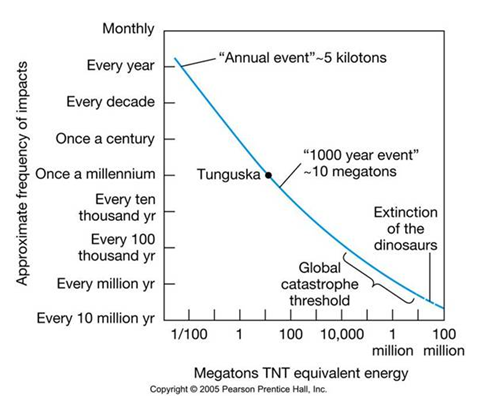
- Inverse r/s b/w he size of the object & the frequency that such objects hit Earth
- Small Impacts
- asteroids with a diameter of 4m impact Earth approx 1/year
- no human is known to have been killed directly by an impact
- chance of single person born today dying due to an impact = 1/200,000
- no human is known to have been killed directly by an impact
- asteroids with a diameter of 4m impact Earth approx 1/year
- Medium & Large Impacts
- objects with diameter of roughly 50m strike Earth approx 1 every 1000 years
- Large collisions - with 5km objects - happen approx once every 20 mn years
- Small Impacts
- Inverse r/s b/w he size of the object & the frequency that such objects hit Earth
NEO Program
- in US, NASA has a congressional mandate to catalogue all NEOs that are at least 1km wide
- as the impact of such an object would be catastrophic
- estimated that 93% of the NEAs are larger than 1km & have been found & that only about 70 remain to be discovered
- Eg) Asteroid 1950 DA
- more than 1km diameter
- highest probability of impacting Earth
- may pass very close to Earth/collide with the Earth in 2880
- 1/300 chance of hitting the Earth
- Deflecting an Asteroid
- Gravity tractor
- Kinetic Impact
- Deflecting an Asteroid
- 1/300 chance of hitting the Earth
- may pass very close to Earth/collide with the Earth in 2880
- as the impact of such an object would be catastrophic
- WISE = IR-wavelength space telescope (2009)
- find the NEA by detecting their thermal radiations
- in US, NASA has a congressional mandate to catalogue all NEOs that are at least 1km wide
Images and files in the map
Information
- Description
- Mind Map on Near-Earth Objects (NEOs), created by hssue94712 on 11/04/2015.
- Created by
- hssue94712
- Views
- 0
- Rating