
Mind map
Hand Movements and Music
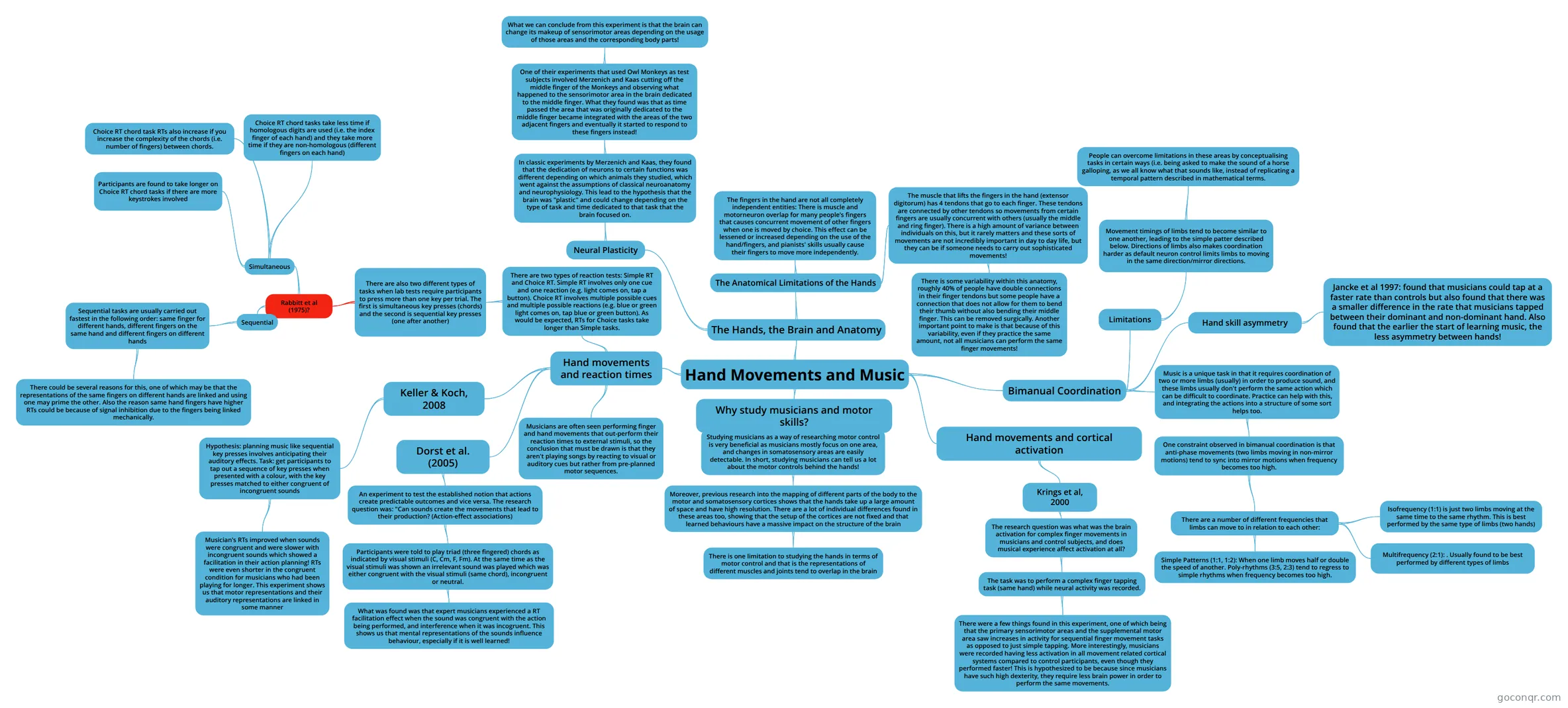
Mind map: Hand movements and music
Map content
Hand Movements and Music
Why study musicians and motor skills?
- Studying musicians as a way of researching motor control is very beneficial as musicians mostly focus on one area, and changes in somatosensory areas are easily detectable. In short, studying musicians can tell us a lot about the motor controls behind the hands!
- Moreover, previous research into the mapping of different parts of the body to the motor and somatosensory cortices shows that the hands take up a large amount of space and have high resolution. There are a lot of individual differences found in these areas too, showing that the setup of the cortices are not fixed and that learned behaviours have a massive impact on the structure of the brain
- There is one limitation to studying the hands in terms of motor control and that is the representations of different muscles and joints tend to overlap in the brain
- Moreover, previous research into the mapping of different parts of the body to the motor and somatosensory cortices shows that the hands take up a large amount of space and have high resolution. There are a lot of individual differences found in these areas too, showing that the setup of the cortices are not fixed and that learned behaviours have a massive impact on the structure of the brain
- Studying musicians as a way of researching motor control is very beneficial as musicians mostly focus on one area, and changes in somatosensory areas are easily detectable. In short, studying musicians can tell us a lot about the motor controls behind the hands!
The Hands, the Brain and Anatomy
- Neural Plasticity
- In classic experiments by Merzenich and Kaas, they found that the dedication of neurons to certain functions was different depending on which animals they studied, which went against the assumptions of classical neuroanatomy and neurophysiology. This lead to the hypothesis that the brain was "plastic" and could change depending on the type of task and time dedicated to that task that the brain focused on.
- One of their experiments that used Owl Monkeys as test subjects involved Merzenich and Kaas cutting off the middle finger of the Monkeys and observing what happened to the sensorimotor area in the brain dedicated to the middle finger. What they found was that as time passed the area that was originally dedicated to the middle finger became integrated with the areas of the two adjacent fingers and eventually it started to respond to these fingers instead!
- What we can conclude from this experiment is that the brain can change its makeup of sensorimotor areas depending on the usage of those areas and the corresponding body parts!
- One of their experiments that used Owl Monkeys as test subjects involved Merzenich and Kaas cutting off the middle finger of the Monkeys and observing what happened to the sensorimotor area in the brain dedicated to the middle finger. What they found was that as time passed the area that was originally dedicated to the middle finger became integrated with the areas of the two adjacent fingers and eventually it started to respond to these fingers instead!
- In classic experiments by Merzenich and Kaas, they found that the dedication of neurons to certain functions was different depending on which animals they studied, which went against the assumptions of classical neuroanatomy and neurophysiology. This lead to the hypothesis that the brain was "plastic" and could change depending on the type of task and time dedicated to that task that the brain focused on.
- The Anatomical Limitations of the Hands
- The fingers in the hand are not all completely independent entities: There is muscle and motorneuron overlap for many people's fingers that causes concurrent movement of other fingers when one is moved by choice. This effect can be lessened or increased depending on the use of the hand/fingers, and pianists' skills usually cause their fingers to move more independently.
- The muscle that lifts the fingers in the hand (extensor digitorum) has 4 tendons that go to each finger. These tendons are connected by other tendons so movements from certain fingers are usually concurrent with others (usually the middle and ring finger). There is a high amount of variance between individuals on this, but it rarely matters and these sorts of movements are not incredibly important in day to day life, but they can be if someone needs to carry out sophisticated movements!
- There is some variability within this anatomy, roughly 40% of people have double connections in their finger tendons but some people have a connection that does not allow for them to bend their thumb without also bending their middle finger. This can be removed surgically. Another important point to make is that because of this variability, even if they practice the same amount, not all musicians can perform the same finger movements!
- Neural Plasticity
Hand movements and reaction times
- Musicians are often seen performing finger and hand movements that out-perform their reaction times to external stimuli, so the conclusion that must be drawn is that they aren't playing songs by reacting to visual or auditory cues but rather from pre-planned motor sequences.
- There are two types of reaction tests: Simple RT and Choice RT. Simple RT involves only one cue and one reaction (e.g. light comes on, tap a button). Choice RT involves multiple possible cues and multiple possible reactions (e.g. blue or green light comes on, tap blue or green button). As would be expected, RTs for Choice tasks take longer than Simple tasks.
- There are also two different types of tasks when lab tests require participants to press more than one key per trial. The first is simultaneous key presses (chords) and the second is sequential key presses (one after another)
- Rabbitt et al (1975)?
- Simultaneous
- Participants are found to take longer on Choice RT chord tasks if there are more keystrokes involved
- Choice RT chord tasks take less time if homologous digits are used (i.e. the index finger of each hand) and they take more time if they are non-homologous (different fingers on each hand)
- Choice RT chord task RTs also increase if you increase the complexity of the chords (i.e. number of fingers) between chords.
- Sequential
- Sequential tasks are usually carried out fastest in the following order: same finger for different hands, different fingers on the same hand and different fingers on different hands
- There could be several reasons for this, one of which may be that the representations of the same fingers on different hands are linked and using one may prime the other. Also the reason same hand fingers have higher RTs could be because of signal inhibition due to the fingers being linked mechanically.
- Sequential tasks are usually carried out fastest in the following order: same finger for different hands, different fingers on the same hand and different fingers on different hands
- Simultaneous
- Rabbitt et al (1975)?
- There are also two different types of tasks when lab tests require participants to press more than one key per trial. The first is simultaneous key presses (chords) and the second is sequential key presses (one after another)
- Dorst et al. (2005)
- An experiment to test the established notion that actions create predictable outcomes and vice versa. The research question was: "Can sounds create the movements that lead to their production? (Action-effect associations)
- Participants were told to play triad (three fingered) chords as indicated by visual stimuli (C, Cm, F, Fm). At the same time as the visual stimuli was shown an irrelevant sound was played which was either congruent with the visual stimuli (same chord), incongruent or neutral.
- What was found was that expert musicians experienced a RT facilitation effect when the sound was congruent with the action being performed, and interference when it was incogruent. This shows us that mental representations of the sounds influence behaviour, especially if it is well learned!
- Participants were told to play triad (three fingered) chords as indicated by visual stimuli (C, Cm, F, Fm). At the same time as the visual stimuli was shown an irrelevant sound was played which was either congruent with the visual stimuli (same chord), incongruent or neutral.
- An experiment to test the established notion that actions create predictable outcomes and vice versa. The research question was: "Can sounds create the movements that lead to their production? (Action-effect associations)
- Keller & Koch, 2008
- Hypothesis: planning music like sequential key presses involves anticipating their auditory effects. Task: get participants to tap out a sequence of key presses when presented with a colour, with the key presses matched to either congruent of incongruent sounds
- Musician's RTs improved when sounds were congruent and were slower with incongruent sounds which showed a facilitation in their action planning! RTs were even shorter in the congruent condition for musicians who had been playing for longer. This experiment shows us that motor representations and their auditory representations are linked in some manner
- Hypothesis: planning music like sequential key presses involves anticipating their auditory effects. Task: get participants to tap out a sequence of key presses when presented with a colour, with the key presses matched to either congruent of incongruent sounds
Hand movements and cortical activation
- Krings et al, 2000
- The research question was what was the brain activation for complex finger movements in musicians and control subjects, and does musical experience affect activation at all?
- The task was to perform a complex finger tapping task (same hand) while neural activity was recorded.
- There were a few things found in this experiment, one of which being that the primary sensorimotor areas and the supplemental motor area saw increases in activity for sequential finger movement tasks as opposed to just simple tapping. More interestingly, musicians were recorded having less activation in all movement related cortical systems compared to control participants, even though they performed faster! This is hypothesized to be because since musicians have such high dexterity, they require less brain power in order to perform the same movements.
- The task was to perform a complex finger tapping task (same hand) while neural activity was recorded.
- The research question was what was the brain activation for complex finger movements in musicians and control subjects, and does musical experience affect activation at all?
- Krings et al, 2000
Bimanual Coordination
- Music is a unique task in that it requires coordination of two or more limbs (usually) in order to produce sound, and these limbs usually don't perform the same action which can be difficult to coordinate. Practice can help with this, and integrating the actions into a structure of some sort helps too.
- One constraint observed in bimanual coordination is that anti-phase movements (two limbs moving in non-mirror motions) tend to sync into mirror motions when frequency becomes too high.
- There are a number of different frequencies that limbs can move to in relation to each other:
- Isofrequency (1:1) is just two limbs moving at the same time to the same rhythm. This is best performed by the same type of limbs (two hands)
- Multifrequency (2:1): . Usually found to be best performed by different types of limbs
- Simple Patterns (1:1, 1:2): When one limb moves half or double the speed of another. Poly-rhythms (3:5, 2:3) tend to regress to simple rhythms when frequency becomes too high.
- There are a number of different frequencies that limbs can move to in relation to each other:
- One constraint observed in bimanual coordination is that anti-phase movements (two limbs moving in non-mirror motions) tend to sync into mirror motions when frequency becomes too high.
- Limitations
- Movement timings of limbs tend to become similar to one another, leading to the simple patter described below. Directions of limbs also makes coordination harder as default neuron control limits limbs to moving in the same direction/mirror directions.
- People can overcome limitations in these areas by conceptualising tasks in certain ways (i.e. being asked to make the sound of a horse galloping, as we all know what that sounds like, instead of replicating a temporal pattern described in mathematical terms.
- Movement timings of limbs tend to become similar to one another, leading to the simple patter described below. Directions of limbs also makes coordination harder as default neuron control limits limbs to moving in the same direction/mirror directions.
- Hand skill asymmetry
- Jancke et al 1997: found that musicians could tap at a faster rate than controls but also found that there was a smaller difference in the rate that musicians tapped between their dominant and non-dominant hand. Also found that the earlier the start of learning music, the less asymmetry between hands!
- Music is a unique task in that it requires coordination of two or more limbs (usually) in order to produce sound, and these limbs usually don't perform the same action which can be difficult to coordinate. Practice can help with this, and integrating the actions into a structure of some sort helps too.
Information
- Description
- Undergraduate The Neuroscience of Music Mind Map on Hand Movements and Music, created by Tomohawk McGinn on 14/04/2015.
- Created by
- Tomohawk McGinn
- Views
- 1
- Rating