
Mind map
New Labour Policies
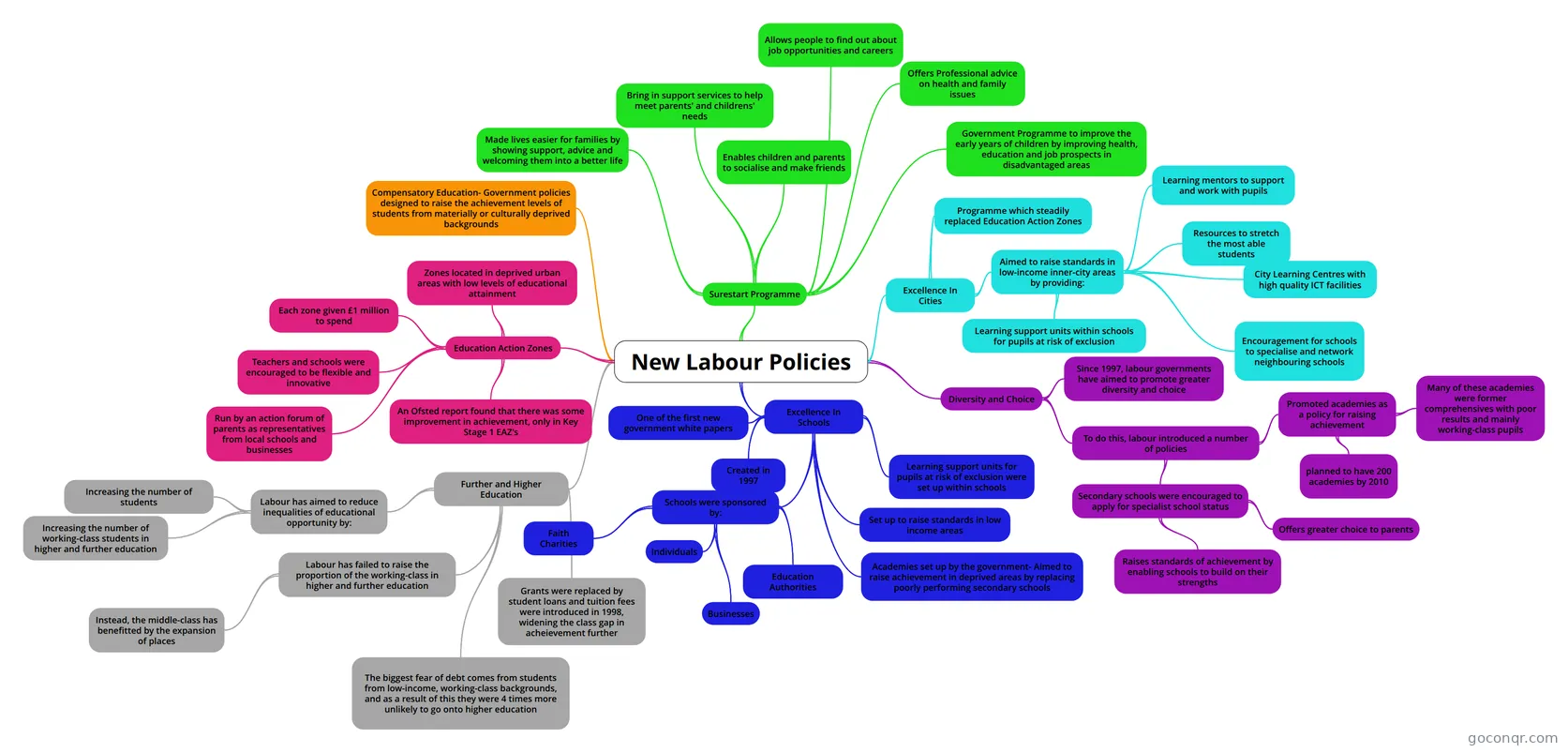
Mind map: New Labour education policies
Map content
New Labour Policies
Surestart Programme
- Government Programme to improve the early years of children by improving health, education and job prospects in disadvantaged areas
- Made lives easier for families by showing support, advice and welcoming them into a better life
- Bring in support services to help meet parents' and childrens' needs
- Offers Professional advice on health and family issues
- Enables children and parents to socialise and make friends
- Allows people to find out about job opportunities and careers
Excellence In Cities
- Programme which steadily replaced Education Action Zones
- Aimed to raise standards in low-income inner-city areas by providing:
- Resources to stretch the most able students
- Learning mentors to support and work with pupils
- City Learning Centres with high quality ICT facilities
- Learning support units within schools for pupils at risk of exclusion
- Encouragement for schools to specialise and network neighbouring schools
Excellence In Schools
- One of the first new government white papers
- Created in 1997
- Learning support units for pupils at risk of exclusion were set up within schools
- Set up to raise standards in low income areas
- Academies set up by the government- Aimed to raise achievement in deprived areas by replacing poorly performing secondary schools
- Schools were sponsored by:
- Faith Charities
- Individuals
- Businesses
- Education Authorities
Education Action Zones
- Zones located in deprived urban areas with low levels of educational attainment
- Each zone given £1 million to spend
- Teachers and schools were encouraged to be flexible and innovative
- An Ofsted report found that there was some improvement in achievement, only in Key Stage 1 EAZ's
- Run by an action forum of parents as representatives from local schools and businesses
Further and Higher Education
- Labour has aimed to reduce inequalities of educational opportunity by:
- Increasing the number of working-class students in higher and further education
- Increasing the number of students
- Labour has failed to raise the proportion of the working-class in higher and further education
- Instead, the middle-class has benefitted by the expansion of places
- Grants were replaced by student loans and tuition fees were introduced in 1998, widening the class gap in acheievement further
- The biggest fear of debt comes from students from low-income, working-class backgrounds, and as a result of this they were 4 times more unlikely to go onto higher education
- Labour has aimed to reduce inequalities of educational opportunity by:
Diversity and Choice
- Since 1997, labour governments have aimed to promote greater diversity and choice
- To do this, labour introduced a number of policies
- Secondary schools were encouraged to apply for specialist school status
- Offers greater choice to parents
- Raises standards of achievement by enabling schools to build on their strengths
- Promoted academies as a policy for raising achievement
- planned to have 200 academies by 2010
- Many of these academies were former comprehensives with poor results and mainly working-class pupils
- Secondary schools were encouraged to apply for specialist school status
Compensatory Education- Government policies designed to raise the achievement levels of students from materially or culturally deprived backgrounds
Information
- Description
- Mind Map on New Labour Policies, created by jonesn on 14/04/2015.
- Created by
- jonesn
- Views
- 0
- Rating
More on Education in the United Kingdom