
Mind map
OCNG Intro
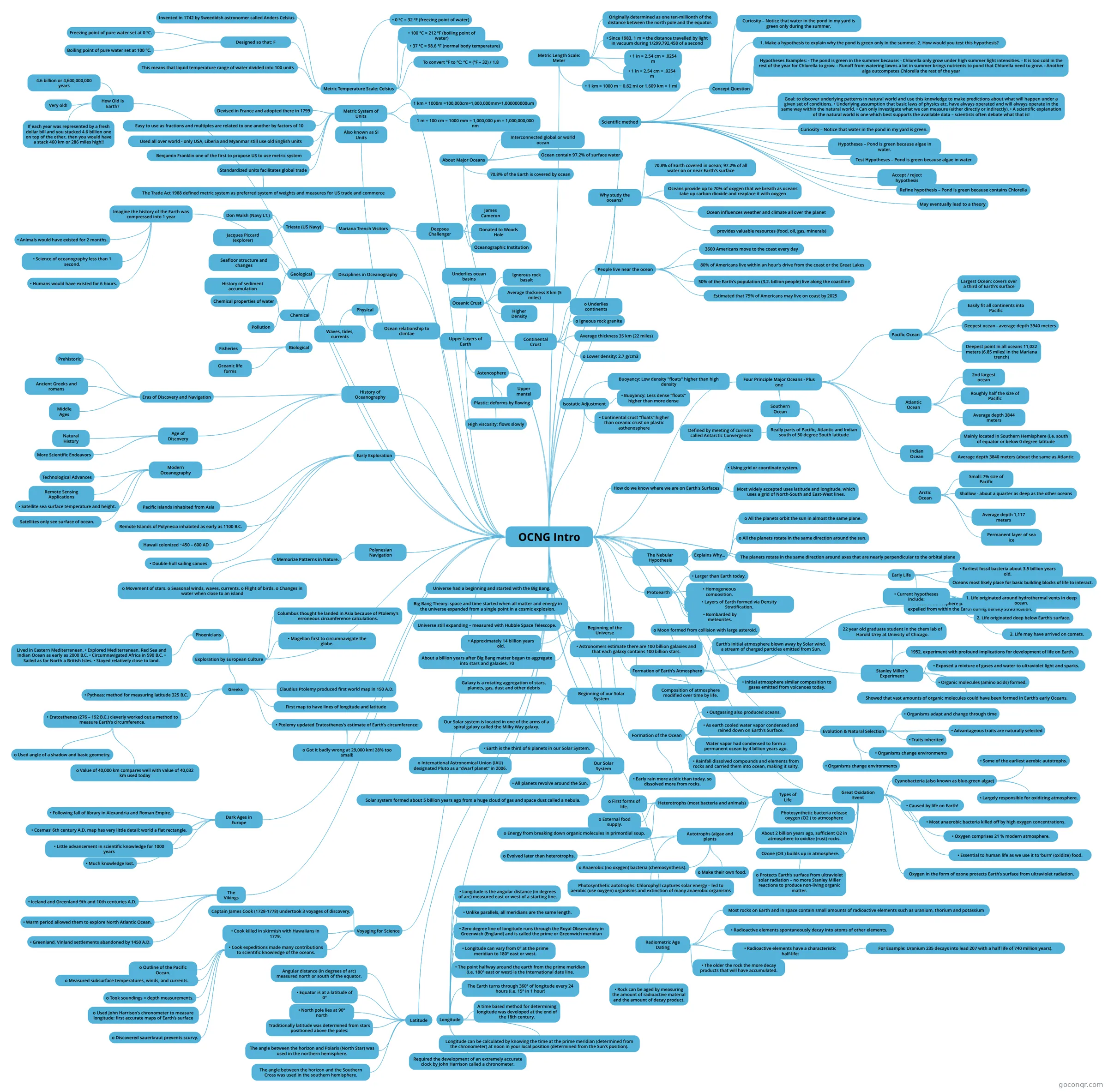
Mind map: Oceanography intro
Map content
OCNG Intro
Disciplines in Oceanography
- Chemical
- Chemical properties of water
- Pollution
- Biological
- Oceanic life forms
- Fisheries
- Physical
- Waves, tides, currents
- Ocean relationship to climtae
- Geological
- Seafloor structure and changes
- History of sediment accumulation
- Chemical
Why study the oceans?
- 70.8% of Earth covered in ocean; 97.2% of all water on or near Earth's surface
- Oceans provide up to 70% of oxygen that we breath as oceans take up carbon dioxide and reaplace it with oxygen
- Ocean influences weather and climate all over the planet
- provides valuable resources (food, oil, gas, minerals)
People live near the ocean
- 50% of the Earth's population (3.2. billion people) live along the coastline
- 80% of Americans live within an hour's drive from the coast or the Great Lakes
- 3600 Americans move to the coast every day
- Estimated that 75% of Americans may live on coast by 2025
Four Principle Major Oceans - Plus one
- Pacific Ocean
- Largest Ocean: covers over a third of Earth's surface
- Easily fit all continents into Pacific
- Deepest ocean - average depth 3940 meters
- Deepest point in all oceans 11,022 meters (6.85 miles! in the Mariana trench)
- Atlantic Ocean
- 2nd largest ocean
- Roughly half the size of Pacific
- Average depth 3844 meters
- Indian Ocean
- Mainly located in Southern Hemisphere (i.e. south of equator or below 0 degree latitude
- Average depth 3840 meters (about the same as Atlantic
- Arctic Ocean
- Small: 7% size of Pacific
- Average depth 1,117 meters
- Permanent layer of sea ice
- Shallow - about a quarter as deep as the other oceans
- Southern Ocean
- Defined by meeting of currents called Antarctic Convergence
- Really parts of Pacific, Atlantic and Indian south of 50 degree South latitude
- Pacific Ocean
About Major Oceans
- 70.8% of the Earth is covered by ocean
- Interconnected global or world ocean
- Ocean contain 97.2% of surface water
Mariana Trench Visitors
- Trieste (US Navy)
- Don Walsh (Navy LT.)
- Jacques Piccard (explorer)
- Deepsea Challenger
- James Cameron
- Donated to Woods Hole
- Oceanographic Institution
- Trieste (US Navy)
Metric System of Units
- Also known as SI Units
- Devised in France and adopted there in 1799
- Easy to use as fractions and multiples are related to one another by factors of 10
- Used all over world - only USA, Liberia and Myanmar still use old English units
- Benjamin Franklin one of the first to propose US to use metric system
- Standardized units facilitates global trade
- The Trade Act 1988 defined metric system as preferred system of weights and measures for US trade and commerce
- 1 km = 1000m =100,000cm=1,000,000mm=1,000000000um
- 1 m = 100 cm = 1000 mm = 1,000,000 µm = 1,000,000,000 nm
Metric Temperature Scale: Celsius
- Invented in 1742 by Sweedidsh astronomer called Anders Celsius
- Designed so that: F
- Freezing point of pure water set at 0 ºC.
- Boiling point of pure water set at 100 ºC.
- This means that liquid temperature range of water divided into 100 units
- • 0 ºC = 32 ºF (freezing point of water)
- • 100 ºC = 212 ºF (boiling point of water)
- • 37 ºC = 98.6 ºF (normal body temperature)
- To convert ºF to ºC: ºC = (ºF – 32) / 1.8
Metric Length Scale: Meter
- Originally determined as one ten-millionth of the distance between the north pole and the equator.
- • Since 1983, 1 m = the distance travelled by light in vacuum during 1/299,792,458 of a second
- • 1 in = 2.54 cm = .0254 m
- • 1 in = 2.54 cm = .0254 m
- • 1 km = 1000 m ~ 0.62 mi or 1.609 km = 1 mi
Scientific method
- Goal: to discover underlying patterns in natural world and use this knowledge to make predictions about what will happen under a given set of conditions. • Underlying assumption that basic laws of physics etc. have always operated and will always operate in the same way within the natural world. • Can only investigate what we can measure (either directly or indirectly). • A scientific explanation of the natural world is one which best supports the available data – scientists often debate what that is!
- Curiosity – Notice that water in the pond in my yard is green.
- Hypotheses – Pond is green because algae in water.
- Test Hypotheses – Pond is green because algae in water
- Accept / reject hypothesis
- May eventually lead to a theory
- Refine hypothesis – Pond is green because contains Chlorella
- Concept Question
- Curiosity – Notice that water in the pond in my yard is green only during the summer.
- 1. Make a hypothesis to explain why the pond is green only in the summer. 2. How would you test this hypothesis?
- Hypotheses Examples: - The pond is green in the summer because: - Chlorella only grow under high summer light intensities. - It is too cold in the rest of the year for Chlorella to grow. - Runoff from watering lawns a lot in summer brings nutrients to pond that Chlorella need to grow. - Another alga outcompetes Chlorella the rest of the year
History of Oceanography
- Eras of Discovery and Navigation
- Prehistoric
- Ancient Greeks and romans
- Middle Ages
- Age of Discovery
- Natural History
- More Scientific Endeavors
- Modern Oceanography
- Technological Advances
- Remote Sensing Applications
- • Satellite sea surface temperature and height.
- Satellites only see surface of ocean.
- Eras of Discovery and Navigation
Early Exploration
- Pacific Islands inhabited from Asia
- Remote Islands of Polynesia inhabited as early as 1100 B.C.
- Hawaii colonized ~450 – 600 AD
- • Double-hull sailing canoes
Polynesian Navigation
- • Memorize Patterns in Nature.
- o Movement of stars. o Seasonal winds, waves, currents. o Flight of birds. o Changes in water when close to an island
- • Memorize Patterns in Nature.
Exploration by European Culture
- Phoenicians
- Lived in Eastern Mediterranean. • Explored Mediterranean, Red Sea and Indian Ocean as early as 2000 B.C. • Circumnavigated Africa in 590 B.C. • Sailed as far North a British Isles. • Stayed relatively close to land.
- Greeks
- • Pytheas: method for measuring latitude 325 B.C.
- • Eratosthenes (276 – 192 B.C.) cleverly worked out a method to measure Earth’s circumference.
- o Used angle of a shadow and basic geometry.
- o Value of 40,000 km compares well with value of 40,032 km used today
- Claudius Ptolemy produced first world map in 150 A.D.
- First map to have lines of longitude and latitude
- • Ptolemy updated Eratosthenes's estimate of Earth’s circumference:
- o Got it badly wrong at 29,000 km! 28% too small!
- Columbus thought he landed in Asia because of Ptolemy’s erroneous circumference calculations.
- • Magellan first to circumnavigate the globe.
- Phoenicians
Dark Ages in Europe
- • Following fall of library in Alexandria and Roman Empire.
- • Cosmas’ 6th century A.D. map has very little detail: world a flat rectangle.
- • Little advancement in scientific knowledge for 1000 years
- • Much knowledge lost.
The Vikings
- • Iceland and Greenland 9th and 10th centuries A.D.
- • Warm period allowed them to explore North Atlantic Ocean.
- • Greenland, Vinland settlements abandoned by 1450 A.D.
Voyaging for Science
- Captain James Cook (1728-1778) undertook 3 voyages of discovery.
- • Cook killed in skirmish with Hawaiians in 1779.
- • Cook expeditions made many contributions to scientific knowledge of the oceans.
- o Outline of the Pacific Ocean.
- o Measured subsurface temperatures, winds, and currents.
- o Took soundings = depth measurements.
- o Used John Harrison’s chronometer to measure longitude: first accurate maps of Earth’s surface
- o Discovered sauerkraut prevents scurvy.
How do we know where we are on Earth's Surfaces
- • Using grid or coordinate system.
- Most widely accepted uses latitude and longitude, which uses a grid of North-South and East-West lines.
Latitude
- Angular distance (in degrees of arc) measured north or south of the equator.
- • Equator is at a latitude of 0º
- • North pole lies at 90º north
- Traditionally latitude was determined from stars positioned above the poles:
- The angle between the horizon and Polaris (North Star) was used in the northern hemisphere.
- The angle between the horizon and the Southern Cross was used in the southern hemisphere.
Longitude
- • Longitude is the angular distance (in degrees of arc) measured east or west of a starting line.
- • Unlike parallels, all meridians are the same length.
- • Zero degree line of longitude runs through the Royal Observatory in Greenwich (England) and is called the prime or Greenwich meridian
- • Longitude can vary from 0º at the prime meridian to 180º east or west.
- • The point halfway around the earth from the prime meridian (i.e. 180º east or west) is the International date line.
- The Earth turns through 360º of longitude every 24 hours (i.e. 15º in 1 hour)
- Required the development of an extremely accurate clock by John Harrison called a chronometer.
- A time based method for determining longitude was developed at the end of the 18th century.
- Longitude can be calculated by knowing the time at the prime meridian (determined from the chronometer) at noon in your local position (determined from the Sun’s position).
Beginning of the Universe
- Universe had a beginning and started with the Big Bang.
- Big Bang Theory: space and time started when all matter and energy in the universe expanded from a single point in a cosmic explosion.
- Universe still expanding – measured with Hubble Space Telescope.
- • Approximately 14 billion years old.
- About a billion years after Big Bang matter began to aggregate into stars and galaxies. 70
Beginning of our Solar System
- Galaxy is a rotating aggregation of stars, planets, gas, dust and other debris
- • Astronomers estimate there are 100 billion galaxies and that each galaxy contains 100 billion stars.
- Our Solar system is located in one of the arms of a spiral galaxy called the Milky Way galaxy.
Our Solar System
- • Earth is the third of 8 planets in our Solar System.
- o International Astronomical Union (IAU) designated Pluto as a “dwarf planet” in 2006.
- • All planets revolve around the Sun.
- Solar system formed about 5 billion years ago from a huge cloud of gas and space dust called a nebula.
- • Earth is the third of 8 planets in our Solar System.
The Nebular Hypothesis
- Explains Why...
- o All the planets orbit the sun in almost the same plane.
- o All the planets rotate in the same direction around the sun.
- The planets rotate in the same direction around axes that are nearly perpendicular to the orbital plane
- Explains Why...
Protoearth
- • Larger than Earth today.
- • Homogeneous composition.
- • Layers of Earth formed via Density Stratification.
- • Bombarded by meteorites.
- o Moon formed from collision with large asteroid.
Formation of Earth's Atmosphere
- Earth’s initial atmosphere blown away by Solar wind, a stream of charged particles emitted from Sun.
- A second atmosphere produced by outgassing of gases expelled from within the Earth during density stratification.
- • Initial atmosphere similar composition to gases emitted from volcanoes today.
- Composition of atmosphere modified over time by life.
Formation of the Ocean
- • Outgassing also produced oceans.
- • As earth cooled water vapor condensed and rained down on Earth’s Surface.
- Water vapor had condensed to form a permanent ocean by 4 billion years ago.
- • Rainfall dissolved compounds and elements from rocks and carried them into ocean, making it salty.
- • Early rain more acidic than today, so dissolved more from rocks.
Early Life
- • Earliest fossil bacteria about 3.5 billion years old.
- Oceans most likely place for basic building blocks of life to interact.
- • Current hypotheses include:
- 2. Life originated deep below Earth’s surface.
- 3. Life may have arrived on comets.
- 1. Life originated around hydrothermal vents in deep ocean.
Stanley Miller's Experiment
- 22 year old graduate student in the chem lab of Harold Urey at Univsity of Chicago.
- 1952, experiment with profound implications for development of life on Earth.
- • Organic molecules (amino acids) formed.
- Showed that vast amounts of organic molecules could have been formed in Earth’s early Oceans.
- • Exposed a mixture of gases and water to ultraviolet light and sparks.
Evolution & Natural Selection
- • Organisms adapt and change through time
- • Advantageous traits are naturally selected
- • Traits inherited
- • Organisms change environments
- • Organisms change environments
Types of Life
- Heterotrophs (most bacteria and animals)
- o First forms of life.
- o External food supply.
- o Energy from breaking down organic molecules in primordial soup.
- Autotrophs (algae and plants
- o Make their own food.
- o Evolved later than heterotrophs.
- o Anaerobic (no oxygen) bacteria (chemosynthesis).
- Photosynthetic autotrophs: Chlorophyll captures solar energy – led to aerobic (use oxygen) organisms and extinction of many anaerobic organisms
- Heterotrophs (most bacteria and animals)
Great Oxidation Event
- Photosynthetic bacteria release oxygen (O2 ) to atmosphere
- About 2 billion years ago, sufficient O2 in atmosphere to oxidize (rust) rocks.
- Ozone (O3 ) builds up in atmosphere.
- o Protects Earth’s surface from ultraviolet solar radiation – no more Stanley Miller reactions to produce non-living organic matter.
- Cyanobacteria (also known as blue-green algae)
- • Some of the earliest aerobic autotrophs.
- • Largely responsible for oxidizing atmosphere.
- • Caused by life on Earth!
- • Most anaerobic bacteria killed off by high oxygen concentrations.
- • Oxygen comprises 21 % modern atmosphere.
- • Essential to human life as we use it to ‘burn’ (oxidize) food.
- Oxygen in the form of ozone protects Earth’s surface from ultraviolet radiation.
Radiometric Age Dating
- Most rocks on Earth and in space contain small amounts of radioactive elements such as uranium, thorium and potassium
- • Radioactive elements spontaneously decay into atoms of other elements.
- • Radioactive elements have a characteristic half-life:
- For Example: Uranium 235 decays into lead 207 with a half life of 740 million years).
- • The older the rock the more decay products that will have accumulated.
- • Rock can be aged by measuring the amount of radioactive material and the amount of decay product.
How Old Is Earth?
- 4.6 billion or 4,600,000,000 years
- Very old!
- If each year was represented by a fresh dollar bill and you stacked 4.6 billion one on top of the other, then you would have a stack 460 km or 286 miles high!!
Imagine the history of the Earth was compressed into 1 year
- • Animals would have existed for 2 months.
- • Humans would have existed for 6 hours.
- • Science of oceanography less than 1 second.
Upper Layers of Earth
- Oceanic Crust
- Underlies ocean basins
- Ignerous rock basalt
- Average thickness 8 km (5 miles)
- Higher Density
- Continental Crust
- o Underlies continents
- o Igneous rock granite
- Average thickness 35 km (22 miles)
- o Lower density: 2.7 g/cm3
- Astenosphere
- Upper mantel
- Plastic: deforms by flowing
- High viscosity: flows slowly
- Oceanic Crust
Isostatic Adjustment
- Buoyancy: Low density "floats" higher than high density
- • Buoyancy: Less dense “floats” higher than more dense
- • Continental crust “floats” higher than oceanic crust on plastic asthenosphere
Information
- Description
- Mind Map on OCNG Intro, created by Sophany on 16/04/2015.
- Created by
- Sophany
- Views
- 1
- Rating