
Mind map
Psychology: Experiments
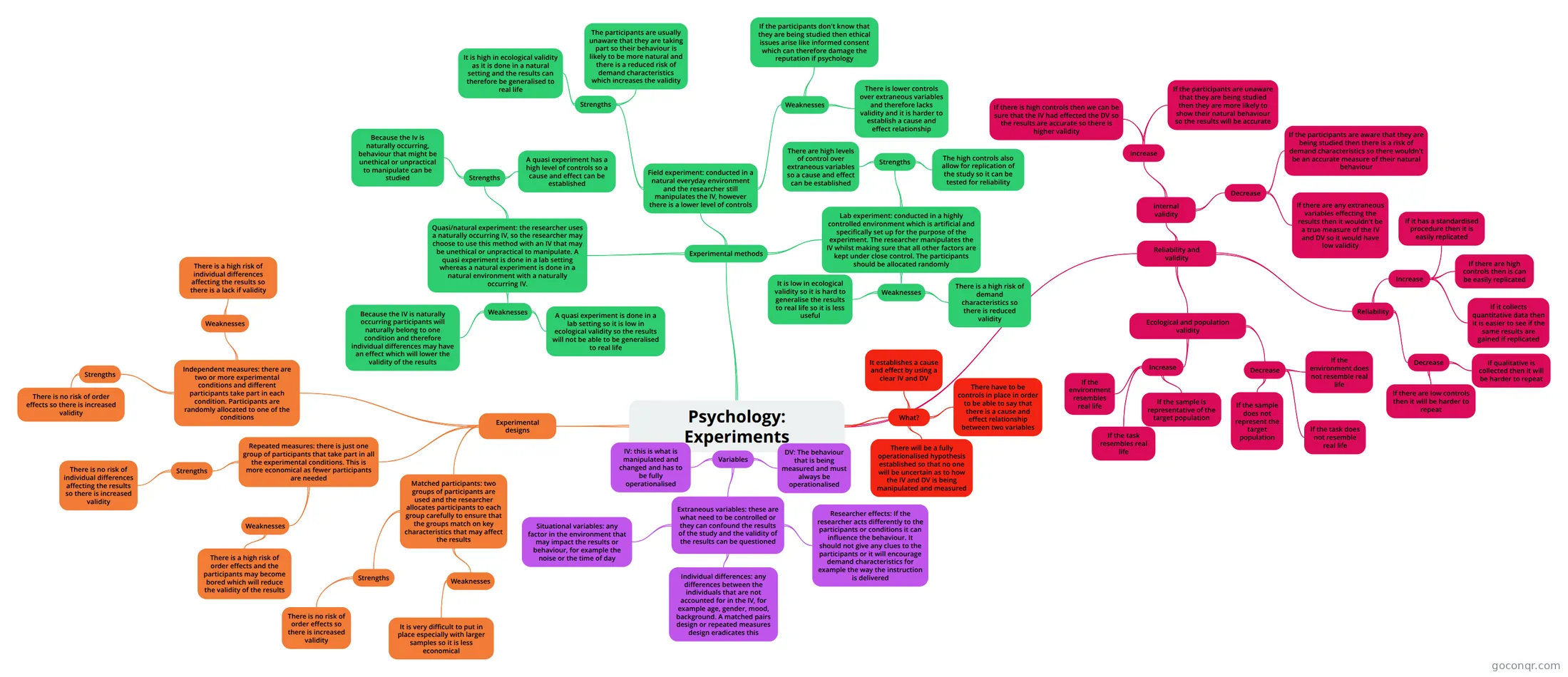
Mind map: Psychology experiments
Map content
Psychology: Experiments
What?
- It establishes a cause and effect by using a clear IV and DV
- There have to be controls in place in order to be able to say that there is a cause and effect relationship between two variables
- There will be a fully operationalised hypothesis established so that no one will be uncertain as to how the IV and DV is being manipulated and measured
Variables
- IV: this is what is manipulated and changed and has to be fully operationalised
- DV: The behaviour that is being measured and must always be operationalised
- Extraneous variables: these are what need to be controlled or they can confound the results of the study and the validity of the results can be questioned
- Situational variables: any factor in the environment that may impact the results or behaviour, for example the noise or the time of day
- Individual differences: any differences between the individuals that are not accounted for in the IV, for example age, gender, mood, background. A matched pairs design or repeated measures design eradicates this
- Researcher effects: If the researcher acts differently to the participants or conditions it can influence the behaviour. It should not give any clues to the participants or it will encourage demand characteristics for example the way the instruction is delivered
Experimental methods
- Lab experiment: conducted in a highly controlled environment which is artificial and specifically set up for the purpose of the experiment. The researcher manipulates the IV whilst making sure that all other factors are kept under close control. The participants should be allocated randomly
- Strengths
- There are high levels of control over extraneous variables so a cause and effect can be established
- The high controls also allow for replication of the study so it can be tested for reliability
- Weaknesses
- It is low in ecological validity so it is hard to generalise the results to real life so it is less useful
- There is a high risk of demand characteristics so there is reduced validity
- Strengths
- Field experiment: conducted in a natural everyday environment and the researcher still manipulates the IV, however there is a lower level of controls
- Strengths
- It is high in ecological validity as it is done in a natural setting and the results can therefore be generalised to real life
- The participants are usually unaware that they are taking part so their behaviour is likely to be more natural and there is a reduced risk of demand characteristics which increases the validity
- Weaknesses
- If the participants don't know that they are being studied then ethical issues arise like informed consent which can therefore damage the reputation if psychology
- There is lower controls over extraneous variables and therefore lacks validity and it is harder to establish a cause and effect relationship
- Strengths
- Quasi/natural experiment: the researcher uses a naturally occurring IV, so the researcher may choose to use this method with an IV that may be unethical or unpractical to manipulate. A quasi experiment is done in a lab setting whereas a natural experiment is done in a natural environment with a naturally occurring IV.
- Strengths
- Because the Iv is naturally occurring, behaviour that might be unethical or unpractical to manipulate can be studied
- A quasi experiment has a high level of controls so a cause and effect can be established
- Weaknesses
- Because the IV is naturally occurring participants will naturally belong to one condition and therefore individual differences may have an effect which will lower the validity of the results
- A quasi experiment is done in a lab setting so it is low in ecological validity so the results will not be able to be generalised to real life
- Strengths
- Lab experiment: conducted in a highly controlled environment which is artificial and specifically set up for the purpose of the experiment. The researcher manipulates the IV whilst making sure that all other factors are kept under close control. The participants should be allocated randomly
Experimental designs
- Independent measures: there are two or more experimental conditions and different participants take part in each condition. Participants are randomly allocated to one of the conditions
- Strengths
- There is no risk of order effects so there is increased validity
- Weaknesses
- There is a high risk of individual differences affecting the results so there is a lack if validity
- Strengths
- Repeated measures: there is just one group of participants that take part in all the experimental conditions. This is more economical as fewer participants are needed
- Strengths
- There is no risk of individual differences affecting the results so there is increased validity
- Weaknesses
- There is a high risk of order effects and the participants may become bored which will reduce the validity of the results
- Strengths
- Matched participants: two groups of participants are used and the researcher allocates participants to each group carefully to ensure that the groups match on key characteristics that may affect the results
- Strengths
- There is no risk of order effects so there is increased validity
- Weaknesses
- It is very difficult to put in place especially with larger samples so it is less economical
- Strengths
- Independent measures: there are two or more experimental conditions and different participants take part in each condition. Participants are randomly allocated to one of the conditions
Reliability and validity
- internal validity
- increase
- If there is high controls then we can be sure that the IV had effected the DV so the results are accurate so there is higher validity
- If the participants are unaware that they are being studied then they are more likely to show their natural behaviour so the results will be accurate
- Decrease
- If there are any extraneous variables effecting the results then it wouldn't be a true measure of the IV and DV so it would have low validity
- If the participants are aware that they are being studied then there is a risk of demand characteristics so there wouldn't be an accurate measure of their natural behaviour
- increase
- Ecological and population validity
- Increase
- If the environment resembles real life
- If the task resembles real life
- If the sample is representative of the target population
- Decrease
- If the environment does not resemble real life
- If the task does not resemble real life
- If the sample does not represent the target population
- Increase
- Reliability
- Increase
- If it has a standardised procedure then it is easily replicated
- If there are high controls then is can be easily replicated
- If it collects quantitative data then it is easier to see if the same results are gained if replicated
- Decrease
- If there are low controls then it will be harder to repeat
- If qualitative is collected then it will be harder to repeat
- Increase
- internal validity
Information
- Description
- Mind Map on Psychology: Experiments, created by victoriahoughton on 16/04/2015.
- Created by
- victoriahoughton
- Views
- 1
- Rating