
Mind map
Subject-matter (artistic works)
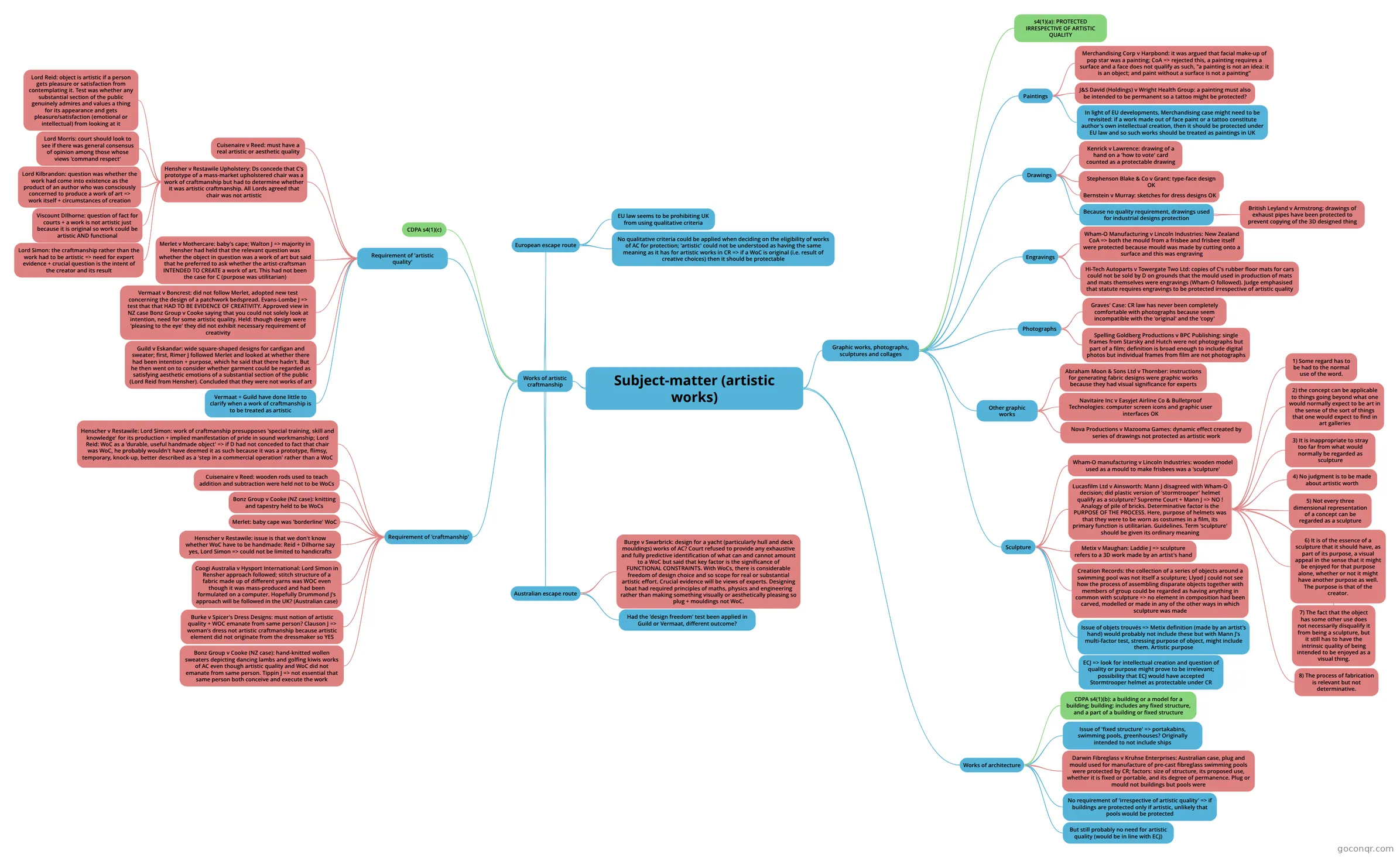
Mind map: Subject-matter artistic works
Map content
Subject-matter (artistic works)
Graphic works, photographs, sculptures and collages
- s4(1)(a): PROTECTED IRRESPECTIVE OF ARTISTIC QUALITY
- Paintings
- Merchandising Corp v Harpbond: it was argued that facial make-up of pop star was a painting; CoA => rejected this, a painting requires a surface and a face does not qualify as such, "a painting is not an idea: it is an object; and paint without a surface is not a painting"
- J&S David (Holdings) v Wright Health Group: a painting must also be intended to be permanent so a tattoo might be protected?
- In light of EU developments, Merchandising case might need to be revisited: if a work made out of face paint or a tattoo constitute author's own intellectual creation, then it should be protected under EU law and so such works should be treated as paintings in UK
- Drawings
- Kenrick v Lawrence: drawing of a hand on a 'how to vote' card counted as a protectable drawing
- Stephenson Blake & Co v Grant: type-face design OK
- Bernstein v Murray: sketches for dress designs OK
- Because no quality requirement, drawings used for industrial designs protection
- British Leyland v Armstrong: drawings of exhaust pipes have been protected to prevent copying of the 3D designed thing
- Engravings
- Wham-O Manufacturing v Lincoln Industries: New Zealand CoA => both the mould from a frisbee and frisbee itself were protected because mould was made by cutting onto a surface and this was engraving
- Hi-Tech Autoparts v Towergate Two Ltd: copies of C's rubber floor mats for cars could not be sold by D on grounds that the mould used in production of mats and mats themselves were engravings (Wham-O followed). Judge emphasised that statute requires engravings to be protected irrespective of artistic quality
- Photographs
- Graves' Case: CR law has never been completely comfortable with photographs because seem incompatible with the 'original' and the 'copy'
- Spelling Goldberg Productions v BPC Publishing: single frames from Starsky and Hutch were not photographs but part of a film; definition is broad enough to include digital photos but individual frames from film are not photographs
- Other graphic works
- Abraham Moon & Sons Ltd v Thornber: instructions for generating fabric designs were graphic works because they had visual significance for experts
- Navitaire Inc v Easyjet Airline Co & Bulletproof Technologies: computer screen icons and graphic user interfaces OK
- Nova Productions v Mazooma Games: dynamic effect created by series of drawings not protected as artistic work
- Sculpture
- Wham-O manufacturing v Lincoln Industries: wooden model used as a mould to make frisbees was a 'sculpture'
- Lucasfilm Ltd v Ainsworth: Mann J disagreed with Wham-O decision; did plastic version of 'stormtrooper' helmet qualify as a sculpture? Supreme Court + Mann J => NO ! Analogy of pile of bricks. Determinative factor is the PURPOSE OF THE PROCESS. Here, purpose of helmets was that they were to be worn as costumes in a film, its primary function is utilitarian. Guidelines. Term 'sculpture' should be given its ordinary meaning
- 1) Some regard has to be had to the normal use of the word.
- 2) the concept can be applicable to things going beyond what one would normally expect to be art in the sense of the sort of things that one would expect to find in art galleries
- 3) It is inappropriate to stray too far from what would normally be regarded as sculpture
- 4) No judgment is to be made about artistic worth
- 5) Not every three dimensional representation of a concept can be regarded as a sculpture
- 6) It is of the essence of a sculpture that it should have, as part of its purpose, a visual appeal in the sense that it might be enjoyed for that purpose alone, whether or not it might have another purpose as well. The purpose is that of the creator.
- 7) The fact that the object has some other use does not necessarily disqualify it from being a sculpture, but it still has to have the intrinsic quality of being intended to be enjoyed as a visual thing.
- 8) The process of fabrication is relevant but not determinative.
- Metix v Maughan: Laddie J => sculpture refers to a 3D work made by an artist's hand
- Creation Records: the collection of a series of objects around a swimming pool was not itself a sculpture; Llyod J could not see how the process of assembling disparate objects together with members of group could be regarded as having anything in common with sculpture => no element in composition had been carved, modelled or made in any of the other ways in which sculpture was made
- Issue of objets trouvés => Metix definition (made by an artist's hand) would probably not include these but with Mann J's multi-factor test, stressing purpose of object, might include them. Artistic purpose
- ECJ => look for intellectual creation and question of quality or purpose might prove to be irrelevant; possibility that ECJ would have accepted Stormtrooper helmet as protectable under CR
Works of architecture
- CDPA s4(1)(b): a building or a model for a building; building: includes any fixed structure, and a part of a building or fixed structure
- Issue of 'fixed structure' => portakabins, swimming pools, greenhouses? Originally intended to not include ships
- Darwin Fibreglass v Kruhse Enterprises: Australian case, plug and mould used for manufacture of pre-cast fibreglass swimming pools were protected by CR; factors: size of structure, its proposed use, whether it is fixed or portable, and its degree of permanence. Plug or mould not buildings but pools were
- No requirement of 'irrespective of artistic quality' => if buildings are protected only if artistic, unlikely that pools would be protected
- But still probably no need for artistic quality (would be in line with ECJ)
Works of artistic craftmanship
- CDPA s4(1)(c)
- Requirement of 'artistic quality'
- Cuisenaire v Reed: must have a real artistic or aesthetic quality
- Hensher v Restawile Upholstery: Ds concede that C's prototype of a mass-market upholstered chair was a work of craftmanship but had to determine whether it was artistic craftmanship. All Lords agreed that chair was not artistic
- Lord Reid: object is artistic if a person gets pleasure or satisfaction from contemplating it. Test was whether any substantial section of the public genuinely admires and values a thing for its appearance and gets pleasure/satisfaction (emotional or intellectual) from looking at it
- Lord Morris: court should look to see if there was general consensus of opinion among those whose views 'command respect'
- Lord Kilbrandon: question was whether the work had come into existence as the product of an author who was consciously concerned to produce a work of art => work itself + circumstances of creation
- Viscount DIlhorne: question of fact for courts + a work is not artistic just because it is original so work could be artistic AND functional
- Lord Simon: the craftmanship rather than the work had to be artistic => need for expert evidence + crucial question is the intent of the creator and its result
- Merlet v Mothercare: baby's cape; Walton J => majority in Hensher had held that the relevant question was whether the object in question was a work of art but said that he preferred to ask whether the artist-craftsman INTENDED TO CREATE a work of art. This had not been the case for C (purpose was utilitarian)
- Vermaat v Boncrest: did not follow Merlet, adopted new test concerning the design of a patchwork bedspread. Evans-Lombe J => test that that HAD TO BE EVIDENCE OF CREATIVITY. Approved view in NZ case Bonz Group v Cooke saying that you could not solely look at intention, need for some artistic quality. Held: though design were 'pleasing to the eye' they did not exhibit necessary requirement of creativity
- Guild v Eskandar: wide square-shaped designs for cardigan and sweater; first, Rimer J followed Merlet and looked at whether there had been intention + purpose, which he said that there hadn't. But he then went on to consider whether garment could be regarded as satisfying aesthetic emotions of a substantial section of the public (Lord Reid from Hensher). Concluded that they were not works of art
- Vermaat + Guild have done little to clarify when a work of craftmanship is to be treated as artistic
- Requirement of 'craftmanship'
- Henscher v Restawile: Lord Simon: work of craftmanship presupposes 'special training, skill and knowledge' for its production + implied manifestation of pride in sound workmanship; Lord Reid: WoC as a 'durable, useful handmade object' => if D had not conceded to fact that chair was WoC, he probably wouldn't have deemed it as such because it was a prototype, flimsy, temporary, knock-up, better described as a 'step in a commercial operation' rather than a WoC
- Cuisenaire v Reed: wooden rods used to teach addition and subtraction were held not to be WoCs
- Bonz Group v Cooke (NZ case): knitting and tapestry held to be WoCs
- Merlet: baby cape was 'borderline' WoC
- Henscher v Restawile: issue is that we don't know whether WoC have to be handmade: Reid + Dilhorne say yes, Lord Simon => could not be limited to handicrafts
- Coogi Australia v Hysport International: Lord Simon in Rensher approach followed; stitch structure of a fabric made up of different yarns was WOC even though it was mass-produced and had been formulated on a computer. Hopefully Drummond J's approach will be followed in the UK? (Australian case)
- Burke v Spicer's Dress Designs: must notion of artistic quality + WOC emanate from same person? Clauson J => woman's dress not artistic craftmanship because artistic element did not originate from the dressmaker so YES
- Bonz Group v Cooke (NZ case): hand-knitted wollen sweaters depicting dancing lambs and golfing kiwis works of AC even though artistic quality and WoC did not emanate from same person. Tippin J => not essential that same person both conceive and execute the work
- Australian escape route
- Burge v Swarbrick: design for a yacht (particularly hull and deck mouldings) works of AC? Court refused to provide any exhaustive and fully predictive identification of what can and cannot amount to a WoC but said that key factor is the significance of FUNCTIONAL CONSTRAINTS. With WoCs, there is considerable freedom of design choice and so scope for real or substantial artistic effort. Crucial evidence will be views of experts. Designing boat had required principles of maths, physics and engineering rather than making something visually or aesthetically pleasing so plug + mouldings not WoC.
- Had the 'design freedom' test been applied in Guild or Vermaat, different outcome?
- European escape route
- EU law seems to be prohibiting UK from using qualitative criteria
- No qualitative criteria could be applied when deciding on the eligibility of works of AC for protection; 'artistic' could not be understood as having the same meaning as it has for artistic works in CR => if a WoC is original (i.e. result of creative choices) then it should be protectable
Information
- Description
- Law second year Intellectual property law (Copyright - subject matter) Mind Map on Subject-matter (artistic works), created by Emilie Schou on 20/04/2015.
- Created by
- Emilie Schou
- Views
- 1
- Rating
More on Copyright eligibility, subject matter and duration