
Mind map
ROMANTICISM
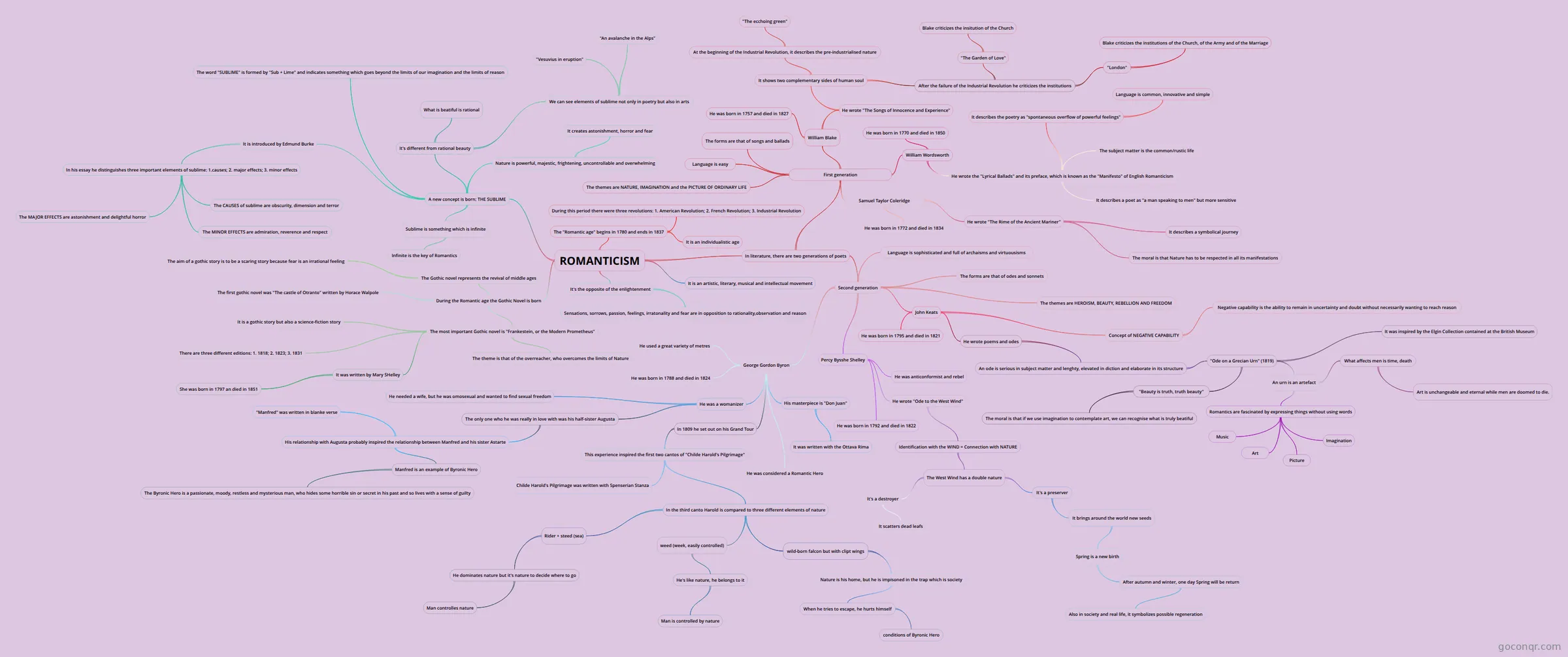
Mind map: Romanticism
Map content
ROMANTICISM
The "Romantic age" begins in 1780 and ends in 1837
- During this period there were three revolutions: 1. American Revolution; 2. French Revolution; 3. Industrial Revolution
- It is an individualistic age
It is an artistic, literary, musical and intellectual movement
It's the opposite of the enlightenment
- Sensations, sorrows, passion, feelings, irratonality and fear are in opposition to rationality,observation and reason
A new concept is born: THE SUBLIME
- Nature is powerful, majestic, frightening, uncontrollable and overwhelming
- It creates astonishment, horror and fear
- It's different from rational beauty
- What is beatiful is rational
- We can see elements of sublime not only in poetry but also in arts
- "An avalanche in the Alps"
- "Vesuvius in eruption"
- It is introduced by Edmund Burke
- In his essay he distinguishes three important elements of sublime: 1.causes; 2. major effects; 3. minor effects
- The CAUSES of sublime are obscurity, dimension and terror
- The MAJOR EFFECTS are astonishment and delightful horror
- The MINOR EFFECTS are admiration, reverence and respect
- In his essay he distinguishes three important elements of sublime: 1.causes; 2. major effects; 3. minor effects
- Sublime is something which is infinite
- Infinite is the key of Romantics
- The word "SUBLIME" is formed by "Sub + Lime" and indicates something which goes beyond the limits of our imagination and the limits of reason
- Nature is powerful, majestic, frightening, uncontrollable and overwhelming
In literature, there are two generations of poets
- First generation
- William Blake
- He wrote "The Songs of Innocence and Experience"
- It shows two complementary sides of human soul
- At the beginning of the Industrial Revolution, it describes the pre-industrialised nature
- "The ecchoing green"
- After the failure of the Industrial Revolution he criticizes the institutions
- "The Garden of Love"
- Blake criticizes the insitution of the Church
- "London"
- Blake criticizes the institutions of the Church, of the Army and of the Marriage
- "The Garden of Love"
- At the beginning of the Industrial Revolution, it describes the pre-industrialised nature
- It shows two complementary sides of human soul
- He was born in 1757 and died in 1827
- He wrote "The Songs of Innocence and Experience"
- William Wordsworth
- He wrote the "Lyrical Ballads" and its preface, which is known as the "Manifesto" of English Romanticism
- It describes the poetry as "spontaneous overflow of powerful feelings"
- Language is common, innovative and simple
- It describes a poet as "a man speaking to men" but more sensitive
- The subject matter is the common/rustic life
- It describes the poetry as "spontaneous overflow of powerful feelings"
- He was born in 1770 and died in 1850
- He wrote the "Lyrical Ballads" and its preface, which is known as the "Manifesto" of English Romanticism
- Samuel Taylor Coleridge
- He wrote "The Rime of the Ancient Mariner"
- It describes a symbolical journey
- The moral is that Nature has to be respected in all its manifestations
- He was born in 1772 and died in 1834
- He wrote "The Rime of the Ancient Mariner"
- The themes are NATURE, IMAGINATION and the PICTURE OF ORDINARY LIFE
- Language is easy
- The forms are that of songs and ballads
- William Blake
- Second generation
- The themes are HEROISM, BEAUTY, REBELLION AND FREEDOM
- Language is sophisticated and full of archaisms and virtuousisms
- The forms are that of odes and sonnets
- John Keats
- He was born in 1795 and died in 1821
- He wrote poems and odes
- An ode is serious in subject matter and lenghty, elevated in diction and elaborate in its structure
- "Ode on a Grecian Urn" (1819)
- It was inspired by the Elgin Collection contained at the British Museum
- An urn is an artefact
- Romantics are fascinated by expressing things without using words
- Music
- Picture
- Art
- Imagination
- What affects men is time, death
- Art is unchangeable and eternal while men are doomed to die.
- Romantics are fascinated by expressing things without using words
- "Beauty is truth, truth beauty"
- The moral is that if we use imagination to contemplate art, we can recognise what is truly beatiful
- "Ode on a Grecian Urn" (1819)
- An ode is serious in subject matter and lenghty, elevated in diction and elaborate in its structure
- Concept of NEGATIVE CAPABILITY
- Negative capability is the ability to remain in uncertainty and doubt without necessarily wanting to reach reason
- George Gordon Byron
- He was born in 1788 and died in 1824
- He was a womanizer
- He needed a wife, but he was omosexual and wanted to find sexual freedom
- The only one who he was really in love with was his half-sister Augusta
- His relationship with Augusta probably inspired the relationship between Manfred and his sister Astarte
- Manfred is an example of Byronic Hero
- The Byronic Hero is a passionate, moody, restless and mysterious man, who hides some horrible sin or secret in his past and so lives with a sense of guilty
- "Manfred" was written in blanke verse
- Manfred is an example of Byronic Hero
- His relationship with Augusta probably inspired the relationship between Manfred and his sister Astarte
- In 1809 he set out on his Grand Tour
- This experience inspired the first two cantos of "Childe Harold's Pilgrimage"
- Childe Harold's Pilgrimage was written with Spenserian Stanza
- In the third canto Harold is compared to three different elements of nature
- Rider + steed (sea)
- He dominates nature but it's nature to decide where to go
- Man controlles nature
- He dominates nature but it's nature to decide where to go
- weed (week, easily controlled)
- He's like nature, he belongs to it
- Man is controlled by nature
- He's like nature, he belongs to it
- wild-born falcon but with clipt wings
- Nature is his home, but he is impisoned in the trap which is society
- When he tries to escape, he hurts himself
- conditions of Byronic Hero
- When he tries to escape, he hurts himself
- Nature is his home, but he is impisoned in the trap which is society
- Rider + steed (sea)
- This experience inspired the first two cantos of "Childe Harold's Pilgrimage"
- He was considered a Romantic Hero
- He used a great variety of metres
- His masterpiece is "Don Juan"
- It was written with the Ottava Rima
- Percy Bysshe Shelley
- He was born in 1792 and died in 1822
- He was anticonformist and rebel
- He wrote "Ode to the West Wind"
- Identification with the WIND = Connection with NATURE
- The West Wind has a double nature
- It's a destroyer
- It scatters dead leafs
- It's a preserver
- It brings around the world new seeds
- Spring is a new birth
- After autumn and winter, one day Spring will be return
- Also in society and real life, it symbolizes possible regeneration
- After autumn and winter, one day Spring will be return
- Spring is a new birth
- It brings around the world new seeds
- It's a destroyer
- The West Wind has a double nature
- Identification with the WIND = Connection with NATURE
- First generation
During the Romantic age the Gothic Novel is born
- The most important Gothic novel is "Frankestein, or the Modern Prometheus"
- It was written by Mary SHelley
- She was born in 1797 an died in 1851
- The theme is that of the overreacher, who overcomes the limits of Nature
- There are three different editions: 1. 1818; 2. 1823; 3. 1831
- It is a gothic story but also a science-fiction story
- It was written by Mary SHelley
- The Gothic novel represents the revival of middle ages
- The aim of a gothic story is to be a scaring story because fear is an irrational feeling
- The first gothic novel was "The castle of Otranto" written by Horace Walpole
- The most important Gothic novel is "Frankestein, or the Modern Prometheus"
Information
- Description
- Languages Mind Map on ROMANTICISM, created by Elisa Corcione on 18/09/2020.
- Created by
- Elisa Corcione
- Views
- 1
- History
-
- Created by Elisa Corcione · Sep 6, 2020
- Copied by Elisa Corcione · Sep 9, 2020
- Copied by Elisa Corcione · Sep 18, 2020
- Rating