
Mind map
Prevention, policing and punishment.
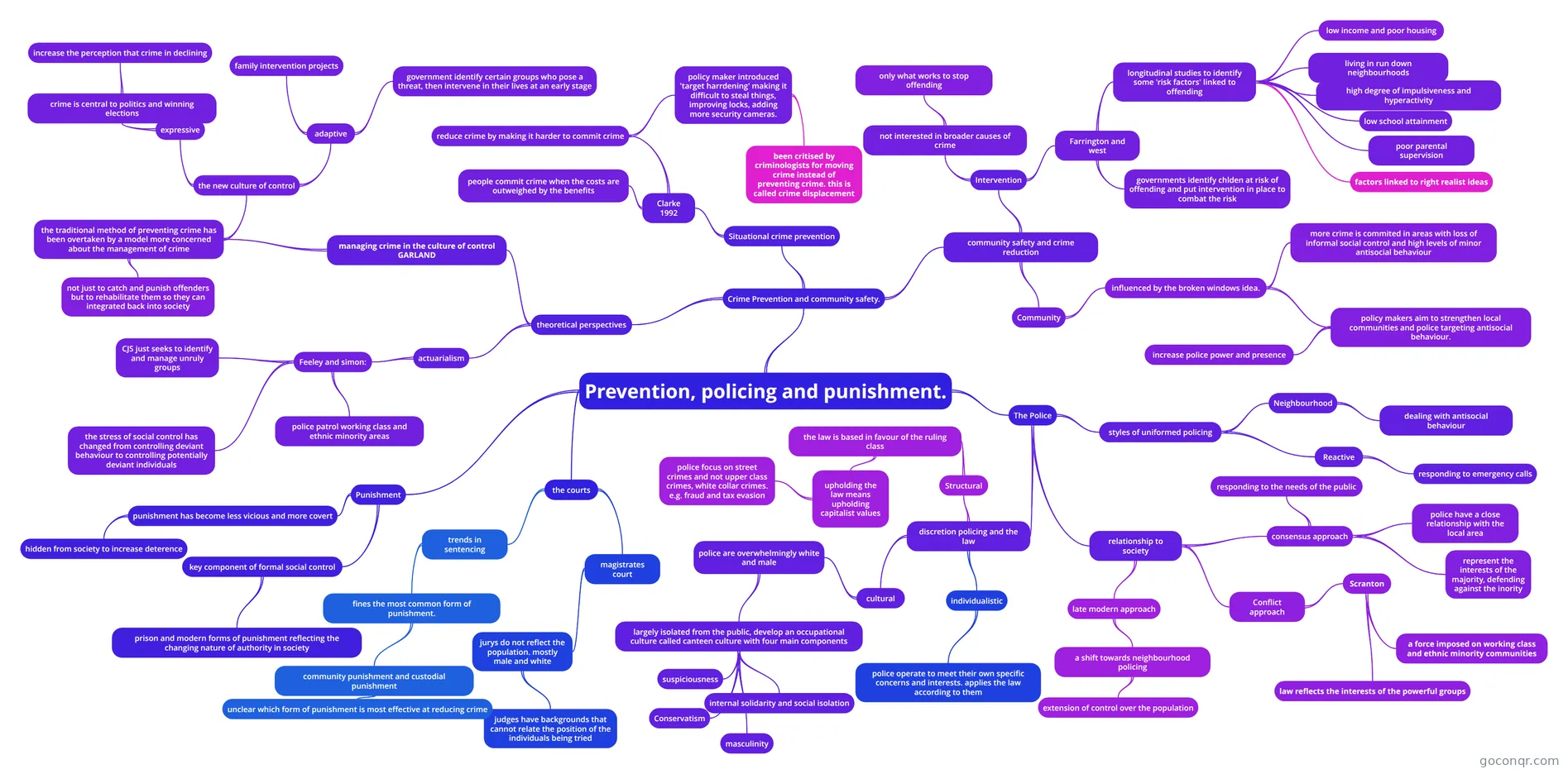
Mind map: Prevention, policing and punishment
Map content
Prevention, policing and punishment.
Crime Prevention and community safety.
- Situational crime prevention
- Clarke 1992
- people commit crime when the costs are outweighed by the benefits
- reduce crime by making it harder to commit crime
- policy maker introduced 'target harrdening' making it difficult to steal things, improving locks, adding more security cameras.
- been critised by criminologists for moving crime instead of preventing crime. this is called crime displacement
- policy maker introduced 'target harrdening' making it difficult to steal things, improving locks, adding more security cameras.
- Clarke 1992
- community safety and crime reduction
- Intervention
- not interested in broader causes of crime
- only what works to stop offending
- Farrington and west
- longitudinal studies to identify some 'risk factors' linked to offending
- low income and poor housing
- living in run down neighbourhoods
- high degree of impulsiveness and hyperactivity
- low school attainment
- poor parental supervision
- factors linked to right realist ideas
- governments identify chlden at risk of offending and put intervention in place to combat the risk
- longitudinal studies to identify some 'risk factors' linked to offending
- not interested in broader causes of crime
- Community
- influenced by the broken windows idea.
- more crime is commited in areas with loss of informal social control and high levels of minor antisocial behaviour
- policy makers aim to strengthen local communities and police targeting antisocial behaviour.
- increase police power and presence
- influenced by the broken windows idea.
- Intervention
- theoretical perspectives
- managing crime in the culture of control GARLAND
- the traditional method of preventing crime has been overtaken by a model more concerned about the management of crime
- not just to catch and punish offenders but to rehabilitate them so they can integrated back into society
- the new culture of control
- adaptive
- government identify certain groups who pose a threat, then intervene in their lives at an early stage
- family intervention projects
- expressive
- crime is central to politics and winning elections
- increase the perception that crime in declining
- crime is central to politics and winning elections
- adaptive
- the traditional method of preventing crime has been overtaken by a model more concerned about the management of crime
- actuarialism
- Feeley and simon:
- CJS just seeks to identify and manage unruly groups
- the stress of social control has changed from controlling deviant behaviour to controlling potentially deviant individuals
- police patrol working class and ethnic minority areas
- Feeley and simon:
- managing crime in the culture of control GARLAND
- Situational crime prevention
The Police
- styles of uniformed policing
- Neighbourhood
- dealing with antisocial behaviour
- Reactive
- responding to emergency calls
- Neighbourhood
- relationship to society
- consensus approach
- police have a close relationship with the local area
- represent the interests of the majority, defending against the inority
- responding to the needs of the public
- Conflict approach
- Scranton
- a force imposed on working class and ethnic minority communities
- law reflects the interests of the powerful groups
- Scranton
- late modern approach
- a shift towards neighbourhood policing
- extension of control over the population
- a shift towards neighbourhood policing
- consensus approach
- discretion policing and the law
- individualistic
- police operate to meet their own specific concerns and interests. applies the law according to them
- cultural
- police are overwhelmingly white and male
- largely isolated from the public, develop an occupational culture called canteen culture with four main components
- suspiciousness
- internal solidarity and social isolation
- Conservatism
- masculinity
- largely isolated from the public, develop an occupational culture called canteen culture with four main components
- police are overwhelmingly white and male
- Structural
- the law is based in favour of the ruling class
- upholding the law means upholding capitalist values
- police focus on street crimes and not upper class crimes, white collar crimes. e.g. fraud and tax evasion
- upholding the law means upholding capitalist values
- the law is based in favour of the ruling class
- individualistic
- styles of uniformed policing
the courts
- magistrates court
- jurys do not reflect the population. mostly male and white
- judges have backgrounds that cannot relate the position of the individuals being tried
- jurys do not reflect the population. mostly male and white
- trends in sentencing
- fines the most common form of punishment.
- community punishment and custodial punishment
- unclear which form of punishment is most effective at reducing crime
- community punishment and custodial punishment
- fines the most common form of punishment.
- magistrates court
Punishment
- key component of formal social control
- prison and modern forms of punishment reflecting the changing nature of authority in society
- punishment has become less vicious and more covert
- hidden from society to increase deterence
- key component of formal social control
Information
- Description
- Mind Map on Prevention, policing and punishment., created by miarcooper on 11/05/2015.
- Created by
- miarcooper
- Views
- 1
- Rating