
Mind map
Urea cycle disorders
Map content
Urea cycle disorders
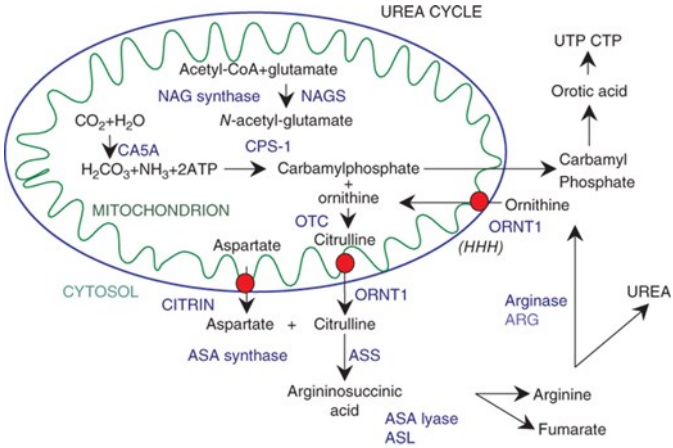
Urea cycle
- fully expressed only in the liver
- ammonia NH3 from the nitrogen group of all amino acids
- forms urea
- requires
- many enzymes
- any of them can be defective
- mitochondrial transporters
- any of them can be defective
- impair urea cycle function
- any of them can be defective
- many enzymes
- requires
- forms urea
- ammonia NH3 from the nitrogen group of all amino acids
- fully expressed only in the liver
Urea cycle disorders
- characterized by
- hyperammonemia
- encephalopathy
- respiratory alkalosis
- 4 of the 5 metabolic diseases
- result in the accumulation of urea precursors
- ammonia
- Ammonia intoxication
- most severe when reactions 1 or 2 are blocked
- Ammonia intoxication
- glutamine
- ammonia
- result in the accumulation of urea precursors
- clinical symptoms
- vomiting
- avoidance of high-protein foods
- intermittent ataxia
- irritability
- lethargy
- severe mental retardation
- CPS1 Carbamoyl Phosphate Synthetase I
- Initiates Urea Biosynthesis
- Condensates CO2 & NH3
- forms carbamoyl phosphate
- reaction requires
- allosteric activator, N-acetylglutamate (NAG)
- Mg2+
- ATP
- reaction requires
- forms carbamoyl phosphate
- gene location 2q25
- deficiency
- autosomal recessive disorder
- one of the most severe UCDs
- clinical symptoms
- hyperammonemia
- seen during the neonatal period
- might results in
- death
- neurological damage
- might results in
- seen during the neonatal period
- hyperammonemia
- Lab findings
- elevated plasma concentrations
- alanine
- glutamine
- normal urinary orotic acid
- elevated plasma concentrations
- clinical symptoms
- one of the most severe UCDs
- autosomal recessive disorder
- deficiency
- rate limiting enzyme
- NAGS N-acetylglutamate synthase
- conversion of glutamate & acetyl coA
- forms NAG
- allosteric activator of CPS1
- forms NAG
- gene location 17q21.3
- mutations
- autosomal recessive disorder
- NAG deficiency
- CPS1 functional deficiency
- NAG deficiency
- autosomal recessive disorder
- mutations
- conversion of glutamate & acetyl coA
- OCT Ornithine transcarbamylase
- from carbamoylphosphate & ornithine
- citrulline synthesis
- gene location Xp21.1
- only X-linked UCD
- most common UCD
- Mutations
- Clinical symptoms
- episodic hyperamonemia symptoms
- hyperammonemia in neonates
- episodic hyperamonemia symptoms
- Lab findings
- elevated plasma concentrations
- glutamine
- alanine
- elevated urinary orotic acid
- elevated plasma concentrations
- deficiency
- abrogate OCT activity
- severe
- neonatal onset
- hemizygous male patients
- severe
- decrease OTC activity
- some enzyme function
- late-onset form
- heterozygous females
- late-onset form
- some enzyme function
- abrogate OCT activity
- Clinical symptoms
- Mutations
- most common UCD
- only X-linked UCD
- from carbamoylphosphate & ornithine
- ASS1 Argininosuccinate synthetase 1
- cytosol of hepatocytes
- conjugates citrulline & aspartate
- transported to cytoplasm from mitochondrial matrix
- through
- ORNT1 transporter
- citrin (carrier)
- forms argininosuccinate
- through
- transported to cytoplasm from mitochondrial matrix
- conjugates citrulline & aspartate
- gene location 9q34
- ASS1 deficiency
- citrullinemia type I
- autosomal recessive disorder
- broad phenotypic variability
- severely affected patients
- neonatal hyperammonemia
- asymptomatic children
- adults with only biochemical manifestations
- severely affected patients
- Lab findings
- elevated plasma concentration
- glutamine
- alanine
- mild elevation of urinary orotic acid
- elevated plasma concentration
- broad phenotypic variability
- autosomal recessive disorder
- citrullinemia type I
- ASS1 deficiency
- cytosol of hepatocytes
- Citrin (aspartate–glutamate carrier)
- mitochondrial membrane aspartate–glutamate transporter
- encoded by SLC25A15
- gene location 7q21.3
- Mutations
- defective citrin activity
- reduced aspartate export to cytosol
- not available as ASS substrate
- Lab findings
- neonatal period and infancy
- high blood amino acids
- citrulline
- phenylalanine
- threonine
- tyrosine
- methionine
- increased galactose
- blood
- urine
- intrahepatic cholestasis
- improves spontaneously
- asymptomatic period during childhood
- adolescence
- become symptomatic again
- adulthood
- become symptomatic again
- neuropsychiatric symptoms
- recurrent hyperammonemia
- increased plasma citrulline
- citrullinemia type 2
- become symptomatic again
- adolescence
- high blood amino acids
- neonatal period and infancy
- reduced aspartate export to cytosol
- defective citrin activity
- Mutations
- gene location 7q21.3
- encoded by SLC25A15
- mitochondrial membrane aspartate–glutamate transporter
- ASL Argininosuccinate lyase
- cytosolic enzyme
- catalyzes argininosuccinate
- to arginine & fumarate
- gene location 7cen-q11.2
- Mutations
- autosomal recessive disorder
- argininosuccinic aciduria
- argininosuccinate tissue accumulation
- argininosuccinic aciduria
- wide range of severity
- clinical & biochemical findings
- caused by combination of
- arginine tissue specific deficiency
- argininosuccinate elevation
- caused by combination of
- clinical & biochemical findings
- onset
- neonatal onset
- severe hyperammonemia
- high mortality rate
- severe hyperammonemia
- late-onset
- cognitive impairment
- stunted growth
- liver dysfunction
- hepatomegaly
- fibrosis/cirrhosis
- hepatomegaly
- neonatal onset
- clinical symptoms
- Hair abnormalities
- trichorrhexis nodosa
- common sequelae
- chronic hepatopathy
- with bleeding tendency
- caused by
- mild elevation of transaminases
- coagulation factor abnormalities
- caused by
- with bleeding tendency
- chronic hepatopathy
- patient in catabolic state
- during an infection
- acute episodes
- severe hyperammonemia
- acute episodes
- during an infection
- Hair abnormalities
- Lab findings
- hyperammonemia
- mild transaminases elevation
- plasma concentrations
- elevated
- glutamine
- alanine
- marked elevation
- argininosuccinate
- also found in
- urine
- CSF
- also found in
- argininosuccinate
- mild elevation
- citrulline
- elevated
- autosomal recessive disorder
- Mutations
- gene location 7cen-q11.2
- to arginine & fumarate
- catalyzes argininosuccinate
- cytosolic enzyme
- ARG1 Arginase 1
- arginine hydrolysis
- ARG1 gene
- located on 6q23
- Mutations
- defective ARG1 activity
- autosomal recessive disorder
- phenotypic variability
- usually without acute onset hyperammonemia
- often develop
- developmental delay
- progressive spasticity
- seizures
- hepatomegaly
- loss of intellectual attainments
- Lab findings
- plasma concentrations
- high arginine
- also in CSF
- moderate elevation of urinary orotic acid
- ammonia
- slightly elevated or normal
- high arginine
- urine
- normal or high
- arginine
- lysine
- cystine
- ornithine
- very elevated
- Urinary guanidino compounds
- α keto guanidino valerate
- alginate
- Urinary guanidino compounds
- normal or high
- plasma concentrations
- phenotypic variability
- autosomal recessive disorder
- defective ARG1 activity
- Mutations
- located on 6q23
- ARG1 gene
- arginine hydrolysis
- ORNT1 mitochondrial ornithine transporter
- encoded by SLC25A15
- located on 13q1
- transport
- ornithine
- from cytosol
- to mitochondrial matrix
- from cytosol
- citrulline
- from mitochondrion
- into cytosol
- from mitochondrion
- ornithine
- Mutations
- ornithine translocase deficiency
- also called
- hyperornithinemia
- hyperammonemia
- homocitrullinuria syndrome
- Homocitrulline
- originate from carbamylation of lysine
- Homocitrulline
- HHH syndrome
- high plasma ornithine
- clinical symptoms
- most affected patients
- hyperammonemia
- accompanied by
- coagulation disorders
- signs of spasticity
- vomiting
- lethargy
- coma
- abnormal growth
- affected intellectual development
- accompanied by
- hyperammonemia
- most affected patients
- also called
- ornithine translocase deficiency
- transport
- located on 13q1
- encoded by SLC25A15
- characterized by
Citrulline CIT
- amino acid
- glutamine metabolism end product
- Glutamine
- ornithine
- CIT
- by intestine
- CIT
- ornithine
- Glutamine
- metabolite of arginine ARG
- small net CIT liver uptake
- enters systemic circulation
- transformed in kidney to ARG
- ARG impacts hepatic enzymes
- 5 fold increase in ureagenesis
- effects regulated by CIT
- 5 fold increase in ureagenesis
- ARG impacts hepatic enzymes
- transformed in kidney to ARG
- enters systemic circulation
- small net CIT liver uptake
- not incorporated into proteins
- almost absent in food
- glutamine metabolism end product
- pharmaconutrient
- supplement
- restore ARG metabolism
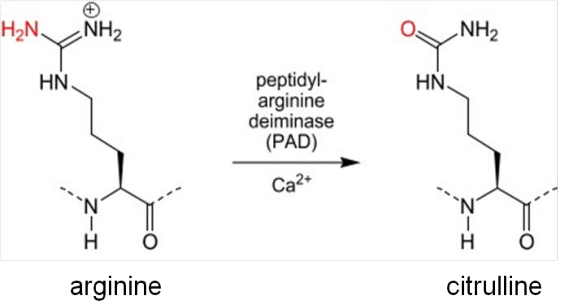
- NO synthase (NOS) enzymes convert ARG into CIT
- NO production
- NO synthase (NOS) enzymes convert ARG into CIT
- restore ARG metabolism
- supplement
- Administration
- safe for oral & IV use
- no identified toxicity
- no side effects
- Treatment
- children
- UCDs
- congenital cardiac defects
- possibly paediatric pulmonary hypertension
- children
- safe for oral & IV use
- Effects
- immunity & oxidative stress
- reduces
- leukocytes and of neutrophils in circulation
- scavenger for
- oxidative lipoproteins
- ADMA
- hydrolysed by DDAH
- L-citrulline
- hydrolysed by DDAH
- induces
- ARG-derived NO-mediated vasoprotection
- suppression
- leukocyte activation
- cell adhesion
- endothelial damage
- CIT malate supplement
- higher neutrophil nitrite concentrations
- no oxidative damage
- polyamines derived from ARG & ornithine might be involved
- suppression
- ARG-derived NO-mediated vasoprotection
- anti-oxidant properties
- reduces
- sports performance and recovery
- Oral supplementation
- increases plasma ARG
- imporve exercise performance
- in young healthy adults under some conditions
- improvements in
- reduced the exercise time by 1.5 %
- immediate concentration after exercise
- pulmonary O2 uptake (V̇ O2) kinetic
- higher tolerance
- increases whole work volume
- grip strength
- peak & explosive power
- muscle soreness and fatigue
- improvements in
- in young healthy adults under some conditions
- studies used CIT as malate salt
- Krebs cycle intermediate
- cellular energy production
- Krebs cycle intermediate
- Oral supplementation
- Anabolic effects
- CIT-enriched diet or supplementation
- study
- higher muscle mass & fat free mass
- lower fat mass
- nomal whole body protein synthesis
- effects of CIT on nitrogen handling are not
- ubiquitous
- uniform
- effects of CIT on nitrogen handling are not
- nomal whole body protein synthesis
- lower fat mass
- higher muscle mass & fat free mass
- study
- CIT co-ingestion with low protein
- ineffective
- compared to NEAA
- Hyperargininaemia after ingestion
- compared to NEAA
- ineffective
- CIT co-ingestion with low protein
- study
- better nitrogen balance at 12 hours
- study
- improvements
- cGMP activity
- greater muscle protein synthesis
- (25% of whole body protein synthesis)
- fractional synthesis rate (FSR) higher on CIT than NEAA
- higher muscle performance
- therefore contribute less than 7% increment in whole body protein synthesis
- other study shows lower hepatic protein synthesis in rats
- lack of CIT effect at the whole-body level
- other study shows lower hepatic protein synthesis in rats
- fractional synthesis rate (FSR) higher on CIT than NEAA
- (25% of whole body protein synthesis)
- greater muscle protein synthesis
- cGMP activity
- improvements
- CIT mechanisms of action begin to be understood
- involvement of mTOR pathway
- coordinates
- protein synthesis & mitochondrial functions
- modulating
- mRNA translation
- nuclear encoded mitochondrial proteins synthesis
- modulating
- protein synthesis & mitochondrial functions
- coordinates
- NOS activity
- necessary for calcium-induced activation of Akt pathway
- cGMP/PI3K dependent pathway
- translation initiation
- muscle protein synthesis
- translation initiation
- cGMP/PI3K dependent pathway
- necessary for calcium-induced activation of Akt pathway
- Nitrite
- enhance mTOR activity
- myoblasts proliferation
- enhance mTOR activity
- involvement of mTOR pathway
- study
- CIT-enriched diet or supplementation
- immunity & oxidative stress
- amino acid
Images and files in the map
Information
- Description
- Mind Map on Urea cycle disorders, created by Valentina Ardila Mora on 14/11/2020.
- Created by
- Valentina Ardila Mora
- Views
- 1
- Rating