
Mind map
“Still I Rise” by Maya Angelou
Map content
“Still I Rise” by Maya Angelou
Poem Themes
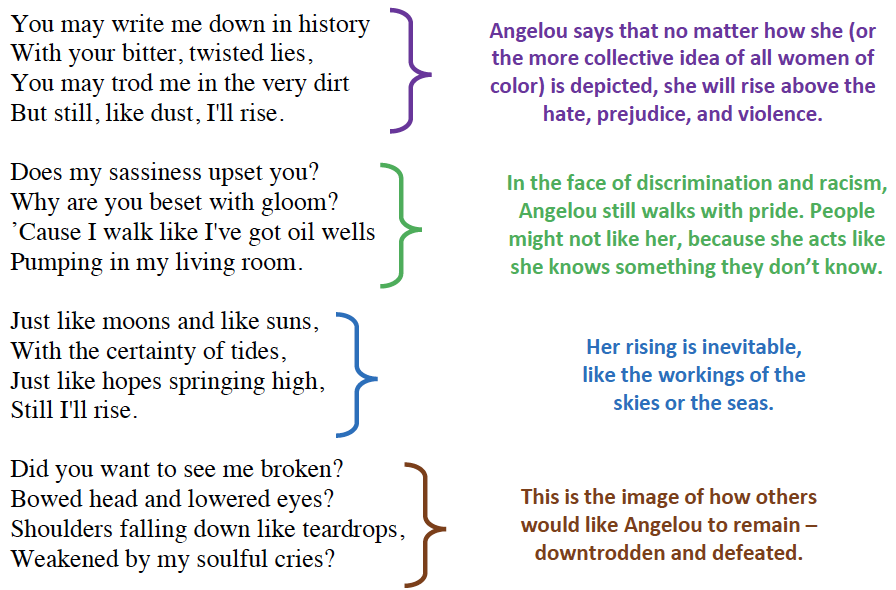
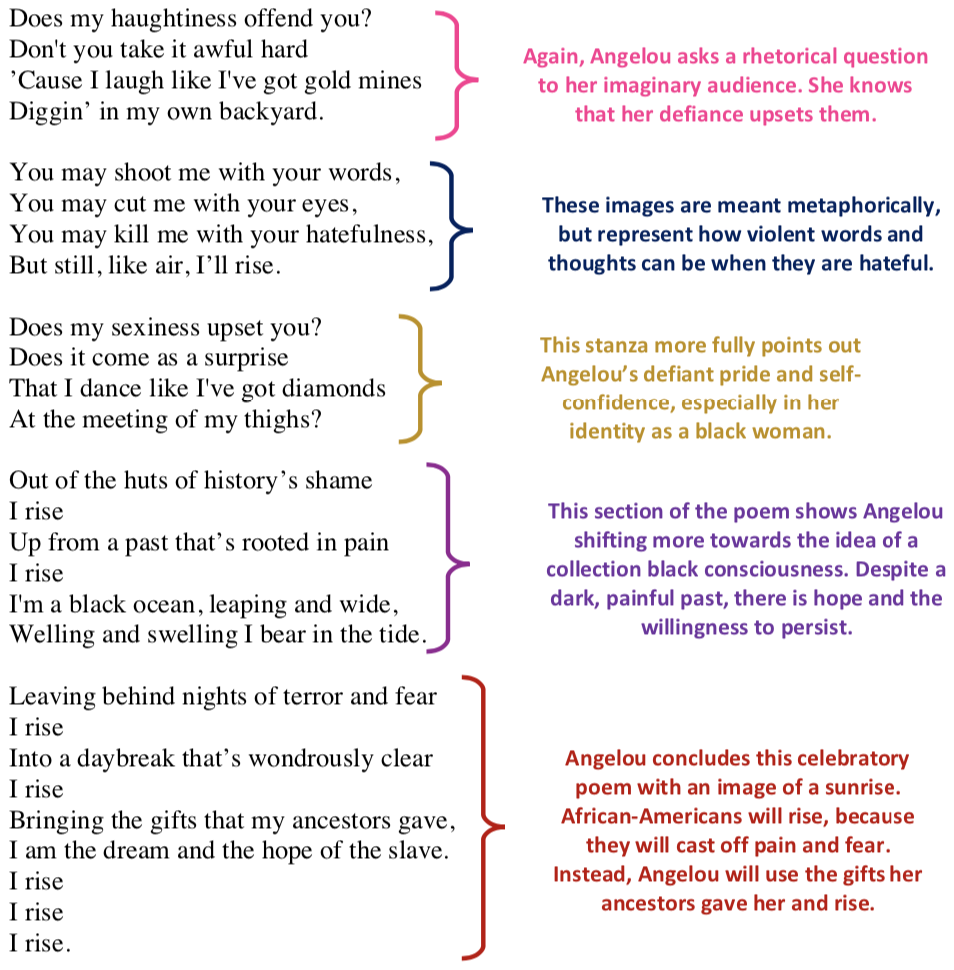
- Defiance
- This poem is a bold statement to anyone who doesn’t like Angelou (or any other black woman) to just give up.
- Angelou is defiant against hateful words, lies, and thoughts.
- She describes herself as sassy, haughty, and sexy – all characteristics that people might stereotypically use to cut down a black woman.
- She takes pride in those traits. She is all of those things in spite of the way others would have her act.
- She describes herself as sassy, haughty, and sexy – all characteristics that people might stereotypically use to cut down a black woman.
- Angelou is defiant against hateful words, lies, and thoughts.
- This poem is a bold statement to anyone who doesn’t like Angelou (or any other black woman) to just give up.
- Rising above Hatred
- The idea of rising is meant metaphorically. Angelou is not simply standing up when others tell her to sit down, she is standing up for herself (with her words and actions).
- Her rise is inevitable and she compares it to dust, air, and oceans.
- And she distinctly states that it is out of “history’s shame” and “a past that’s rooted in pain” that she rises.
- She acknowledges that it is an uphill battle, but that her pride in herself (and that all black women’s pride) cannot be constrained or diminished by others.
- And she distinctly states that it is out of “history’s shame” and “a past that’s rooted in pain” that she rises.
- Her rise is inevitable and she compares it to dust, air, and oceans.
- The idea of rising is meant metaphorically. Angelou is not simply standing up when others tell her to sit down, she is standing up for herself (with her words and actions).
- Defiance
Author Background
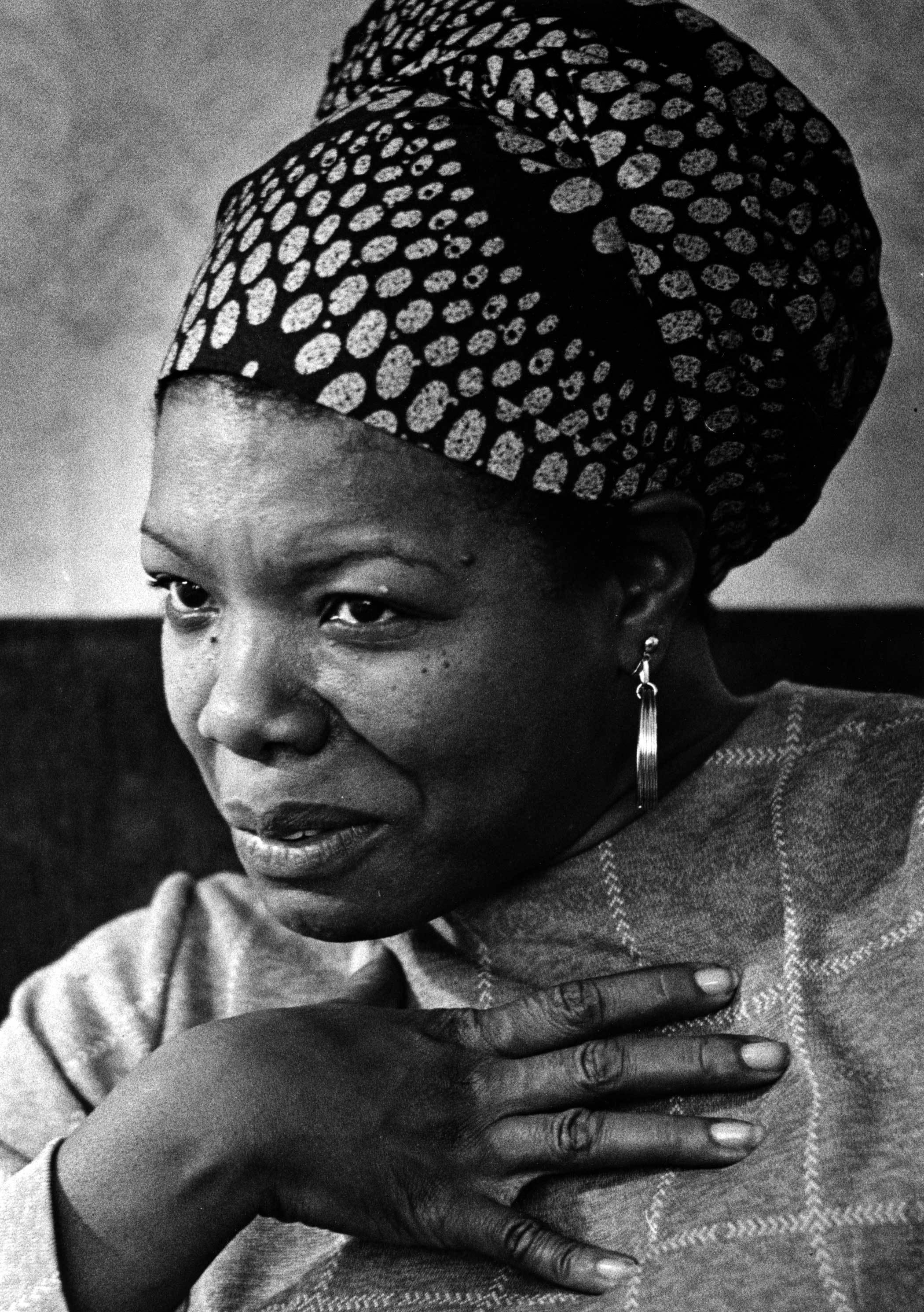
- Maya Angelou, b. 1928, St Louis, MO, d. 2014.
- She grew up in Missouri & Arkansas.
- Over the course of her career she dabbled in many areas. She worked as an author, poet, historian, civil rights activist, songwriter, playwright, dancer, stage and screen producer, director, performer, and singer.
- She grew up in Missouri & Arkansas.
- Maya Angelou, b. 1928, St Louis, MO, d. 2014.
Poem Background
- Published in Angelou’s 3rd volume of poetry "And Still I Rise" (1978).
- Angelou’s poetry focused a lot on her identity as a black woman.
- She was influenced by her childhood growing up in the South, as well as her adult life working as a civil rights activist.
- Angelou’s poetry focused a lot on her identity as a black woman.
- Published in Angelou’s 3rd volume of poetry "And Still I Rise" (1978).
Poem Analysis
- Structure
- 43 lines, 9 stanzas; Broken up into 7 quatrains and 2 ending stanzas
- ABCB rhyme scheme
- Last 2 stanzas change up rhyme scheme to ABACDD
- ABCB rhyme scheme
- 43 lines, 9 stanzas; Broken up into 7 quatrains and 2 ending stanzas
- Perspective
- This poem was written with a first-person perspective.
- This unknown narrator addresses another person throughout the poem as “you.” (perhaps the audience directly)
- The narrator poses rhetorical questions to this unnamed person.
- This unknown narrator addresses another person throughout the poem as “you.” (perhaps the audience directly)
- This poem was written with a first-person perspective.
- Poetic Devices
- Simile
- “like dust”
- Dust rises no matter what you do to stop it. Dust is so fine that you can’t even see to stop its inevitable rise.
- “like air”
- Angelou also compares the narrator to air. Air is all around and cannot help but rise up.
- “like moons and like suns”
- Angelou compares rising with other inevitable events. Suns and moons always rise each day, without fail.
- “Shoulders falling down like teardrops”
- This simile contrasts rising with the falling or slumping of a person’s shoulders, like the downward path of tears.
- “like I’ve got oil wells...” and “like I’ve got gold mines...” and “like I’ve got diamonds...”
- The narrator is defiant, so no matter her true circumstances, she tries to present herself as well-off and confident. She portrays herself as happily and contentedly as if she had hidden wealth.
- “like I’ve got oil wells...” and “like I’ve got gold mines...” and “like I’ve got diamonds...”
- This simile contrasts rising with the falling or slumping of a person’s shoulders, like the downward path of tears.
- “Shoulders falling down like teardrops”
- Angelou compares rising with other inevitable events. Suns and moons always rise each day, without fail.
- “like moons and like suns”
- Angelou also compares the narrator to air. Air is all around and cannot help but rise up.
- “like air”
- Dust rises no matter what you do to stop it. Dust is so fine that you can’t even see to stop its inevitable rise.
- “like dust”
- Metaphor
- Rising
- When Angelou refers to rising, she means rising above pain, rising above the past, and rising above the constraints of society’s racism and discrimination.
- Trodding someone into dirt (1st stanza)
- While this could be literal, this could be more of a metaphor tied to the saying “to rake someone through the mud” when it comes to telling lies or slandering them
- “shoot me with your words” and “cut me with your eyes” and “kill me with your hatefulness”
- These actions are not physically violent, but they can still potentially harm someone mentally.
- The narrator isn’t concerned by these types of meanspirited actions. Someone may do all of these things, and still, she will rise above it all.
- “I’m a black ocean, leaping and wide”; The narrator has hidden depths.
- “I am the dream and the hope of the slave”
- Angelou/the narrator is the kind of person and is living a life that a slave would have only been able to dream or hope about.
- “I am the dream and the hope of the slave”
- “I’m a black ocean, leaping and wide”; The narrator has hidden depths.
- The narrator isn’t concerned by these types of meanspirited actions. Someone may do all of these things, and still, she will rise above it all.
- These actions are not physically violent, but they can still potentially harm someone mentally.
- “shoot me with your words” and “cut me with your eyes” and “kill me with your hatefulness”
- While this could be literal, this could be more of a metaphor tied to the saying “to rake someone through the mud” when it comes to telling lies or slandering them
- Trodding someone into dirt (1st stanza)
- When Angelou refers to rising, she means rising above pain, rising above the past, and rising above the constraints of society’s racism and discrimination.
- Rising
- Imagery
- Angelou puts two main images into this poem: how others would like to see her (defeated, downtrodden) and how she acts in reality (proud, head unbowed, strong)
- Personification
- “hopes springing high”
- Hope here is alive and defiant.
- “hopes springing high”
- Repetition
- “Still I rise”
- This repetition conveys the idea of a continual rising. There is a long process to the rise and triumph of the black woman who is the subject of this poem.
- “I rise / I rise / I rise.”
- This line emphasizes rising as a metaphor for overcoming hardship, racism, and sexism.
- “I rise / I rise / I rise.”
- This repetition conveys the idea of a continual rising. There is a long process to the rise and triumph of the black woman who is the subject of this poem.
- “Still I rise”
- Rhetorical Questions
- Angelou begins several stanzas with questions to whoever the narrator is addressing.
- She poses two types of questions: about what things upset that addressee and whether that addressee wants to see the narrator broken.
- Angelou begins several stanzas with questions to whoever the narrator is addressing.
- Simile
- Structure
Poem Breakdown
Images and files in the map
Information
- Description
- User has deleted their subject information Mind Map on “Still I Rise” by Maya Angelou, created by Deleted user on 06/02/2021.
- Created by
- Deleted user
- Views
- 16
- History
-
- Created by Joseph Gianotti · Jan 28, 2021
- Copied by Joseph Gianotti · Feb 6, 2021
- Rating