
Mind map
The Scarlet Letter: Chapter 18
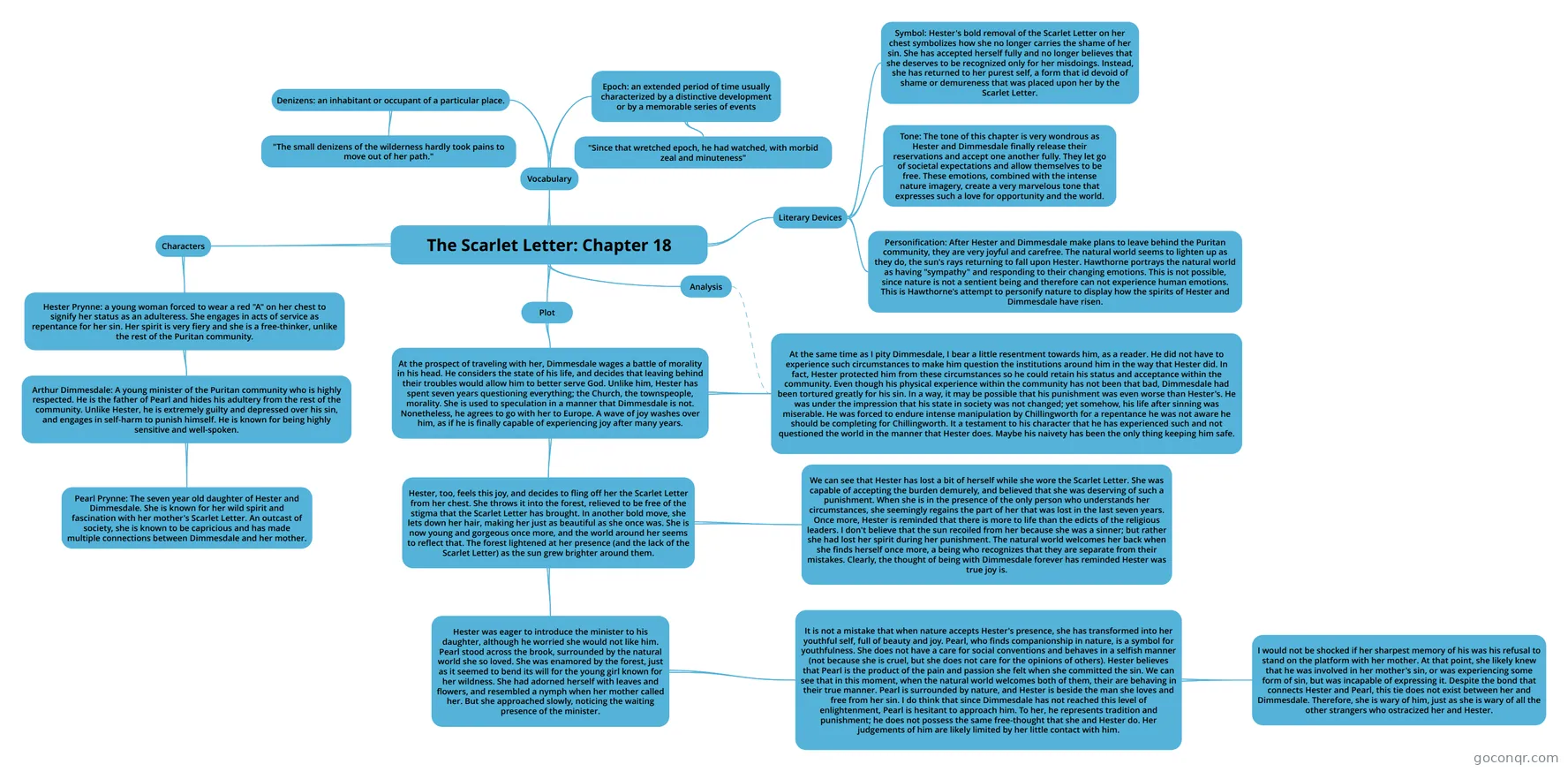
Mind map: The Scarlet Letter chapter 18
Map content
The Scarlet Letter: Chapter 18
Plot
- At the prospect of traveling with her, Dimmesdale wages a battle of morality in his head. He considers the state of his life, and decides that leaving behind their troubles would allow him to better serve God. Unlike him, Hester has spent seven years questioning everything; the Church, the townspeople, morality. She is used to speculation in a manner that Dimmesdale is not. Nonetheless, he agrees to go with her to Europe. A wave of joy washes over him, as if he is finally capable of experiencing joy after many years.
- Hester, too, feels this joy, and decides to fling off her the Scarlet Letter from her chest. She throws it into the forest, relieved to be free of the stigma that the Scarlet Letter has brought. In another bold move, she lets down her hair, making her just as beautiful as she once was. She is now young and gorgeous once more, and the world around her seems to reflect that. The forest lightened at her presence (and the lack of the Scarlet Letter) as the sun grew brighter around them.
- Hester was eager to introduce the minister to his daughter, although he worried she would not like him. Pearl stood across the brook, surrounded by the natural world she so loved. She was enamored by the forest, just as it seemed to bend its will for the young girl known for her wildness. She had adorned herself with leaves and flowers, and resembled a nymph when her mother called her. But she approached slowly, noticing the waiting presence of the minister.
- It is not a mistake that when nature accepts Hester's presence, she has transformed into her youthful self, full of beauty and joy. Pearl, who finds companionship in nature, is a symbol for youthfulness. She does not have a care for social conventions and behaves in a selfish manner (not because she is cruel, but she does not care for the opinions of others). Hester believes that Pearl is the product of the pain and passion she felt when she committed the sin. We can see that in this moment, when the natural world welcomes both of them, their are behaving in their true manner. Pearl is surrounded by nature, and Hester is beside the man she loves and free from her sin. I do think that since Dimmesdale has not reached this level of enlightenment, Pearl is hesitant to approach him. To her, he represents tradition and punishment; he does not possess the same free-thought that she and Hester do. Her judgements of him are likely limited by her little contact with him.
- I would not be shocked if her sharpest memory of his was his refusal to stand on the platform with her mother. At that point, she likely knew that he was involved in her mother's sin, or was experiencing some form of sin, but was incapable of expressing it. Despite the bond that connects Hester and Pearl, this tie does not exist between her and Dimmesdale. Therefore, she is wary of him, just as she is wary of all the other strangers who ostracized her and Hester.
- It is not a mistake that when nature accepts Hester's presence, she has transformed into her youthful self, full of beauty and joy. Pearl, who finds companionship in nature, is a symbol for youthfulness. She does not have a care for social conventions and behaves in a selfish manner (not because she is cruel, but she does not care for the opinions of others). Hester believes that Pearl is the product of the pain and passion she felt when she committed the sin. We can see that in this moment, when the natural world welcomes both of them, their are behaving in their true manner. Pearl is surrounded by nature, and Hester is beside the man she loves and free from her sin. I do think that since Dimmesdale has not reached this level of enlightenment, Pearl is hesitant to approach him. To her, he represents tradition and punishment; he does not possess the same free-thought that she and Hester do. Her judgements of him are likely limited by her little contact with him.
- We can see that Hester has lost a bit of herself while she wore the Scarlet Letter. She was capable of accepting the burden demurely, and believed that she was deserving of such a punishment. When she is in the presence of the only person who understands her circumstances, she seemingly regains the part of her that was lost in the last seven years. Once more, Hester is reminded that there is more to life than the edicts of the religious leaders. I don't believe that the sun recoiled from her because she was a sinner; but rather she had lost her spirit during her punishment. The natural world welcomes her back when she finds herself once more, a being who recognizes that they are separate from their mistakes. Clearly, the thought of being with Dimmesdale forever has reminded Hester was true joy is.
- Hester was eager to introduce the minister to his daughter, although he worried she would not like him. Pearl stood across the brook, surrounded by the natural world she so loved. She was enamored by the forest, just as it seemed to bend its will for the young girl known for her wildness. She had adorned herself with leaves and flowers, and resembled a nymph when her mother called her. But she approached slowly, noticing the waiting presence of the minister.
- At the same time as I pity Dimmesdale, I bear a little resentment towards him, as a reader. He did not have to experience such circumstances to make him question the institutions around him in the way that Hester did. In fact, Hester protected him from these circumstances so he could retain his status and acceptance within the community. Even though his physical experience within the community has not been that bad, Dimmesdale had been tortured greatly for his sin. In a way, it may be possible that his punishment was even worse than Hester's. He was under the impression that his state in society was not changed; yet somehow, his life after sinning was miserable. He was forced to endure intense manipulation by Chillingworth for a repentance he was not aware he should be completing for Chillingworth. It a testament to his character that he has experienced such and not questioned the world in the manner that Hester does. Maybe his naivety has been the only thing keeping him safe.
- Hester, too, feels this joy, and decides to fling off her the Scarlet Letter from her chest. She throws it into the forest, relieved to be free of the stigma that the Scarlet Letter has brought. In another bold move, she lets down her hair, making her just as beautiful as she once was. She is now young and gorgeous once more, and the world around her seems to reflect that. The forest lightened at her presence (and the lack of the Scarlet Letter) as the sun grew brighter around them.
- At the prospect of traveling with her, Dimmesdale wages a battle of morality in his head. He considers the state of his life, and decides that leaving behind their troubles would allow him to better serve God. Unlike him, Hester has spent seven years questioning everything; the Church, the townspeople, morality. She is used to speculation in a manner that Dimmesdale is not. Nonetheless, he agrees to go with her to Europe. A wave of joy washes over him, as if he is finally capable of experiencing joy after many years.
Characters
- Hester Prynne: a young woman forced to wear a red "A" on her chest to signify her status as an adulteress. She engages in acts of service as repentance for her sin. Her spirit is very fiery and she is a free-thinker, unlike the rest of the Puritan community.
- Arthur Dimmesdale: A young minister of the Puritan community who is highly respected. He is the father of Pearl and hides his adultery from the rest of the community. Unlike Hester, he is extremely guilty and depressed over his sin, and engages in self-harm to punish himself. He is known for being highly sensitive and well-spoken.
- Pearl Prynne: The seven year old daughter of Hester and Dimmesdale. She is known for her wild spirit and fascination with her mother's Scarlet Letter. An outcast of society, she is known to be capricious and has made multiple connections between Dimmesdale and her mother.
- Arthur Dimmesdale: A young minister of the Puritan community who is highly respected. He is the father of Pearl and hides his adultery from the rest of the community. Unlike Hester, he is extremely guilty and depressed over his sin, and engages in self-harm to punish himself. He is known for being highly sensitive and well-spoken.
- Hester Prynne: a young woman forced to wear a red "A" on her chest to signify her status as an adulteress. She engages in acts of service as repentance for her sin. Her spirit is very fiery and she is a free-thinker, unlike the rest of the Puritan community.
Literary Devices
- Tone: The tone of this chapter is very wondrous as Hester and Dimmesdale finally release their reservations and accept one another fully. They let go of societal expectations and allow themselves to be free. These emotions, combined with the intense nature imagery, create a very marvelous tone that expresses such a love for opportunity and the world.
- Personification: After Hester and Dimmesdale make plans to leave behind the Puritan community, they are very joyful and carefree. The natural world seems to lighten up as they do, the sun's rays returning to fall upon Hester. Hawthorne portrays the natural world as having "sympathy" and responding to their changing emotions. This is not possible, since nature is not a sentient being and therefore can not experience human emotions. This is Hawthorne's attempt to personify nature to display how the spirits of Hester and Dimmesdale have risen.
- Symbol: Hester's bold removal of the Scarlet Letter on her chest symbolizes how she no longer carries the shame of her sin. She has accepted herself fully and no longer believes that she deserves to be recognized only for her misdoings. Instead, she has returned to her purest self, a form that id devoid of shame or demureness that was placed upon her by the Scarlet Letter.
Vocabulary
- Denizens: an inhabitant or occupant of a particular place.
- "The small denizens of the wilderness hardly took pains to move out of her path."
- Epoch: an extended period of time usually characterized by a distinctive development or by a memorable series of events
- "Since that wretched epoch, he had watched, with morbid zeal and minuteness"
- Denizens: an inhabitant or occupant of a particular place.
Analysis
Information
- Description
- Mind Map on The Scarlet Letter: Chapter 18, created by Alyssia Ouhocine on 24/02/2021.
- Created by
- Alyssia Ouhocine
- Views
- 6
- Rating