
Mind map
Network Security Threats And How To Prevent Them
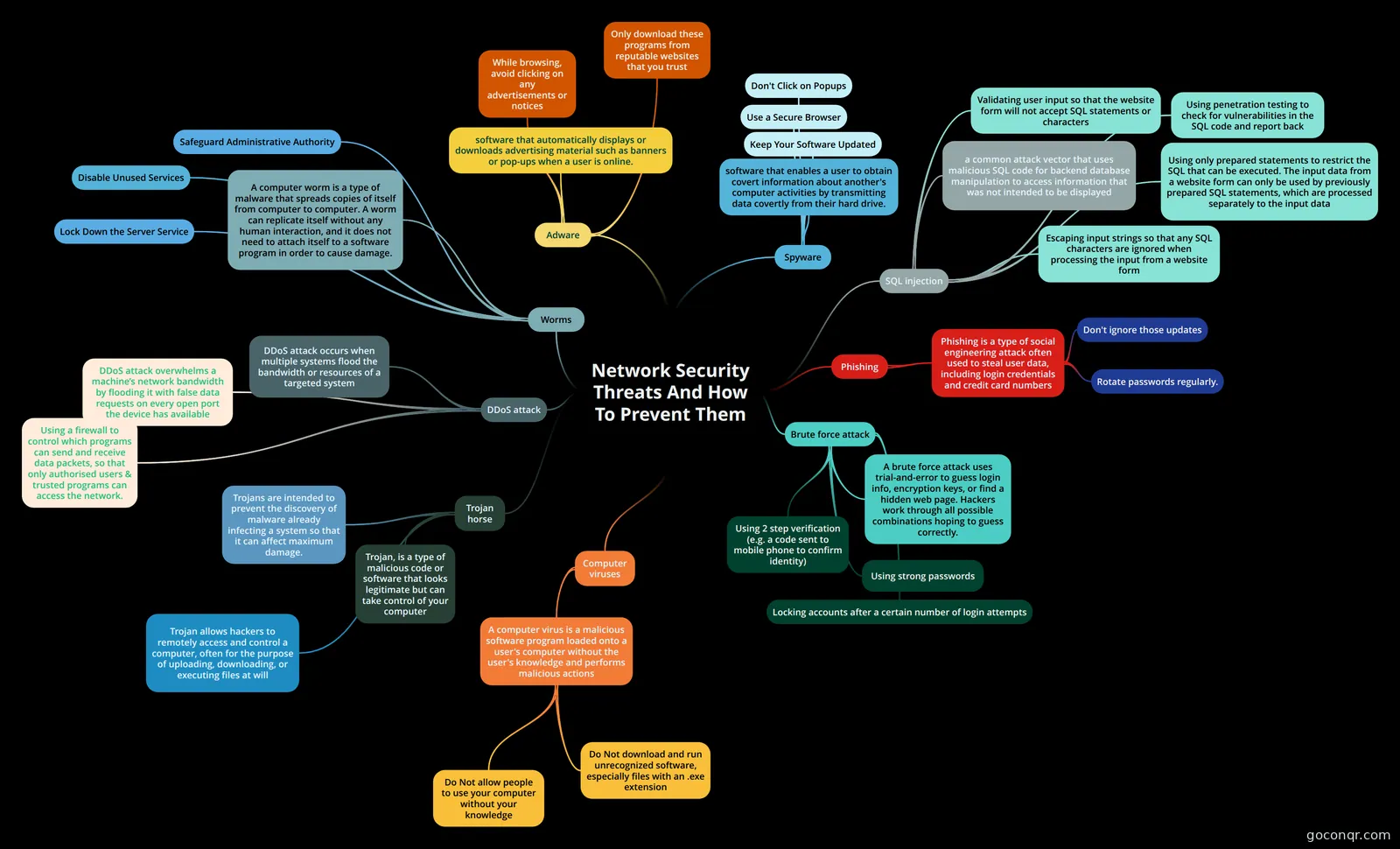
Mind map: Network security threats and how to prevent them
Map content
Network Security Threats And How To Prevent Them
Spyware
- software that enables a user to obtain covert information about another's computer activities by transmitting data covertly from their hard drive.
- Keep Your Software Updated
- Don't Click on Popups
- Use a Secure Browser
Worms
- A computer worm is a type of malware that spreads copies of itself from computer to computer. A worm can replicate itself without any human interaction, and it does not need to attach itself to a software program in order to cause damage.
- Disable Unused Services
- Lock Down the Server Service
- Safeguard Administrative Authority
Trojan horse
- Trojan, is a type of malicious code or software that looks legitimate but can take control of your computer
- Trojan allows hackers to remotely access and control a computer, often for the purpose of uploading, downloading, or executing files at will
- Trojans are intended to prevent the discovery of malware already infecting a system so that it can affect maximum damage.
Phishing
- Phishing is a type of social engineering attack often used to steal user data, including login credentials and credit card numbers
- Rotate passwords regularly.
- Don't ignore those updates
- Phishing is a type of social engineering attack often used to steal user data, including login credentials and credit card numbers
Computer viruses
- A computer virus is a malicious software program loaded onto a user's computer without the user's knowledge and performs malicious actions
- Do Not allow people to use your computer without your knowledge
- Do Not download and run unrecognized software, especially files with an .exe extension
- A computer virus is a malicious software program loaded onto a user's computer without the user's knowledge and performs malicious actions
Adware
- software that automatically displays or downloads advertising material such as banners or pop-ups when a user is online.
- Only download these programs from reputable websites that you trust
- While browsing, avoid clicking on any advertisements or notices
Brute force attack
- A brute force attack uses trial-and-error to guess login info, encryption keys, or find a hidden web page. Hackers work through all possible combinations hoping to guess correctly.
- Using strong passwords
- Locking accounts after a certain number of login attempts
- Using 2 step verification (e.g. a code sent to mobile phone to confirm identity)
DDoS attack
- DDoS attack occurs when multiple systems flood the bandwidth or resources of a targeted system
- Using a firewall to control which programs can send and receive data packets, so that only authorised users & trusted programs can access the network.
- DDoS attack overwhelms a machine’s network bandwidth by flooding it with false data requests on every open port the device has available
SQL injection
- a common attack vector that uses malicious SQL code for backend database manipulation to access information that was not intended to be displayed
- Using penetration testing to check for vulnerabilities in the SQL code and report back
- Validating user input so that the website form will not accept SQL statements or characters
- Escaping input strings so that any SQL characters are ignored when processing the input from a website form
- Using only prepared statements to restrict the SQL that can be executed. The input data from a website form can only be used by previously prepared SQL statements, which are processed separately to the input data
Information
- Description
- Mind Map on Network Security Threats And How To Prevent Them, created by Lukas Fear on 10/03/2021.
- Created by
- Lukas Fear
- Views
- 0
- Rating
More on Network Threats and Attacks