
Mind map
SMO Analysis
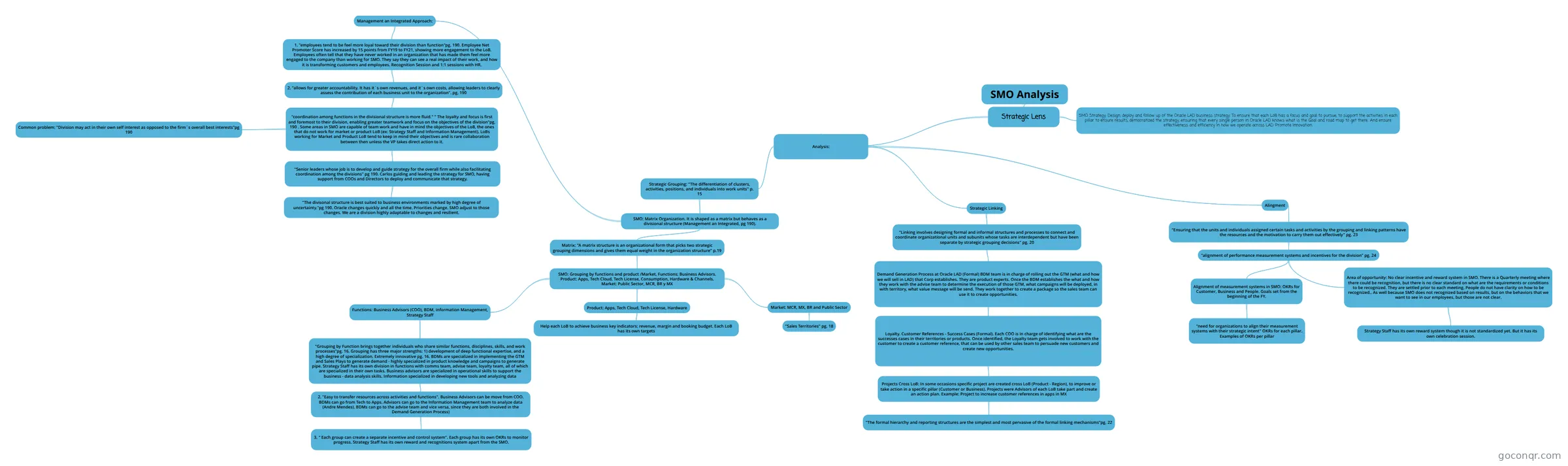
Mind map: SMO analysis
Map content
SMO Analysis
Strategic Lens
- Analysis:
- Strategic Grouping: "The differentiation of clusters, activities, positions, and individuals into work units" p. 15
- SMO: Matrix Organization. It is shaped as a matrix but behaves as a divisional structure (Management an Integrated, pg 190).
- Matrix: "A matrix structure is an organizational form that picks two strategic grouping dimensions and gives them equal weight in the organization structure" p.19
- SMO: Grouping by functions and product /Market. Functions: Business Advisors. Product: Apps, Tech Cloud, Tech License, Consumption, Hardware & Channels. Market: Public Sector, MCR, BR y MX
- Functions: Business Advisors (COO), BDM, Information Management, Strategy Staff
- "Grouping by Function brings together individuals who share similar functions, disciplines, skills, and work processes"pg. 16. Grouping has three major strengths: 1) development of deep functional expertise, and a high degree of specialization. Extremely innovative pg. 16. BDMs are specialized in implementing the GTM and Sales Plays to generate demand - highly specialized in product knowledge and campaigns to generate pipe. Strategy Staff has its own division in functions with comms team, advise team, loyalty team, all of which are specialized in their own tasks. Business advisors are specialized in operational skills to support the business - data analysis skills. Information specialized in developing new tools and analyzing data
- 2. "Easy to transfer resources across activities and functions". Business Advisors can be move from COO. BDMs can go from Tech to Apps. Advisors can go to the Information Management team to analyze data (Andre Mendes). BDMs can go to the advise team and vice versa, since they are both involved in the Demand Generation Process)
- 3. " Each group can create a separate incentive and control system". Each group has its own OKRs to monitor progress. Strategy Staff has its own reward and recognitions system apart from the SMO.
- 2. "Easy to transfer resources across activities and functions". Business Advisors can be move from COO. BDMs can go from Tech to Apps. Advisors can go to the Information Management team to analyze data (Andre Mendes). BDMs can go to the advise team and vice versa, since they are both involved in the Demand Generation Process)
- "Grouping by Function brings together individuals who share similar functions, disciplines, skills, and work processes"pg. 16. Grouping has three major strengths: 1) development of deep functional expertise, and a high degree of specialization. Extremely innovative pg. 16. BDMs are specialized in implementing the GTM and Sales Plays to generate demand - highly specialized in product knowledge and campaigns to generate pipe. Strategy Staff has its own division in functions with comms team, advise team, loyalty team, all of which are specialized in their own tasks. Business advisors are specialized in operational skills to support the business - data analysis skills. Information specialized in developing new tools and analyzing data
- Product: Apps, Tech Cloud, Tech License, Hardware
- Help each LoB to achieve business key indicators: revenue, margin and booking budget. Each LoB has its own targets
- Market: MCR, MX, BR and Public Sector
- "Sales Territories" pg. 18
- Functions: Business Advisors (COO), BDM, Information Management, Strategy Staff
- SMO: Grouping by functions and product /Market. Functions: Business Advisors. Product: Apps, Tech Cloud, Tech License, Consumption, Hardware & Channels. Market: Public Sector, MCR, BR y MX
- Management an Integrated Approach:
- 1. "employees tend to be feel more loyal toward their division than function"pg. 190. Employee Net Promoter Score has increased by 15 points from FY19 to FY21, showing more engagement to the LoB. Employees often tell that they have never worked in an organization that has made them feel more engaged to the company than working for SMO. They say they can see a real impact of their work, and how it is transforming customers and employees. Recognition Session and 1:1 sessions with HR.
- 2. "allows for greater accountability. It has it´s own revenues, and it´s own costs, allowing leaders to clearly assess the contribution of each business unit to the organization". pg. 190
- "coordination among functions in the divisional structure is more fluid." " The loyalty and focus is first and foremost to their division, enabling greater teamwork and focus on the objectives of the division"pg. 190 . Some areas in SMO are capable of team work and have in mind the objectives of the LoB, the ones that do not work for market or product LoB (ex: Strategy Staff and Information Management). LoBs working for Market and Product LoB tend to keep in mind their objectives and is rare collaboration between then unless the VP takes direct action to it.
- "Senior leaders whose job is to develop and guide strategy for the overall firm while also facilitating coordination among the divisions" pg 190. Carlos guiding and leading the strategy for SMO, having support from COOs and Directors to deploy and communicate that strategy.
- "The divisonal structure is best suited to business environments marked by high degree of uncertainty."pg 190. Oracle changes quickly and all the time. Priorities change. SMO adjust to those changes. We are a division highly adaptable to changes and resilient.
- Common problem: "Division may act in their own self interest as opposed to the firm´s overall best interests"pg 190
- "Senior leaders whose job is to develop and guide strategy for the overall firm while also facilitating coordination among the divisions" pg 190. Carlos guiding and leading the strategy for SMO, having support from COOs and Directors to deploy and communicate that strategy.
- "coordination among functions in the divisional structure is more fluid." " The loyalty and focus is first and foremost to their division, enabling greater teamwork and focus on the objectives of the division"pg. 190 . Some areas in SMO are capable of team work and have in mind the objectives of the LoB, the ones that do not work for market or product LoB (ex: Strategy Staff and Information Management). LoBs working for Market and Product LoB tend to keep in mind their objectives and is rare collaboration between then unless the VP takes direct action to it.
- 2. "allows for greater accountability. It has it´s own revenues, and it´s own costs, allowing leaders to clearly assess the contribution of each business unit to the organization". pg. 190
- 1. "employees tend to be feel more loyal toward their division than function"pg. 190. Employee Net Promoter Score has increased by 15 points from FY19 to FY21, showing more engagement to the LoB. Employees often tell that they have never worked in an organization that has made them feel more engaged to the company than working for SMO. They say they can see a real impact of their work, and how it is transforming customers and employees. Recognition Session and 1:1 sessions with HR.
- Matrix: "A matrix structure is an organizational form that picks two strategic grouping dimensions and gives them equal weight in the organization structure" p.19
- SMO: Matrix Organization. It is shaped as a matrix but behaves as a divisional structure (Management an Integrated, pg 190).
- Strategic Linking
- "Linking involves designing formal and informal structures and processes to connect and coordinate organizational units and subunits whose tasks are interdependent but have been separate by strategic grouping decisions" pg. 20
- Demand Generation Process at Oracle LAD (Formal) BDM team is in charge of rolling out the GTM (what and how we will sell in LAD) that Corp establishes. They are product experts. Once the BDM establishes the what and how they work with the advise team to determine the execution of those GTM, what campaigns will be deployed, in with territory, what value message will be send. They work together to create a package so the sales team can use it to create opportunities.
- Loyalty. Customer References - Success Cases (Formal). Each COO is in charge of identifying what are the successes cases in their territories or products. Once identified, the Loyalty team gets involved to work with the customer to create a customer reference, that can be used by other sales team to persuade new customers and create new opportunities.
- Projects Cross LoB: In some occasions specific project are created cross LoB (Product - Region), to improve or take action in a specific pillar (Customer or Business). Projects were Advisors of each LoB take part and create an action plan. Example: Project to increase customer references in apps in MX
- "The formal hierarchy and reporting structures are the simplest and most pervasive of the formal linking mechanisms"pg. 22
- Projects Cross LoB: In some occasions specific project are created cross LoB (Product - Region), to improve or take action in a specific pillar (Customer or Business). Projects were Advisors of each LoB take part and create an action plan. Example: Project to increase customer references in apps in MX
- Loyalty. Customer References - Success Cases (Formal). Each COO is in charge of identifying what are the successes cases in their territories or products. Once identified, the Loyalty team gets involved to work with the customer to create a customer reference, that can be used by other sales team to persuade new customers and create new opportunities.
- Demand Generation Process at Oracle LAD (Formal) BDM team is in charge of rolling out the GTM (what and how we will sell in LAD) that Corp establishes. They are product experts. Once the BDM establishes the what and how they work with the advise team to determine the execution of those GTM, what campaigns will be deployed, in with territory, what value message will be send. They work together to create a package so the sales team can use it to create opportunities.
- "Linking involves designing formal and informal structures and processes to connect and coordinate organizational units and subunits whose tasks are interdependent but have been separate by strategic grouping decisions" pg. 20
- Alingment
- "Ensuring that the units and individuals assigned certain tasks and activities by the grouping and linking patterns have the resources and the motivation to carry them out effectively" pg. 23
- "alignment of performance measurement systems and incentives for the division" pg. 24
- Alignment of measurement systems in SMO: OKRs for Customer, Business and People. Goals set from the beginning of the FY.
- "need for organizations to align their measurement systems with their strategic intent" OKRs for each pillar. Examples of OKRs per pillar
- Area of opportunity: No clear incentive and reward system in SMO. There is a Quarterly meeting where there could be recognition, but there is no clear standard on what are the requirements or conditions to be recognized. They are settled prior to each meeting. People do not have clarity on how to be recognized.. As well because SMO does not recognized based on results, but on the behaviors that we want to see in our employees, but those are not clear.
- Strategy Staff has its own reward system though it is not standardized yet. But it has its own celebration session.
- Alignment of measurement systems in SMO: OKRs for Customer, Business and People. Goals set from the beginning of the FY.
- "alignment of performance measurement systems and incentives for the division" pg. 24
- "Ensuring that the units and individuals assigned certain tasks and activities by the grouping and linking patterns have the resources and the motivation to carry them out effectively" pg. 23
- Strategic Grouping: "The differentiation of clusters, activities, positions, and individuals into work units" p. 15
- Analysis:
- SMO Strategy: Design, deploy and follow up of the Oracle LAD business strategy. To ensure that each LoB has a focus and goal to pursue, to support the activities in each pillar to ensure results, democratized the strategy, ensuring that every single person in Oracle LAD knows what is the Goal and road map to get there.. And ensure effectiveness and efficiency in how we operate across LAD. Promote Innovation.
Information
- Description
- Mind Map on SMO Analysis, created by Natalia Galvis on 07/04/2021.
- Created by
- Natalia Galvis
- Views
- 6
- Rating