
Mind map
Microbial diversity: Archaea and Bacteria
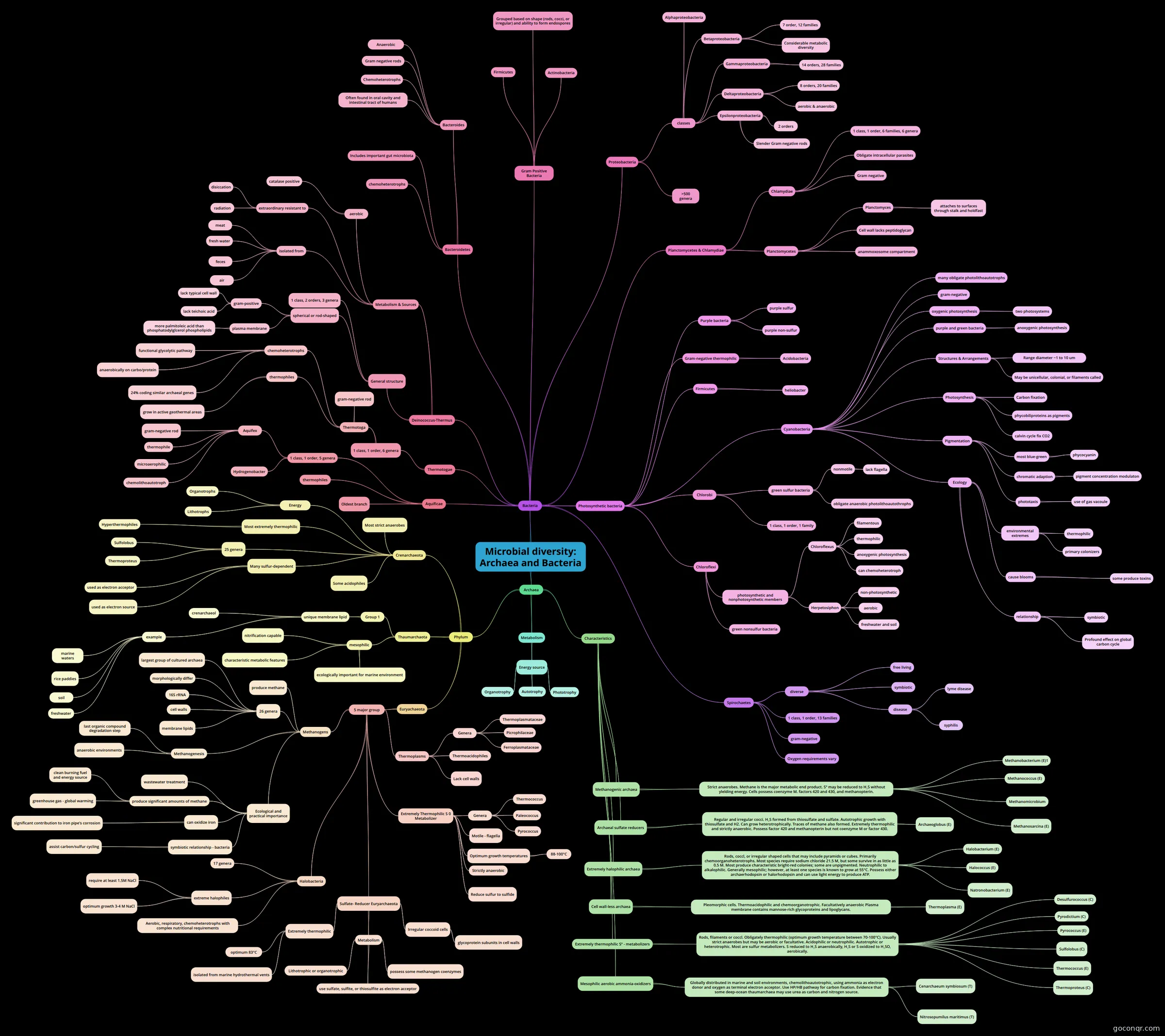
Mind map: Microbial diversity: Archaea and Bacteria
Map content
Microbial diversity: Archaea and Bacteria
Archaea
- Phylum
- Crenarchaeota
- Most extremely thermophilic
- Hyperthermophiles
- Most strict anaerobes
- Some acidophiles
- Many sulfur-dependent
- used as electron acceptor
- used as electron source
- Energy
- Organotrophs
- Lithotrophs
- 25 genera
- Sulfolobus
- Thermoproteus
- Most extremely thermophilic
- Thaumarchaota
- Group 1
- unique membrane lipid
- crenarchaeol
- example
- marine waters
- rice paddies
- soil
- freshwater
- unique membrane lipid
- mesophilic
- nitrification capable
- characteristic metabolic features
- ecologically important for marine environment
- Group 1
- Euryachaeota
- 5 major group
- Methanogens
- produce methane
- Methanogenesis
- last organic compound degradation step
- anaerobic environments
- 26 genera
- largest group of cultured archaea
- morphologically differ
- 16S rRNA
- cell walls
- membrane lipids
- Ecological and practical importance
- wastewater treatment
- produce significant amounts of methane
- clean burning fuel and energy source
- greenhouse gas - global warming
- can oxidize iron
- significant contribution to iron pipe's corrosion
- symbiotic relationship - bacteria
- assist carbon/sulfur cycling
- Halobacteria
- 17 genera
- extreme halophiles
- require at least 1.5M NaCl
- optimum growth 3-4 M NaCl
- Aerobic, respiratory, chemoheterotrophs with complex nutritional requirements
- Thermoplasms
- Genera
- Thermoplasmataceae
- Picrophilaceae
- Ferroplasmataceae
- Thermoacidophiles
- Lack cell walls
- Genera
- Extremely Thermophilic S 0 Metabolizer
- Genera
- Thermococcus
- Paleococcus
- Pyrococcus
- Motile - flagella
- Optimum growth temperatures
- 88-100°C
- Strictly anaerobic
- Reduce sulfur to sulfide
- Genera
- Sulfate- Reducer Euryarchaeota
- Irregular coccoid cells
- glycoprotein subunits in cell walls
- Extremely thermophilic
- optimum 83°C
- isolated from marine hydrothermal vents
- Metabolism
- Lithotrophic or organotrophic
- use sulfate, sulfite, or thiosulfite as electron acceptor
- possess some methanogen coenzymes
- Irregular coccoid cells
- Methanogens
- 5 major group
- Crenarchaeota
- Characteristics
- Methanogenic archaea
- Strict anaerobes. Methane is the major metabolic end product. Sº may be reduced to H₂S without ylelding energy. Cells possess coenzyme M. factors 420 and 430, and methanopterin.
- Methanobacterium (E)1
- Methanococcus (E)
- Methanomicrobium
- Methanosarcina (E)
- Strict anaerobes. Methane is the major metabolic end product. Sº may be reduced to H₂S without ylelding energy. Cells possess coenzyme M. factors 420 and 430, and methanopterin.
- Archaeal sulfate reducers
- Regular and irregular cocci. H₂S formed from thiosulfate and sulfate. Autotrophic growth with thiosulfate and H2. Can grow heterotrophically. Traces of methane also formed. Extremely thermophilic and strictly anaerobic. Possess factor 420 and methanopterin but not coenzyme M or factor 430.
- Archaeoglobus (E)
- Regular and irregular cocci. H₂S formed from thiosulfate and sulfate. Autotrophic growth with thiosulfate and H2. Can grow heterotrophically. Traces of methane also formed. Extremely thermophilic and strictly anaerobic. Possess factor 420 and methanopterin but not coenzyme M or factor 430.
- Extremely halophilic archaea
- Rods, coccl, or irregular shaped cells that may include pyramids or cubes. Primarily chemoorganoheterotrophs. Most species require sodium chloride 21.5 M, but some survive in as little as 0.5 M. Most produce characteristic bright-red colonies; some are unpigmented. Neutrophilic to alkalophilic. Generally mesophilic; however, at least one species is known to grow at 55°C. Possess either archaerhodopsin or halorhodopsin and can use light energy to produce ATP.
- Halobacterium (E)
- Halococcus (E)
- Natronobacterium (E)
- Rods, coccl, or irregular shaped cells that may include pyramids or cubes. Primarily chemoorganoheterotrophs. Most species require sodium chloride 21.5 M, but some survive in as little as 0.5 M. Most produce characteristic bright-red colonies; some are unpigmented. Neutrophilic to alkalophilic. Generally mesophilic; however, at least one species is known to grow at 55°C. Possess either archaerhodopsin or halorhodopsin and can use light energy to produce ATP.
- Cell wall-less archaea
- Pleomorphic cells. Thermoacidophilic and chemoorganotrophic. Facultatively anaerobic Plasma membrane contains mannose-rich glycoproteins and lipoglycans.
- Thermoplasma (E)
- Pleomorphic cells. Thermoacidophilic and chemoorganotrophic. Facultatively anaerobic Plasma membrane contains mannose-rich glycoproteins and lipoglycans.
- Extremely thermophilic Sº - metabolizers
- Rods, filaments or coccl. Obligately thermophilic (optimum growth temperature between 70-100°C). Usually strict anaerobes but may be aerobic or facultative. Acidophilic or neutrophilic. Autotrophic or heterotrophic. Most are sulfur metabolizers. S reduced to H₂S anaerobically, H₂S or S oxidized to H₂SO, aerobically.
- Desulfurococcus (C)
- Pyrodictium (C)
- Pyrococcus (E)
- Sulfolobus (C)
- Thermococcus (E)
- Thermoproteus (C)
- Rods, filaments or coccl. Obligately thermophilic (optimum growth temperature between 70-100°C). Usually strict anaerobes but may be aerobic or facultative. Acidophilic or neutrophilic. Autotrophic or heterotrophic. Most are sulfur metabolizers. S reduced to H₂S anaerobically, H₂S or S oxidized to H₂SO, aerobically.
- Mesophilic aerobic ammonia-oxidizers
- Globally distributed in marine and soil environments, chemolithoautotrophic, using ammonia as electron donor and oxygen as terminal electron acceptor. Use HP/HB pathway for carbon fixation. Evidence that some deep-ocean thaumarchaea may use urea as carbon and nitrogen source.
- Cenarchaeum symbiosum (T)
- Nitrosopumilus maritimus (T)
- Globally distributed in marine and soil environments, chemolithoautotrophic, using ammonia as electron donor and oxygen as terminal electron acceptor. Use HP/HB pathway for carbon fixation. Evidence that some deep-ocean thaumarchaea may use urea as carbon and nitrogen source.
- Methanogenic archaea
- Metabolism
- Energy source
- Autotrophy
- Phototrophy
- Organotrophy
- Energy source
- Phylum
Bacteria
- Aquificae
- Oldest branch
- 1 class, 1 order, 5 genera
- Aquifex
- gram-negative rod
- thermophile
- microaerophilic
- chemolithoautotroph
- Hydrogenobacter
- Aquifex
- thermophiles
- Thermotogae
- 1 class, 1 order, 6 genera
- Thermotoga
- gram-negative rod
- thermophiles
- grow in active geothermal areas
- chemoheterotrophs
- functional glycolytic pathway
- anaerobically on carbo/protein
- 24% coding similar archaeal genes
- Thermotoga
- 1 class, 1 order, 6 genera
- Deinococcus-Thermus
- General structure
- 1 class, 2 orders, 3 genera
- spherical or rod-shaped
- gram-positive
- lack typical cell wall
- lack teichoic acid
- plasma membrane
- more palmitoleic acid than phosphatodylglcerol phospholipids
- gram-positive
- Metabolism & Sources
- aerobic
- catalase positive
- extraordinary resistant to
- disiccation
- radiation
- isolated from
- meat
- feces
- air
- fresh water
- aerobic
- General structure
- Photosynthetic bacteria
- Chloroflexi
- green nonsulfur bacteria
- photosynthetic and nonphotosynthetic members
- Chloroflexus
- filamentous
- thermophilic
- anoxygenic photosynthesis
- can chemoheterotroph
- Herpetosiphon
- non-photosynthetic
- aerobic
- freshwater and soil
- Chloroflexus
- Chlorobi
- green sulfur bacteria
- nonmotile
- lack flagella
- obligate anaerobic photolithoautothrophs
- nonmotile
- 1 class, 1 order, 1 family
- green sulfur bacteria
- Purple bacteria
- purple sulfur
- purple non-sulfur
- Firmicutes
- heliobacter
- Gram-negative thermophilic
- Acidobacteria
- Cyanobacteria
- oxygenic photosynthesis
- two photosystems
- purple and green bacteria
- anoxygenic photosynthesis
- gram-negative
- many obligate photolithoautotrophs
- Structures & Arrangements
- Range diameter ~1 to 10 um
- May be unicellular, colonial, or filaments called
- Photosynthesis
- Carbon fixation
- phycobiliproteins as pigments
- calvin cycle fix CO2
- Pigmentation
- most blue-green
- phycocyanin
- chromatic adaption
- pigment concentration modulaton
- phototaxis
- use of gas vacoule
- most blue-green
- Ecology
- environmental extremes
- thermophilic
- primary colonizers
- cause blooms
- some produce toxins
- relationship
- symbiotic
- Profound effect on global carbon cycle
- environmental extremes
- oxygenic photosynthesis
- Chloroflexi
- Spirochaetes
- 1 class, 1 order, 13 families
- gram-negative
- Oxygen requirements vary
- diverse
- free living
- symbiotic
- disease
- lyme disease
- syphilis
- Planctomycetes & Chlamydiae
- Planctomycetes
- anammoxosome compartment
- Cell wall lacks peptidoglycan
- Planctomyces
- attaches to surfaces through stalk and holdfast
- Chlamydiae
- Gram negative
- Obligate intracellular parasites
- 1 class, 1 order, 6 families, 6 genera
- Planctomycetes
- Bacteroidetes
- chemoheterotrophs
- Includes important gut microbiota
- Bacteroides
- Anaerobic
- Gram negative rods
- Chemoheterotrophs
- Often found in oral cavity and intestinal tract of humans
- Proteobacteria
- >500 genera
- classes
- Alphaproteobacteria
- Betaproteobacteria
- 7 order, 12 families
- Considerable metabolic diversity
- Gammaproteobacteria
- 14 orders, 28 families
- Deltaproteobacteria
- 8 orders, 20 families
- aerobic & anaerobic
- Epsilonproteobacteria
- 2 orders
- Slender Gram negative rods
- Gram Positive Bacteria
- Firmicutes
- Actinobacteria
- Grouped based on shape (rods, cocci, or irregular) and ability to form endospores
- Aquificae
Information
- Description
- Mind Map on Microbial diversity: Archaea and Bacteria, created by Raiyan Rafi on 04/05/2021.
- Created by
- Raiyan Rafi
- Views
- 1
- Rating