
Mind map
The Role of Needs Analysis in ESL Program Design
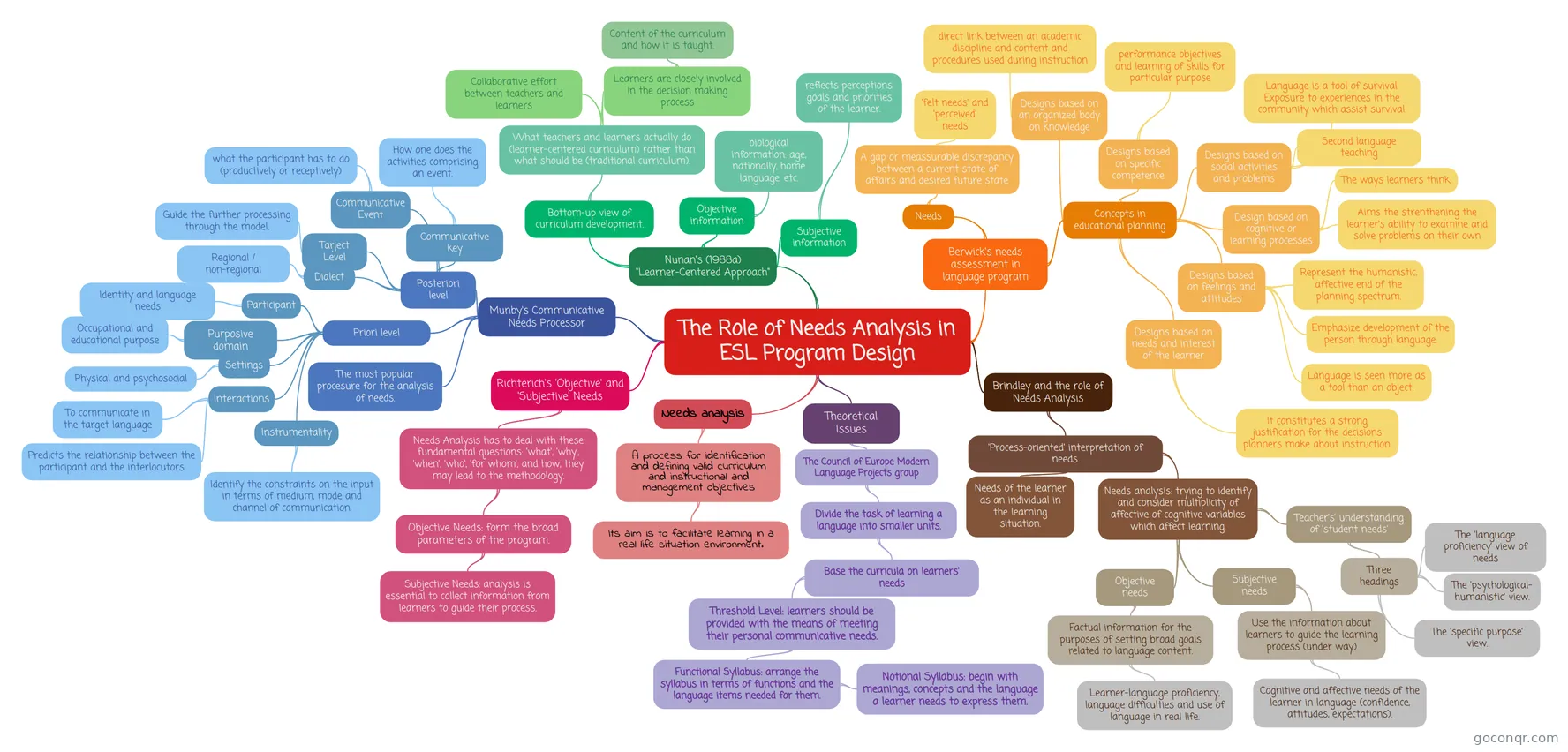
Mind map: Needs analysis in ESL program design
Map content
The Role of Needs Analysis in ESL Program Design
Needs analysis
- A process for identification and defining valid curriculum and instructional and management objectives
- Its aim is to facilitate learning in a real life situation environment.
- A process for identification and defining valid curriculum and instructional and management objectives
Theoretical Issues
- The Council of Europe Modern Language Projects group
- Divide the task of learning a language into smaller units.
- Base the curricula on learners' needs
- Threshold Level: learners should be provided with the means of meeting their personal communicative needs.
- Functional Syllabus: arrange the syllabus in terms of functions and the language items needed for them.
- Notional Syllabus: begin with meanings, concepts and the language a learner needs to express them.
- Functional Syllabus: arrange the syllabus in terms of functions and the language items needed for them.
- Threshold Level: learners should be provided with the means of meeting their personal communicative needs.
- Base the curricula on learners' needs
- Divide the task of learning a language into smaller units.
- The Council of Europe Modern Language Projects group
Richterich's 'Objective' and 'Subjective' Needs
- Needs Analysis has to deal with these fundamental questions: 'what', 'why', 'when', 'who', 'for whom', and how, they may lead to the methodology.
- Objective Needs: form the broad parameters of the program.
- Subjective Needs: analysis is essential to collect information from learners to guide their process.
- Objective Needs: form the broad parameters of the program.
- Needs Analysis has to deal with these fundamental questions: 'what', 'why', 'when', 'who', 'for whom', and how, they may lead to the methodology.
Munby's Communicative Needs Processor
- The most popular procesure for the analysis of needs.
- Priori level
- Participant
- Identity and language needs
- Purposive domain
- Occupational and educational purpose
- Settings
- Physical and psychosocial
- Interactions
- To communicate in the target language
- Predicts the relationship between the participant and the interlocutors
- Instrumentality
- Identify the constraints on the input in terms of medium, mode and channel of communication.
- Participant
- Posteriori level
- Dialect
- Regional / non-regional
- Tarject Level
- Guide the further processing through the model.
- Communicative Event
- what the participant has to do (productively or receptively)
- Communicative key
- How one does the activities comprising an event.
- Dialect
Nunan's (1988a) "Learner-Centered Approach"
- Bottom-up view of curriculum development.
- What teachers and learners actually do (learner-centered curriculum) rather than what should be (traditional curriculum).
- Collaborative effort between teachers and learners
- Learners are closely involved in the decision making process
- Content of the curriculum and how it is taught.
- What teachers and learners actually do (learner-centered curriculum) rather than what should be (traditional curriculum).
- Objective information
- biological information: age, nationally, home language, etc.
- Subjective information
- reflects perceptions, goals and priorities of the learner.
- Bottom-up view of curriculum development.
Berwick's needs assessment in language program
- Needs
- A gap or meassurable discrepancy between a current state of affairs and desired future state
- 'felt needs' and 'perceived' needs
- A gap or meassurable discrepancy between a current state of affairs and desired future state
- Concepts in educational planning
- Designs based on an organized body on knowledge
- direct link between an academic discipline and content and procedures used during instruction
- Designs based on specific competence
- performance objectives and learning of skills for particular purpose
- Designs based on social activities and problems
- Language is a tool of survival. Exposure to experiences in the community which assist survival.
- Second language teaching
- Design based on cognitive or learning processes
- The ways learners think.
- Aims the strenthening the learner's ability to examine and solve problems on their own
- Designs based on feelings and attitudes
- Represent the humanistic, affective end of the planning spectrum.
- Emphasize development of the person through language.
- Language is seen more as a tool than an object.
- Designs based on needs and interest of the learner
- It constitutes a strong justification for the decisions planners make about instruction.
- Designs based on an organized body on knowledge
- Needs
Brindley and the role of Needs Analysis
- 'Process-oriented' interpretation of needs.
- Needs of the learner as an individual in the learning situation.
- Needs analysis: trying to identify and consider multiplicity of affective of cognitive variables which affect learning.
- Objective needs
- Factual information for the purposes of setting broad goals related to language content.
- Learner-language proficiency, language difficulties and use of language in real life.
- Factual information for the purposes of setting broad goals related to language content.
- Subjective needs
- Use the information about learners to guide the learning process (under way)
- Cognitive and affective needs of the learner in language (confidence, attitudes, expectations).
- Use the information about learners to guide the learning process (under way)
- Teacher's' understanding of 'student needs'
- Three headings
- The 'language proficiency' view of needs
- The 'psychological- humanistic' view.
- The 'specific purpose' view.
- Three headings
- Objective needs
- 'Process-oriented' interpretation of needs.
Information
- Description
- Mind Map on The Role of Needs Analysis in ESL Program Design, created by María Estela Hernánd on 23/08/2015.
- Created by
- María Estela Hernánd
- Views
- 0
- Rating