
Mind map
Types of Ovens
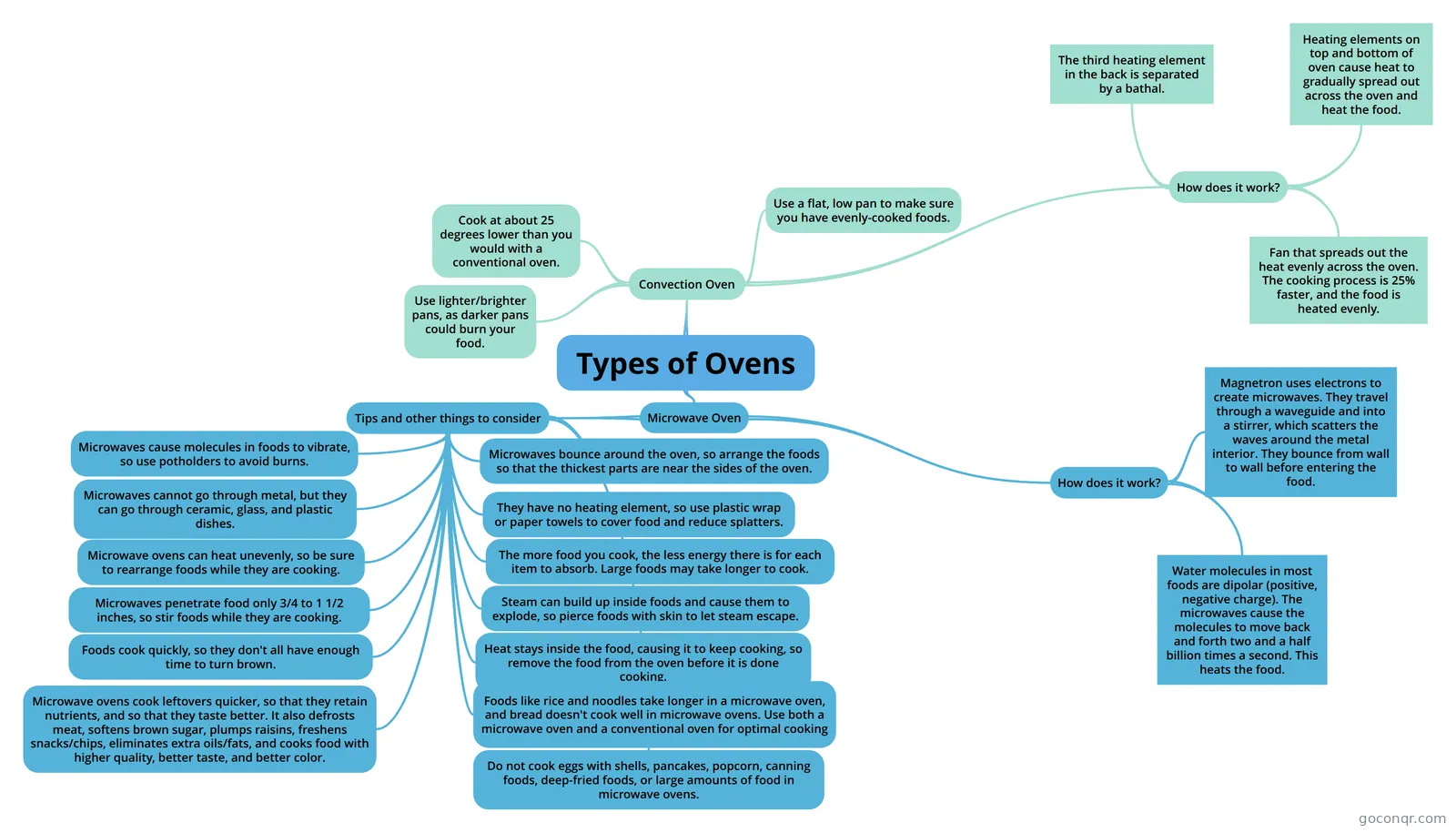
Mind map: Types of ovens
Map content
Types of Ovens
Microwave Oven
- How does it work?
- Magnetron uses electrons to create microwaves. They travel through a waveguide and into a stirrer, which scatters the waves around the metal interior. They bounce from wall to wall before entering the food.
- Water molecules in most foods are dipolar (positive, negative charge). The microwaves cause the molecules to move back and forth two and a half billion times a second. This heats the food.
- Tips and other things to consider
- Microwaves cause molecules in foods to vibrate, so use potholders to avoid burns.
- Microwaves cannot go through metal, but they can go through ceramic, glass, and plastic dishes.
- Microwave ovens can heat unevenly, so be sure to rearrange foods while they are cooking.
- Microwaves penetrate food only 3/4 to 1 1/2 inches, so stir foods while they are cooking.
- Microwaves bounce around the oven, so arrange the foods so that the thickest parts are near the sides of the oven.
- They have no heating element, so use plastic wrap or paper towels to cover food and reduce splatters.
- The more food you cook, the less energy there is for each item to absorb. Large foods may take longer to cook.
- Steam can build up inside foods and cause them to explode, so pierce foods with skin to let steam escape.
- Heat stays inside the food, causing it to keep cooking, so remove the food from the oven before it is done cooking.
- Foods cook quickly, so they don't all have enough time to turn brown.
- Foods like rice and noodles take longer in a microwave oven, and bread doesn't cook well in microwave ovens. Use both a microwave oven and a conventional oven for optimal cooking
- Microwave ovens cook leftovers quicker, so that they retain nutrients, and so that they taste better. It also defrosts meat, softens brown sugar, plumps raisins, freshens snacks/chips, eliminates extra oils/fats, and cooks food with higher quality, better taste, and better color.
- Do not cook eggs with shells, pancakes, popcorn, canning foods, deep-fried foods, or large amounts of food in microwave ovens.
- How does it work?
Convection Oven
- How does it work?
- Heating elements on top and bottom of oven cause heat to gradually spread out across the oven and heat the food.
- The third heating element in the back is separated by a bathal.
- Fan that spreads out the heat evenly across the oven. The cooking process is 25% faster, and the food is heated evenly.
- Cook at about 25 degrees lower than you would with a conventional oven.
- Use a flat, low pan to make sure you have evenly-cooked foods.
- Use lighter/brighter pans, as darker pans could burn your food.
- How does it work?
Information
- Description
- Mind Map on Types of Ovens, created by Benjamin Dirksen on 08/09/2021.
- Created by
- Benjamin Dirksen
- Views
- 13
- Rating