
Mind map
Quality Assurance (QA) and Quality Control (QC)
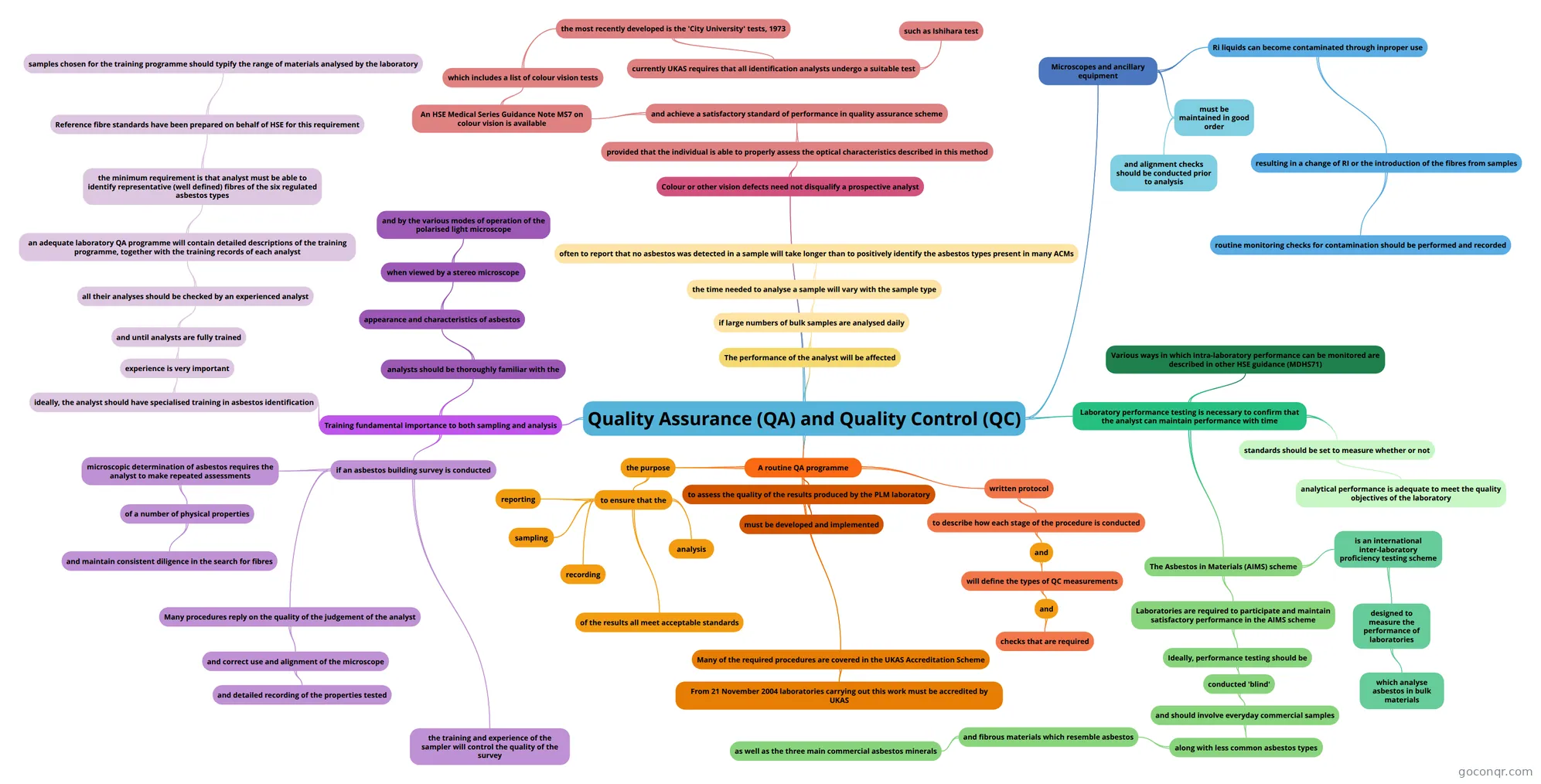
Mind map: Quality Assurance (QA) and Quality Control (QC)
Map content
Quality Assurance (QA) and Quality Control (QC)
A routine QA programme
- to assess the quality of the results produced by the PLM laboratory
- must be developed and implemented
- the purpose
- to ensure that the
- sampling
- analysis
- recording
- reporting
- of the results all meet acceptable standards
- to ensure that the
- written protocol
- to describe how each stage of the procedure is conducted
- and
- will define the types of QC measurements
- and
- checks that are required
- and
- will define the types of QC measurements
- and
- to describe how each stage of the procedure is conducted
- Many of the required procedures are covered in the UKAS Accreditation Scheme
- From 21 November 2004 laboratories carrying out this work must be accredited by UKAS
- to assess the quality of the results produced by the PLM laboratory
The performance of the analyst will be affected
- if large numbers of bulk samples are analysed daily
- the time needed to analyse a sample will vary with the sample type
- often to report that no asbestos was detected in a sample will take longer than to positively identify the asbestos types present in many ACMs
- the time needed to analyse a sample will vary with the sample type
- if large numbers of bulk samples are analysed daily
Laboratory performance testing is necessary to confirm that the analyst can maintain performance with time
- standards should be set to measure whether or not
- analytical performance is adequate to meet the quality objectives of the laboratory
- Various ways in which intra-laboratory performance can be monitored are described in other HSE guidance (MDHS71)
- The Asbestos in Materials (AIMS) scheme
- is an international inter-laboratory proficiency testing scheme
- designed to measure the performance of laboratories
- which analyse asbestos in bulk materials
- designed to measure the performance of laboratories
- Laboratories are required to participate and maintain satisfactory performance in the AIMS scheme
- Ideally, performance testing should be
- conducted 'blind'
- and should involve everyday commercial samples
- along with less common asbestos types
- and fibrous materials which resemble asbestos
- as well as the three main commercial asbestos minerals
- and fibrous materials which resemble asbestos
- along with less common asbestos types
- and should involve everyday commercial samples
- conducted 'blind'
- Ideally, performance testing should be
- is an international inter-laboratory proficiency testing scheme
- standards should be set to measure whether or not
Training fundamental importance to both sampling and analysis
- if an asbestos building survey is conducted
- the training and experience of the sampler will control the quality of the survey
- microscopic determination of asbestos requires the analyst to make repeated assessments
- of a number of physical properties
- and maintain consistent diligence in the search for fibres
- of a number of physical properties
- Many procedures reply on the quality of the judgement of the analyst
- and correct use and alignment of the microscope
- and detailed recording of the properties tested
- and correct use and alignment of the microscope
- analysts should be thoroughly familiar with the
- appearance and characteristics of asbestos
- when viewed by a stereo microscope
- and by the various modes of operation of the polarised light microscope
- when viewed by a stereo microscope
- appearance and characteristics of asbestos
- ideally, the analyst should have specialised training in asbestos identification
- experience is very important
- and until analysts are fully trained
- all their analyses should be checked by an experienced analyst
- an adequate laboratory QA programme will contain detailed descriptions of the training programme, together with the training records of each analyst
- the minimum requirement is that analyst must be able to identify representative (well defined) fibres of the six regulated asbestos types
- Reference fibre standards have been prepared on behalf of HSE for this requirement
- samples chosen for the training programme should typify the range of materials analysed by the laboratory
- Reference fibre standards have been prepared on behalf of HSE for this requirement
- the minimum requirement is that analyst must be able to identify representative (well defined) fibres of the six regulated asbestos types
- an adequate laboratory QA programme will contain detailed descriptions of the training programme, together with the training records of each analyst
- all their analyses should be checked by an experienced analyst
- and until analysts are fully trained
- experience is very important
- if an asbestos building survey is conducted
Microscopes and ancillary equipment
- must be maintained in good order
- and alignment checks should be conducted prior to analysis
- Ri liquids can become contaminated through inproper use
- resulting in a change of RI or the introduction of the fibres from samples
- routine monitoring checks for contamination should be performed and recorded
- resulting in a change of RI or the introduction of the fibres from samples
- must be maintained in good order
Colour or other vision defects need not disqualify a prospective analyst
- provided that the individual is able to properly assess the optical characteristics described in this method
- and achieve a satisfactory standard of performance in quality assurance scheme
- An HSE Medical Series Guidance Note MS7 on colour vision is available
- which includes a list of colour vision tests
- the most recently developed is the 'City University' tests, 1973
- currently UKAS requires that all identification analysts undergo a suitable test
- such as Ishihara test
- currently UKAS requires that all identification analysts undergo a suitable test
- the most recently developed is the 'City University' tests, 1973
- which includes a list of colour vision tests
- An HSE Medical Series Guidance Note MS7 on colour vision is available
- and achieve a satisfactory standard of performance in quality assurance scheme
- provided that the individual is able to properly assess the optical characteristics described in this method
Information
- Description
- Mind Map on Quality Assurance (QA) and Quality Control (QC), created by Harpreet Sandhu on 24/09/2021.
- Created by
- Harpreet Sandhu
- Views
- 5
- Rating
More on Inspection and Testing