
Mind map
Topic 1A: Protein Structure and Function
Map content
Topic 1A: Protein Structure and Function
Amino acids
- absolute configuration: determined by substituents around the chiral alpha carbon (except glycine). All amino acids naturally found in proteins are in the L configuration
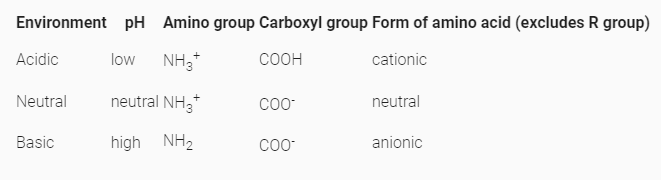
- In aqueous environments, the AA will be a zwitterion (dipolar). Both the amino and carboxyl groups will be ionized. Charge will be neutral (excluding the R group).
- in acidic environments, the AA will be a cation, with the amino group ionized and carboxyl group neutral. Charge will be positive (excluding the R group).
- in basic environments, the AA will be an anion, with the amino group in a neutral state, and the carboxyl group charged. Charge of AA will be negative (excluding the R group).
- Reactions:
- disulfide bridges in cysteine: covalent disulfide bond between the sulfur in the R groups of 2 cysteines, affecting protein stability and folding
- AAs join together via peptide bonds to form polypeptides, through a dehydration synthesis reaction
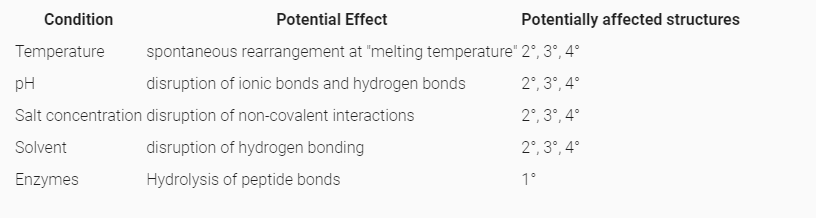
- Peptide bonds are broken via hydrolysis
Conformational Stability: stability of a particular conformation of a protein can be described by change in Gibbs free energy; pH, temperature, salt concentrations, and chaperones all play a role as well.
- 1° primary structure: made up of polypeptide (linear AAs), N and C termini
- 2° secondary structure: folding of polypeptide into alpha helices and beta sheets, held together by hydrogen bonding
- 3° tertiary structure: side chain interactions.
- Proline is notable for this d/t its unique self connected 5 member ring structure, has conformation rigidity as it creates kinks in 2° structure and cannot contributes to H bonding. It is useful in accommodating tight turns in protein folding
- disulfide bridges provide conformational stability
- hydrophobic interactions: hydrophobic side chains "bind" to each other and are brought into the interior of the protein in aqueous environments
- 4° structure: multiple polypeptide subunits, held together by disulfide bonds and noncovalent interactions
- misfolding: occurs when conditions are inappropriate or there are problems with chaperone-assisted folding; results in inactive or toxic proteins
- denaturing: loss of 4°, 3°, and 2° structure as a protein unravels
- hydrophobic interactions and H bonding are integral to stability; contribute via repulsive forces (thermodynamically favorable location of hydrophobic residues inside the core of the protein) and attractive forces (van der Waals and London dispersion forces between non-polar residues; these are amplified in close quarters)
- solvation layer: the structured organization of a solvent (water) around a solute (polypeptide). In a hydrophilic solvent, the protein will rearrange to optimize interactions with the solvent (hydrophilic side chains on surface and hydrophobic in the core)
Protein functions
- enzymes
- https://wou.edu/chemistry/courses/online-chemistry-textbooks/ch450-and-ch451-biochemistry-defining-life-at-the-molecular-level/chapter-7-catalytic-mechanisms-of-enzymes/
- biological catalysts that increase reaction rates by stabilizing the transition state of their substrate and thus lowering activation energy; they are not consumed like reactants during the reaction. Their specificity allows mechanism of controlling reactions.
- activation energy: the difference between the free energy of the reactants and the free energy of the transition state. Lowered activation energy will allow the reaction to proceed faster. Even spontaneous reactions may not proceed at a perceivable rate d/t kinetic barrier of activation energy, which is why enzymes are needed.
- they DO NOT impact Keq or the thermodynamically favorable direction of the reaction
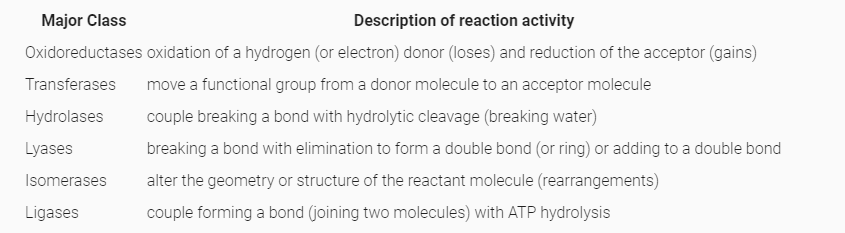
- classified by reaction type
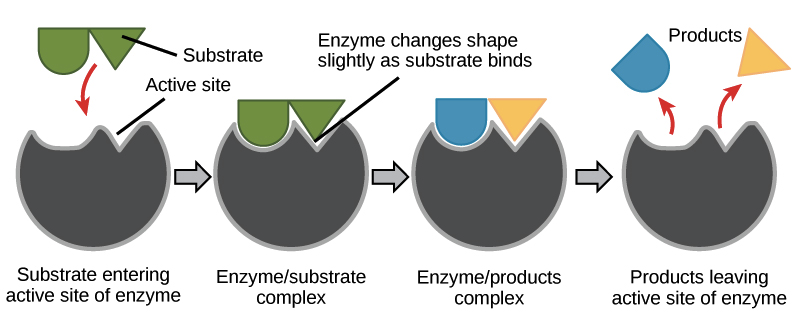
- 2 models of enzyme-substrate interaction
- active-site model: shape and local chemical characteristics (functional groups) of an active site are responsible for the specificity of the enzyme
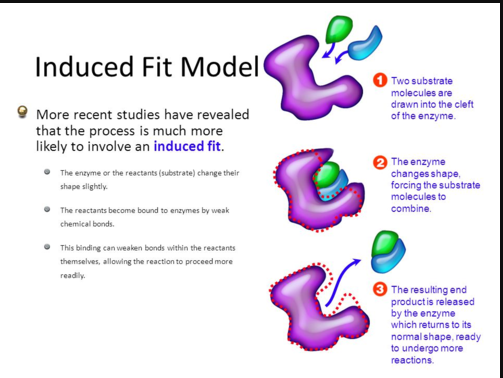
- induced fit model: interaction is reliant on the mutual effects the enzyme and substrate have on each other. Binding releases a type of free energy "binding energy" which results in nearby substrate inducing a small conformational change in the enzyme to boost the enzyme's affinity for the substrate.
- active-site model: shape and local chemical characteristics (functional groups) of an active site are responsible for the specificity of the enzyme
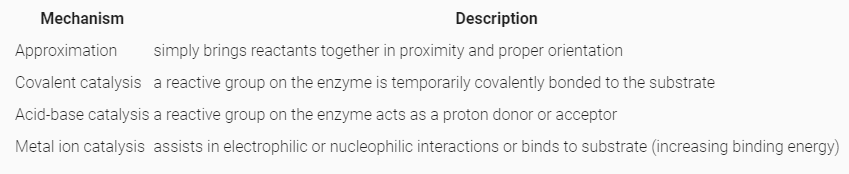
- Mechanisms of catalysis: ways in which the chemical reaction is assisted in proceeding
- cofactors: non-protein molecules, in particular, inorganic ions that assist an enzyme in its catalytic activity, but can also include coenzymes. Ex: iron (II), Mg (II)
- coenzymes: organic molecules that assist an enzyme in its catalytic activity. Often derived from vitamins (water soluble vitamins like B and C are often pre-cursors or act as the coenzyme themselves). Ex: Coenzyme A, heme, NAD+
- holoenzyme: cofactor + enzyme bound covalently/closely with each other; enzyme is in its active form
- apoenzyme: enzyme without its cofactor, enzyme is inactive
- cofactors: non-protein molecules, in particular, inorganic ions that assist an enzyme in its catalytic activity, but can also include coenzymes. Ex: iron (II), Mg (II)
- as with other proteins, change in environmental conditions can impact activity (i.e temperature (high can increase rate but also denature), pH).
- can also be made of RNA, do not forget RIBOZYMES
- Enzyme kinetics
- collision theory: reaction rate is directly proportional to the frequency of effective collisions between reactant molecules
- increase in relative [substrate] will increase reaction rate to a certain maximum (Vmax), when [enzyme] is held constant. After hitting max turnover, adding more substrate will not change the reaction rate, however adding more enzyme can (this would be a different Vmax though, as Vmax is defined for a set [enzyme]).
- Michaelis-Menten equation: calculates rate of reaction using Vmax, [substrate], and Michaelis constant (Km = [substrate] required for the reaction rate to reach ½Vmax. Km does not fluctuate with changes in [enzyme] and is indicative of enzyme-substrate affinity).
- the greater the enzyme-substrate affinity, the lower the Km, because less substrate is required to reach 1/2Vmax
- EXCEPTION: cooperative or allosteric enzymes (binding of one ligand will increase the affinity for binding another ligand at a different site--> called the allosteric site)
- Feedback Regulation: a product of the reaction binds to allosteric or active site and impacts enzyme's activity levels and potentially its metabolic pathway
- Inhibition: binding of product to a site on the enzyme decreases or stops the activity of the enzyme
- https://jackwestin.com/resources/mcat-content/control-of-enzyme-activity/inhibition-types
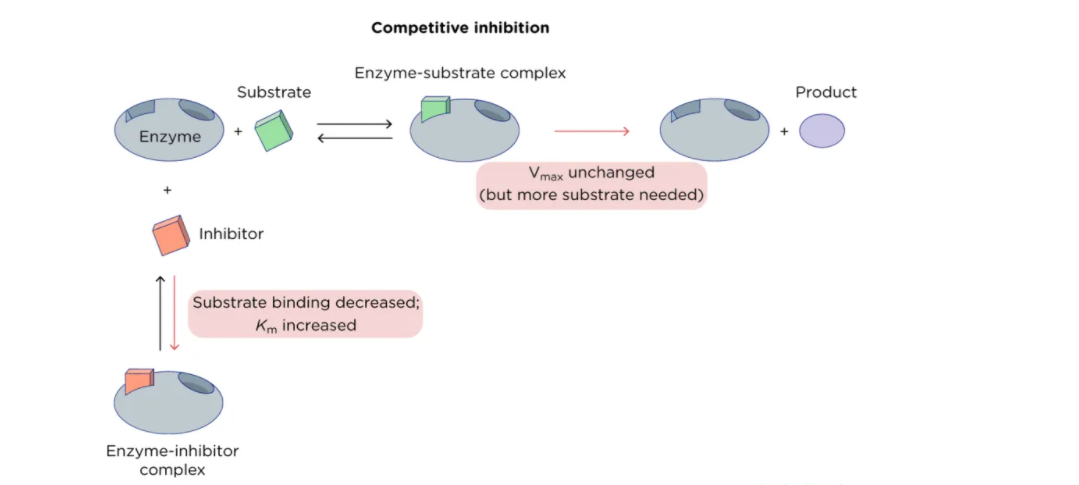
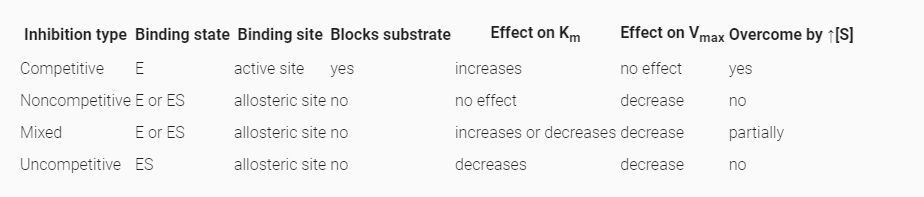
- Competitive inhibitor: similar enough to substrate that it can compete to bind to active site, decreasing enzyme activity as substrate cannot bind and be processed
- Affects Km but not max rxn rate
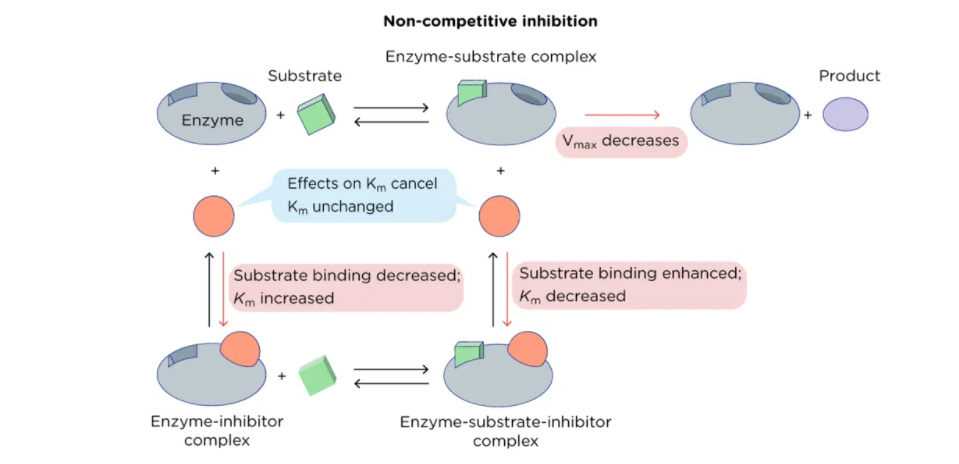
- Non-competitive inhibitor: binds to allosteric site on enzyme, causing conformational change that reduces affinity for substrate
- Affects max rxn rate but not Km
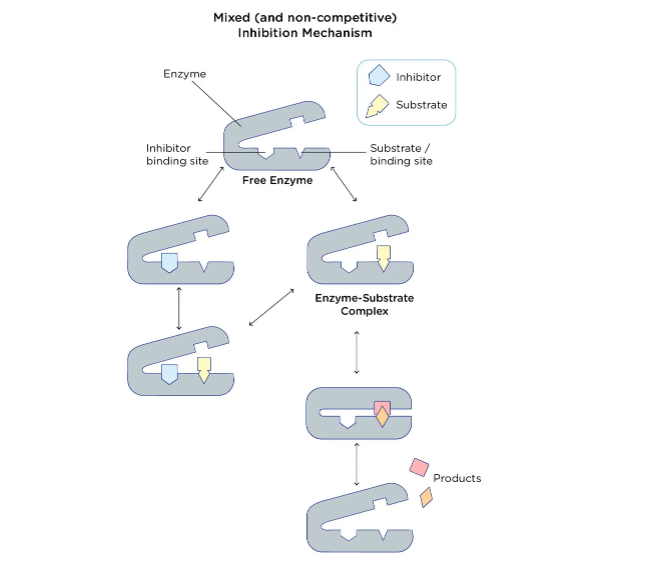
- Mixed inhibitor: binds to allosteric site, when substrate is bound to active site, and when it is not, thereby decreasing enzyme activity levels through conformational change
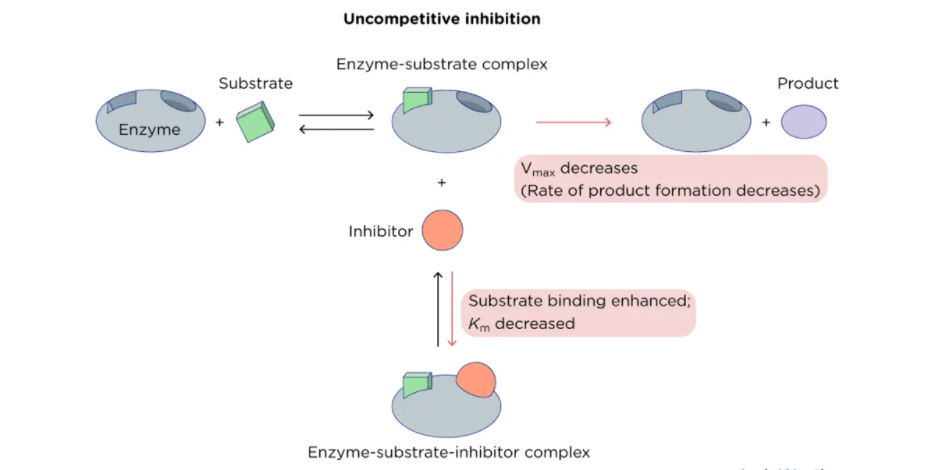
- Uncompetitive inhibitor: binds only to the enzyme-substrate complex, usually when [substrate] is high
- Affects both max rxn rate and Km
- Inhibition: binding of product to a site on the enzyme decreases or stops the activity of the enzyme
- Feedback Regulation: a product of the reaction binds to allosteric or active site and impacts enzyme's activity levels and potentially its metabolic pathway
- Michaelis-Menten equation: calculates rate of reaction using Vmax, [substrate], and Michaelis constant (Km = [substrate] required for the reaction rate to reach ½Vmax. Km does not fluctuate with changes in [enzyme] and is indicative of enzyme-substrate affinity).
- increase in relative [substrate] will increase reaction rate to a certain maximum (Vmax), when [enzyme] is held constant. After hitting max turnover, adding more substrate will not change the reaction rate, however adding more enzyme can (this would be a different Vmax though, as Vmax is defined for a set [enzyme]).
- collision theory: reaction rate is directly proportional to the frequency of effective collisions between reactant molecules
- Regulatory Enzymes: enzymes along a specific pathway responsible for regulation of the pathway
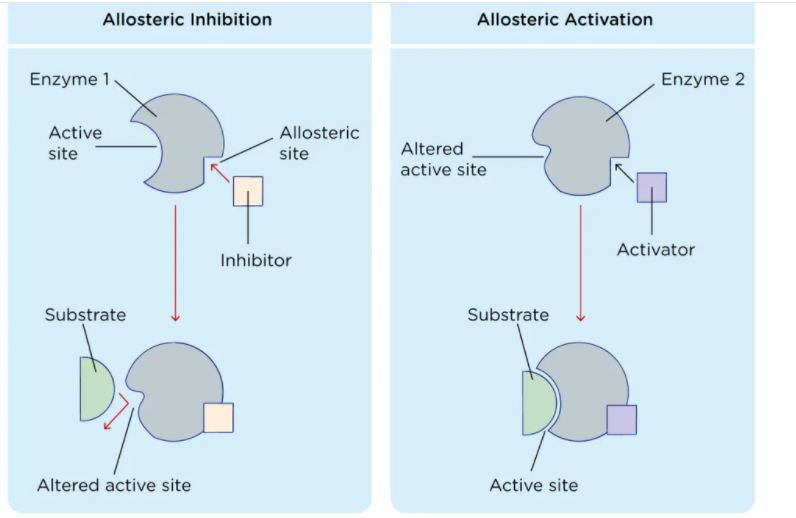
- allosteric: activator or inhibitor molecule binds to allosteric site and these molecules are typically upstream or downstream product (feedback loop), to change the metabolic rate of the enzyme. Can be heterotropic (effector molecule is not a substrate of the enzyme) or homotropic (effector molecule is a substrate of enzyme)
- Covalent modifications: phosphorylation of an enzyme to activate or deactivate it, by changing the conformation of its active site
- Zymogens: aka proenzymes, the inactive form of an enzyme that must undergo a biochemical change to convert to its final active form. Activation triggers include proteolytic cleavage of an activation segment, change in environmental pH, or cofactors.
- allosteric: activator or inhibitor molecule binds to allosteric site and these molecules are typically upstream or downstream product (feedback loop), to change the metabolic rate of the enzyme. Can be heterotropic (effector molecule is not a substrate of the enzyme) or homotropic (effector molecule is a substrate of enzyme)
- Non-enzymatic
- structure (e.g. collagen), transportation (e.g. hemoglobin), regulation (e.g. peptide hormones), movement (e.g. myosin), and immune defense (e.g. antibodies).
- Motor proteins: kinesins, dyneins, myosin; are powered by the exergonic reaction ATP hydrolysis
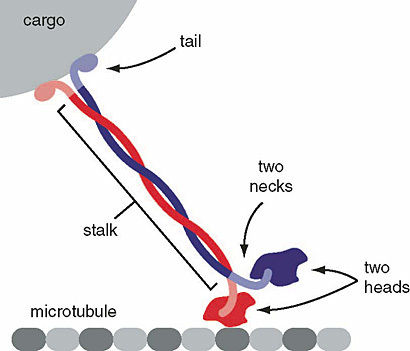
- Kinesin walks microtubule "tracks" to deliver cellular cargo (e.g. chromosomes during mitosis, vesicles), generally in an antegrade direction (center to periphery)
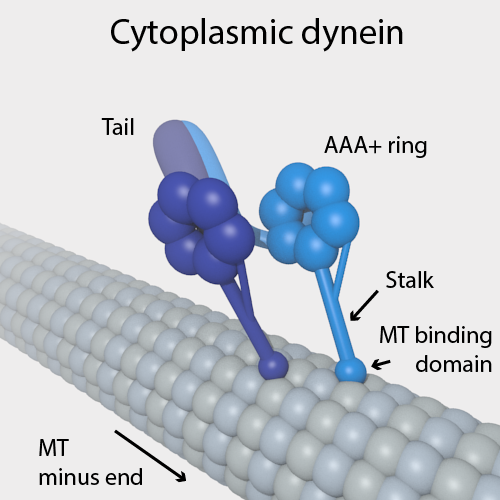
- Dynein is used in retrograde cargo transport in the axons of neurons, and is capable of sliding microtubules in relation to one another, generating the movement of cilia and flagella.
- muscle contraction achieved by myosin binding and releasing actin
- Kinesin walks microtubule "tracks" to deliver cellular cargo (e.g. chromosomes during mitosis, vesicles), generally in an antegrade direction (center to periphery)
- Motor proteins: kinesins, dyneins, myosin; are powered by the exergonic reaction ATP hydrolysis
- structure (e.g. collagen), transportation (e.g. hemoglobin), regulation (e.g. peptide hormones), movement (e.g. myosin), and immune defense (e.g. antibodies).
- ability to bind other molecules with non-covalent interactions
- modulated by affinity (how readily the protein binds its target) and specificity (preferential binding of the target over other entities)
- can be altered by change in conformation
- antibodies are a strong example of this, particularly specificity
- enzymes
protein domains: can be 25 to 500 amino acids long; they are distinct structural units that are important in protein function. Example: zinc fingers (commonly found in transcription factors) and pleckstrin homology domains (found in proteins in signaling pathways, they typically function in lipid binding).
Images and files in the map
Information
- Description
- Mind Map on Topic 1A: Protein Structure and Function, created by 000 000 on 17/10/2021.
- Created by
- 000 000
- Views
- 3
- Rating