
Mind map
Main Criteria for Curriculum Design
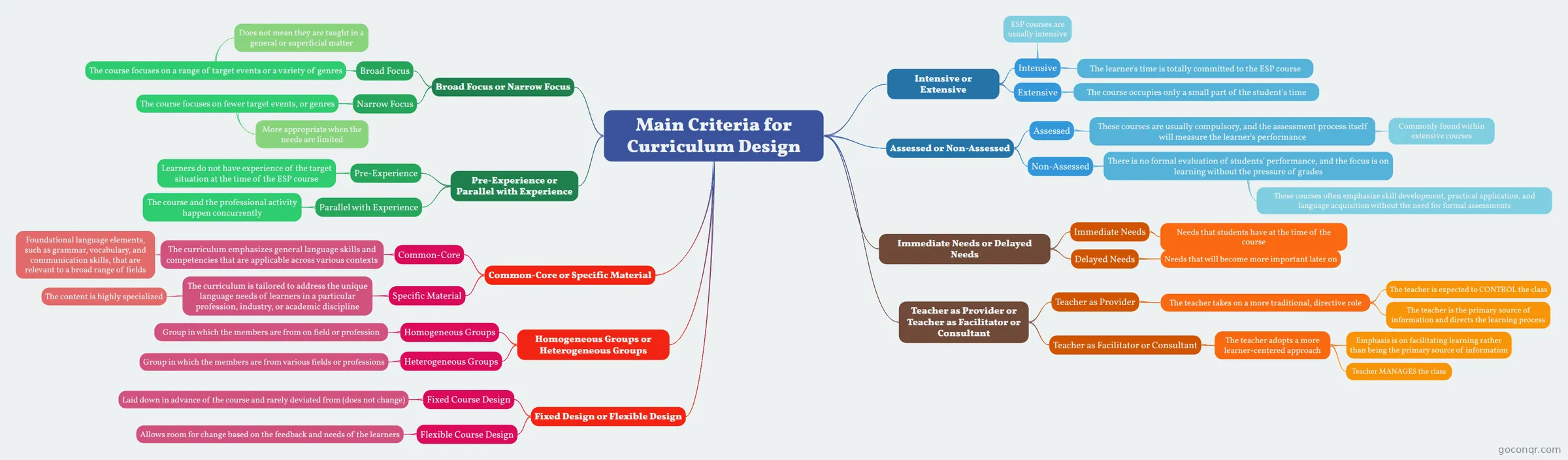
Mind map: Main criteria for curriculum design
Map content
Main Criteria for Curriculum Design
Intensive or Extensive
- Intensive
- The learner's time is totally committed to the ESP course
- ESP courses are usually intensive
- Extensive
- The course occupies only a small part of the student's time
- Intensive
Assessed or Non-Assessed
- Assessed
- These courses are usually compulsory, and the assessment process itself will measure the learner's performance
- Commonly found within extensive courses
- These courses are usually compulsory, and the assessment process itself will measure the learner's performance
- Non-Assessed
- There is no formal evaluation of students' performance, and the focus is on learning without the pressure of grades
- These courses often emphasize skill development, practical application, and language acquisition without the need for formal assessments
- There is no formal evaluation of students' performance, and the focus is on learning without the pressure of grades
- Assessed
Immediate Needs or Delayed Needs
- Immediate Needs
- Needs that students have at the time of the course
- Delayed Needs
- Needs that will become more important later on
- Immediate Needs
Teacher as Provider or Teacher as Facilitator or Consultant
- Teacher as Provider
- The teacher takes on a more traditional, directive role
- The teacher is the primary source of information and directs the learning process
- The teacher is expected to CONTROL the class
- The teacher takes on a more traditional, directive role
- Teacher as Facilitator or Consultant
- The teacher adopts a more learner-centered approach
- Emphasis is on facilitating learning rather than being the primary source of information
- Teacher MANAGES the class
- The teacher adopts a more learner-centered approach
- Teacher as Provider
Broad Focus or Narrow Focus
- Broad Focus
- The course focuses on a range of target events or a variety of genres
- Does not mean they are taught in a general or superficial matter
- The course focuses on a range of target events or a variety of genres
- Narrow Focus
- The course focuses on fewer target events, or genres
- More appropriate when the needs are limited
- The course focuses on fewer target events, or genres
- Broad Focus
Pre-Experience or Parallel with Experience
- Pre-Experience
- Learners do not have experience of the target situation at the time of the ESP course
- Parallel with Experience
- The course and the professional activity happen concurrently
- Pre-Experience
Common-Core or Specific Material
- Common-Core
- The curriculum emphasizes general language skills and competencies that are applicable across various contexts
- Foundational language elements, such as grammar, vocabulary, and communication skills, that are relevant to a broad range of fields
- The curriculum emphasizes general language skills and competencies that are applicable across various contexts
- Specific Material
- The curriculum is tailored to address the unique language needs of learners in a particular profession, industry, or academic discipline
- The content is highly specialized
- The curriculum is tailored to address the unique language needs of learners in a particular profession, industry, or academic discipline
- Common-Core
Homogeneous Groups or Heterogeneous Groups
- Homogeneous Groups
- Group in which the members are from on field or profession
- Heterogeneous Groups
- Group in which the members are from various fields or professions
- Homogeneous Groups
Fixed Design or Flexible Design
- Fixed Course Design
- Laid down in advance of the course and rarely deviated from (does not change)
- Flexible Course Design
- Allows room for change based on the feedback and needs of the learners
- Fixed Course Design
Information
- Description
- Mind Map on Main Criteria for Curriculum Design, created by Daniela Lara on 18/11/2021.
- Created by
- Daniela Lara
- Views
- 0
- Rating