
Mind map
4.7 magnetism and electromagnetism
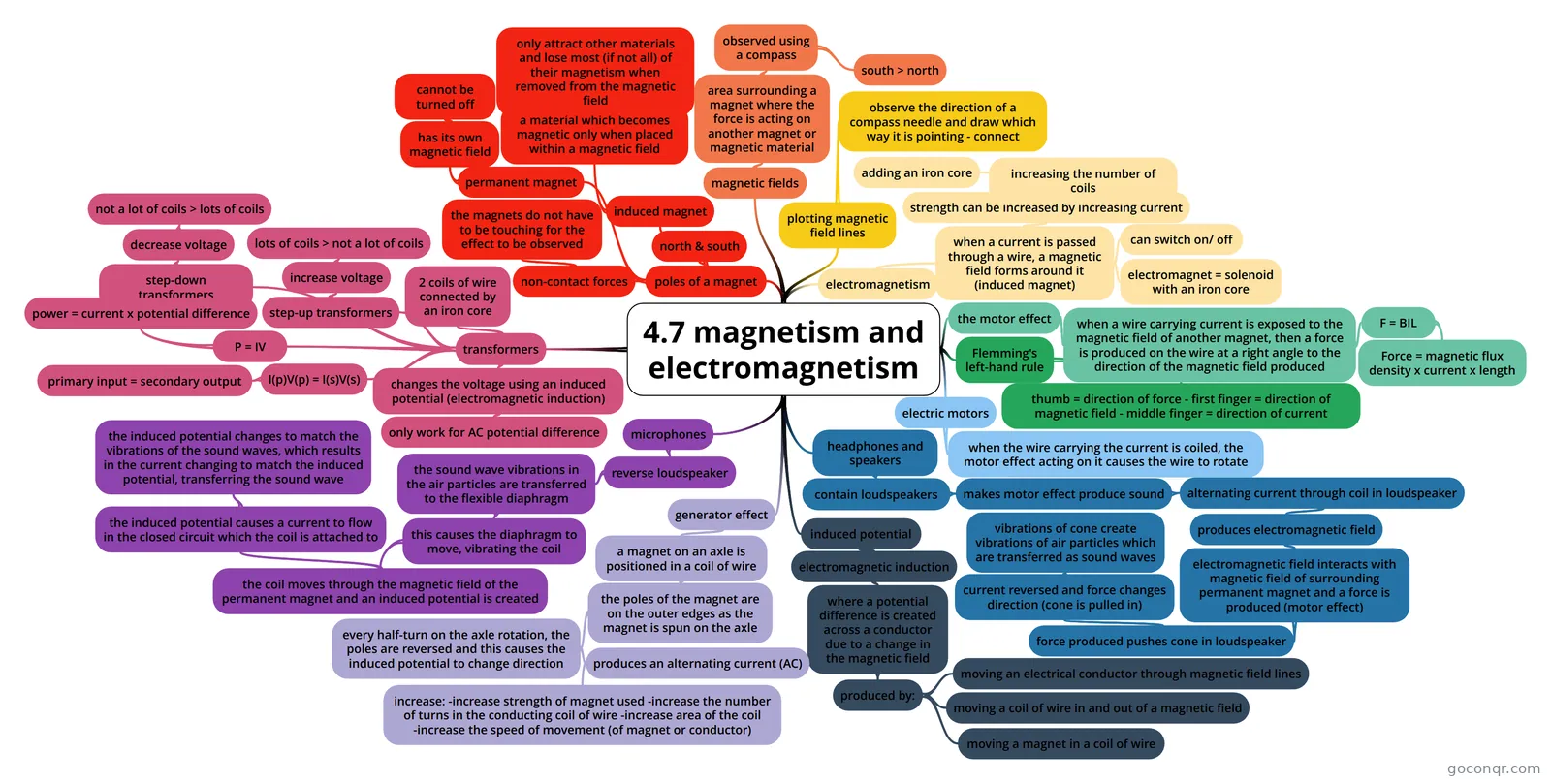
Mind map: magnetism and electromagnetism
Map content
4.7 magnetism and electromagnetism
poles of a magnet
- north & south
- non-contact forces
- the magnets do not have to be touching for the effect to be observed
- permanent magnet
- has its own magnetic field
- cannot be turned off
- has its own magnetic field
- induced magnet
- a material which becomes magnetic only when placed within a magnetic field
- only attract other materials and lose most (if not all) of their magnetism when removed from the magnetic field
- a material which becomes magnetic only when placed within a magnetic field
magnetic fields
- area surrounding a magnet where the force is acting on another magnet or magnetic material
- observed using a compass
- south > north
- observed using a compass
- area surrounding a magnet where the force is acting on another magnet or magnetic material
plotting magnetic field lines
- observe the direction of a compass needle and draw which way it is pointing - connect
electromagnetism
- when a current is passed through a wire, a magnetic field forms around it (induced magnet)
- can switch on/ off
- strength can be increased by increasing current
- adding an iron core
- increasing the number of coils
- electromagnet = solenoid with an iron core
- when a current is passed through a wire, a magnetic field forms around it (induced magnet)
the motor effect
- when a wire carrying current is exposed to the magnetic field of another magnet, then a force is produced on the wire at a right angle to the direction of the magnetic field produced
- F = BIL
- Force = magnetic flux density x current x length
- F = BIL
- when a wire carrying current is exposed to the magnetic field of another magnet, then a force is produced on the wire at a right angle to the direction of the magnetic field produced
Flemming's left-hand rule
- thumb = direction of force - first finger = direction of magnetic field - middle finger = direction of current
electric motors
- when the wire carrying the current is coiled, the motor effect acting on it causes the wire to rotate
headphones and speakers
- contain loudspeakers
- makes motor effect produce sound
- alternating current through coil in loudspeaker
- produces electromagnetic field
- electromagnetic field interacts with magnetic field of surrounding permanent magnet and a force is produced (motor effect)
- force produced pushes cone in loudspeaker
- current reversed and force changes direction (cone is pulled in)
- vibrations of cone create vibrations of air particles which are transferred as sound waves
- current reversed and force changes direction (cone is pulled in)
- force produced pushes cone in loudspeaker
- electromagnetic field interacts with magnetic field of surrounding permanent magnet and a force is produced (motor effect)
- produces electromagnetic field
- alternating current through coil in loudspeaker
- makes motor effect produce sound
- contain loudspeakers
induced potential
- electromagnetic induction
- where a potential difference is created across a conductor due to a change in the magnetic field
- produced by:
- moving a magnet in a coil of wire
- moving an electrical conductor through magnetic field lines
- moving a coil of wire in and out of a magnetic field
- produced by:
- where a potential difference is created across a conductor due to a change in the magnetic field
- electromagnetic induction
transformers
- changes the voltage using an induced potential (electromagnetic induction)
- only work for AC potential difference
- 2 coils of wire connected by an iron core
- step-up transformers
- increase voltage
- lots of coils > not a lot of coils
- increase voltage
- step-down transformers
- decrease voltage
- not a lot of coils > lots of coils
- decrease voltage
- P = IV
- power = current x potential difference
- I(p)V(p) = I(s)V(s)
- primary input = secondary output
- changes the voltage using an induced potential (electromagnetic induction)
generator effect
- a magnet on an axle is positioned in a coil of wire
- the poles of the magnet are on the outer edges as the magnet is spun on the axle
- every half-turn on the axle rotation, the poles are reversed and this causes the induced potential to change direction
- produces an alternating current (AC)
- increase: -increase strength of magnet used -increase the number of turns in the conducting coil of wire -increase area of the coil -increase the speed of movement (of magnet or conductor)
- produces an alternating current (AC)
- every half-turn on the axle rotation, the poles are reversed and this causes the induced potential to change direction
- the poles of the magnet are on the outer edges as the magnet is spun on the axle
- a magnet on an axle is positioned in a coil of wire
microphones
- reverse loudspeaker
- the sound wave vibrations in the air particles are transferred to the flexible diaphragm
- this causes the diaphragm to move, vibrating the coil
- the coil moves through the magnetic field of the permanent magnet and an induced potential is created
- the induced potential causes a current to flow in the closed circuit which the coil is attached to
- the induced potential changes to match the vibrations of the sound waves, which results in the current changing to match the induced potential, transferring the sound wave
- the induced potential causes a current to flow in the closed circuit which the coil is attached to
- the coil moves through the magnetic field of the permanent magnet and an induced potential is created
- this causes the diaphragm to move, vibrating the coil
- the sound wave vibrations in the air particles are transferred to the flexible diaphragm
- reverse loudspeaker
Information
- Description
- GCSE Physics Mind Map on 4.7 magnetism and electromagnetism, created by Rebecca Hall on 25/11/2021.
- Created by
- Rebecca Hall
- Views
- 2
- Rating