
35555853
Description

Mind Map by OSCAR ALEJANDRO ROMERO RODRIGUEZ, updated more than 1 year ago

|
Created by OSCAR ALEJANDRO ROMERO RODRIGUEZ
over 4 years ago
|
|
MacKenzie, 2013, Chapter 5 - Designing
HCI Experiments
- 5.1 What methodology?
- The way the experiment is designed and carried out
- Decide the people (participants), the hardware and software (materials or apparatus), the
tasks, the orfer of the tasks, the procedure for briefing and preparing the participants, the
variables, the data copllected and analyzed, and so on.
- ACM (Association for Computing Machinery), is the
dominant organization overseeing computer science
and related special interests such as HCI
- APA (American Psychological Association), is
the dominant organization overseeing
experimental psychology.
- Publication: Manual of the American Psychological
Association, it's a valuable resource for researchers
undertaking experiments involving human participants
- Publication: Manual of the American Psychological
Association, it's a valuable resource for researchers
undertaking experiments involving human participants
- ACM (Association for Computing Machinery), is the
dominant organization overseeing computer science
and related special interests such as HCI
- Decide the people (participants), the hardware and software (materials or apparatus), the
tasks, the orfer of the tasks, the procedure for briefing and preparing the participants, the
variables, the data copllected and analyzed, and so on.
- Is the bedrock of science, if the method is weak or
flawed, there's no science forthcoming
- An ad-hoc or made-up methodology wakens research
- An ad-hoc or made-up methodology wakens research
- The way the experiment is designed and carried out
- 5.2 Ethics approval
- Crucial step that precedes the design of every
HCI experiment, due humans are involved.
- Researchers must respect, safety,
welfare, and dignity of human
partcipants in their research and
them equally and fairly
- The approval process is governed by the institution
or funding agency overseeing the research.
- Research projects must be accepted by the HRPC (Human
Participant Review Community), the IRB (Institutional Review
Board), or the ERC (Ethics Review Committee), and so on.
- Crucial step that precedes the design of every
HCI experiment, due humans are involved.
- 5.3 Experiment design
- Process of bringing together all the pieces necessary to test
hyphoteses on a user interface or interaction technique.
- Involves deciding on and defining which variables to
use, what tasks and procedure to use, how many
participants to use and how to solicit them, and so on.
- Involves deciding on and defining which variables to
use, what tasks and procedure to use, how many
participants to use and how to solicit them, and so on.
- Questions or expressions that help to identify variables
- "More quickly" or "Fewer steps" capture
the essence of dependent variables.
- "With the interface than with an existing interface"
capture the essence of an independent variable.
- A testable research questions inherently
expresses the relationship between an
independent and a dependent variable.
- "More quickly" or "Fewer steps" capture
the essence of dependent variables.
- Process of bringing together all the pieces necessary to test
hyphoteses on a user interface or interaction technique.
- 5.4 Independent variables
- Is a circumstance or characteristic that is manipulated or
systematically controlled to a change in a human response while
the user is interacting with a computer.
- Also known as a factor variable.
- Experiments designed with
independent variables are often
called factorial experiments.
- Manipulated across multiple (at least two)
levels of the circumstance or characteristic.
- Levels are often called test conditions
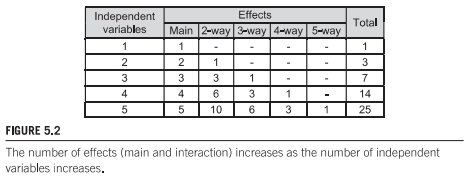
- A design with a single independent
variable includes a main effect
- A design with two independent variables
includes two main effects and one interaction
effect (two way interaction between variables),
for a total of three effects.
- The effect is on the dependent variable
- Levels are often called test conditions
- Manipulated across multiple (at least two)
levels of the circumstance or characteristic.
- Experiments designed with
independent variables are often
called factorial experiments.
- Also known as a factor variable.
- Independent because it is independent of participant
behaviour, there's nothing a participant can do to
influence an independent variable.
- Typically a nominal-scale attribute, often
related to a property of an interface.
- In HCI are anything that migth affect users
proficiency in using a computer system.
- In HCI are anything that migth affect users
proficiency in using a computer system.
- Is a circumstance or characteristic that is manipulated or
systematically controlled to a change in a human response while
the user is interacting with a computer.
- 5.5 Dependent variables
- In HCI is a measured human behaviour
- the most common dependent
varaibles relate to speed and accuracy
- Time often reported as
task completion time.
- Others include preparation time, action time,
thoughput, gaze shifts, mouse-to-keyboard hands
transitions, etc
- Others include preparation time, action time,
thoughput, gaze shifts, mouse-to-keyboard hands
transitions, etc
- Accuracy often reported as the percentage of trials
or other actions performed correctly or incorrectly
(successful rates o error rates are used)
- Time often reported as
task completion time.
- Is the variable that depends on the human
- the most common dependent
varaibles relate to speed and accuracy
- Are the results or effects of independent
variables interactions and manipulations
- Are used for post-test analysis
- In HCI is a measured human behaviour
- 5.6 Other variables
- Control variables
- It's a circumstance, facotr or constant that influence a dependent
variable, and must remain unchanged throughout the course of the
investigation, to influence the outcome.
- It's a circumstance, facotr or constant that influence a dependent
variable, and must remain unchanged throughout the course of the
investigation, to influence the outcome.
- Random variables
- Instead of controlling the
circumstances, or factors, sometime
some migth be allowed to vary
ramdomly.
- Tipically random variables pertain to
characteristics of the participants.
- Tipically random variables pertain to
characteristics of the participants.
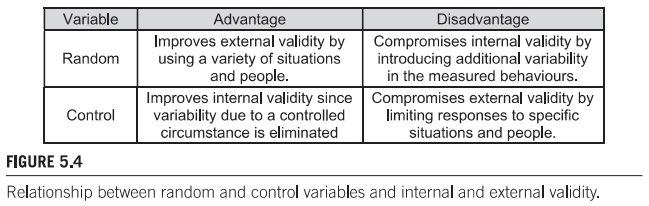
- There is a cost since more variability is introduced in the measures,
but there is a benefit since results are more generalizable.
- Comparisson is best presented in terms of internal and external validity.
- Comparisson is best presented in terms of internal and external validity.
- Instead of controlling the
circumstances, or factors, sometime
some migth be allowed to vary
ramdomly.
- Confounding variables
- Any circumstance or condition that changes
systematically with an independent variable.
- Are usually problematic variables in research, it is not
clear if the effect is presented due the independent
variable or to the confounding variable.
- Researches must eliminate, adjust or
change considerations, to avoid incorrect
interpretations in effects.
- Researches must eliminate, adjust or
change considerations, to avoid incorrect
interpretations in effects.
- Influences independent and dependent variables.
- Any circumstance or condition that changes
systematically with an independent variable.
- Receive considerable less attention and are
rarely mentioned in research papers,
nevertheless are very important in research.
- Control variables
- 5.7 Task and procedure
- There are 2 objectives in designing a good task
(descriminate test conditions), represent and discriminate.
- A task similar to actual or expected usage will improve the external validity (ability
to generalize results in other people and situations)
- A task that is representative of actual usage may
decrease internal validity (the effects observed, i.e. the
differences in means on a dependent variable)
- A task similar to actual or expected usage will improve the external validity (ability
to generalize results in other people and situations)
- Task may require a performance-base or skill bases in HCI
- The experimental procedure includes the
task, the instructions, demostration, or
practice given to the participants.
- There are 2 objectives in designing a good task
(descriminate test conditions), represent and discriminate.
- 5.8 Participants
- HCI often required people with specific
skills, filtering processes might be
required to ensureonly appropiate
participants are used in the research.
- Generalize results to people that were not participants, apply
when these people are member of the same population to
whom results are assumed to hold.
- How many participants are good enough?
- Tip: always investigate similar researches to stablish a base line 'a priori'
- Sometimes statistical significance is otained
wihout need too much participants.
- A large number of participants: statistically significant
results for a difference of no practical significance
- Not enough participants may
prevent statistical significance
from appearing
- Tip: always investigate similar researches to stablish a base line 'a priori'
- Selection method it's also important,
sometimes to have better external
validity, is required to select parcipants
randomly
- The selection criteria should be clear and
stated in the write-up of the methodology,
in a section labeled "Participants"
- HCI often required people with specific
skills, filtering processes might be
required to ensureonly appropiate
participants are used in the research.
- 5.9 Questionnaire design
- Purposes in most HCI experiments
- Gather information
on demographics
(age, gender, etc)
- Experience with
related
technology
- Are also used at the end of the research to
obtain opinions and feelings from participants
about the interfaces or interaction techniques
- Gather information
on demographics
(age, gender, etc)
- Questionnaires are the
primary instrument for
survey research
- Sometimes when giving
response options, is
useful to add the option
'Other'
- Have in mind the question be useful to easily
calculate standard deviations, relationships in
data for ratio-scale, include ratio-scale items
helps to find correlated responses
- Ordinal responses helps to obtain ordinal data, although
inherently is lower data quality than ratio-scale
- Ordinal responses helps to obtain ordinal data, although
inherently is lower data quality than ratio-scale
- Sometimes when giving
response options, is
useful to add the option
'Other'
- Purposes in most HCI experiments
- 5.10 Within-subjects and between-subjects
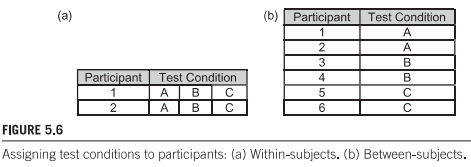
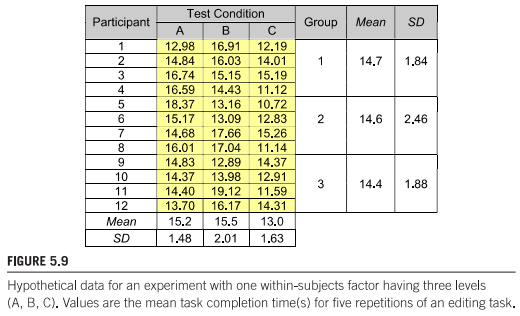
- Within-subjects
- Each participant is tested on each level.
- Also called repeated measures,
because the measurements on
each test condition are repeated
for each participant.
- Requires fewer participants but
more testing for each participant
- The variance due to paticipants will be
approximately the same across test conditions
- It is not necessary to balance groups,
because there's only one group
- Each participant is tested on each level.
- Between-subjects
- Each participant is tested only in one level.
- Balance groups of participants is required
to ensure the groups are more or less
equal in terms of characteristics that might
introduce bias in the measurements
- Balancing is usually done through a
random assigment, but also assignation
according to reasonable criteria
- Balancing is usually done through a
random assigment, but also assignation
according to reasonable criteria
- Avoid interference (conflict that arises when a participant is
exposed to one test condition and then switches to another
test condition) between test conditions
- The majority of facotrs that
appear in HCI experiments are
like this
- The majority of facotrs that
appear in HCI experiments are
like this
- More participants are needed to obtain the same
number of observations for each test condition
- Each participant is tested only in one level.
- How to administering test conditions (levels or factors) in participants
- For an experiment with two factors
it is posible top assign the levels of
one factor within-subjects and the
levels of the other factor
between-subjects.
- This is known as mixed design
- This is known as mixed design
- Within-subjects
- 5.11 Order effects, counterbalancing, and latin squares
- Order effects
occurs depending
on the nature of
the task
- Practice in
within-subjects is a
confounding
variable due the
practice increases
systematically from
one test condition
to the next.
- Known as
practice effect
or learnig effect
- An effect of fatigue
may follow after this,
and so on.
- An effect of fatigue
may follow after this,
and so on.
- When the experiment has
confounding influence, it's
necessary make a compensatory
ordering of conditions
- Most common method of
compensating order effects is to
divide participants into groups
and administer conditions in
different order
- Most common method of
compensating order effects is to
divide participants into groups
and administer conditions in
different order
- Known as
practice effect
or learnig effect
- Practice in
within-subjects is a
confounding
variable due the
practice increases
systematically from
one test condition
to the next.
- Counterbalancing
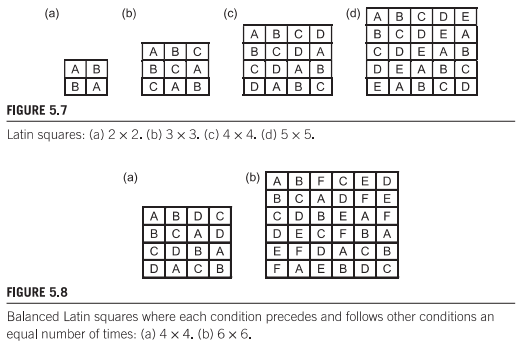
- A lating square is an n X n table filled with n different symbols positoned
such that each symbol occurs exactly once in each row and each column.
- Order effects
occurs depending
on the nature of
the task
- 5.12 Group effects and asymmetric skill transfer
- There are cases where different effects appear for
one order A -> B compared to another B -> A
- In such cases there migth be a group effect (differences across groups in
the mean scores on a dependent variable)
- Counterbalancing does not work
- Usually due to asymmetric skill transfer
(differences in the amount of impromented,
depedning on the order of testing)
- Counterbalancing does not work
- In such cases there migth be a group effect (differences across groups in
the mean scores on a dependent variable)
- There are cases where different effects appear for
one order A -> B compared to another B -> A
- 5.13 Longitudinal studies
- An experimental evaluation
where participants practice
over a prolonged period.
- Sometimes the research has a
particular interest in learning,
or the acquisition of skill.
- In this case the experimental procedure invovles testing user over a prolonged period
while their impromevement in performance is measured.
- Learning is not eliminated using methods as
counterbalancing, order effects or learning
effects are important in this case.
- Learning is not eliminated using methods as
counterbalancing, order effects or learning
effects are important in this case.
- In this case the experimental procedure invovles testing user over a prolonged period
while their impromevement in performance is measured.
- Sometimes the research has a
particular interest in learning,
or the acquisition of skill.
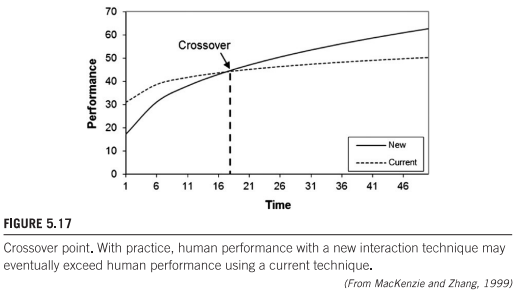
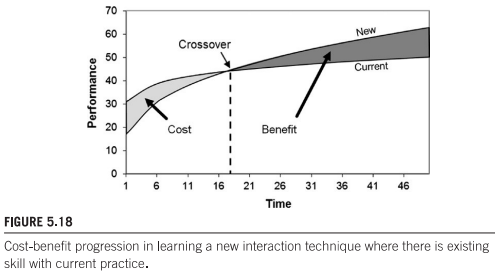
- Crossover point
and cost-benefit
- An experimental evaluation
where participants practice
over a prolonged period.
- 5.14 Running the experiment
- Experment design ✓, Apparatis build and tested ✓,
Participant recruited and scheduled ✓
- Are you sure the time to begin the
experiment has arrived?
- Are you sure the time to begin the
experiment has arrived?
- It is always useful to have a pilot test
- It can be with oen or two participants
- Helps to:
- Smooth out the prtocol for briefing
- Preparint participants
- Check the amount of time per participant
- Check if instructions are clear enough for participants
- Avoid undepressure on participants
- Avoid conveying indifference or disregard
- Smooth out the prtocol for briefing
- Helps to:
- It can be with oen or two participants
- Experment design ✓, Apparatis build and tested ✓,
Participant recruited and scheduled ✓
Media attachments
Want to create your own Mind Maps for free with GoConqr? Learn more.