
Mind map
IDEA DEVELOPMENT By: Brayan Martinez De Santiago
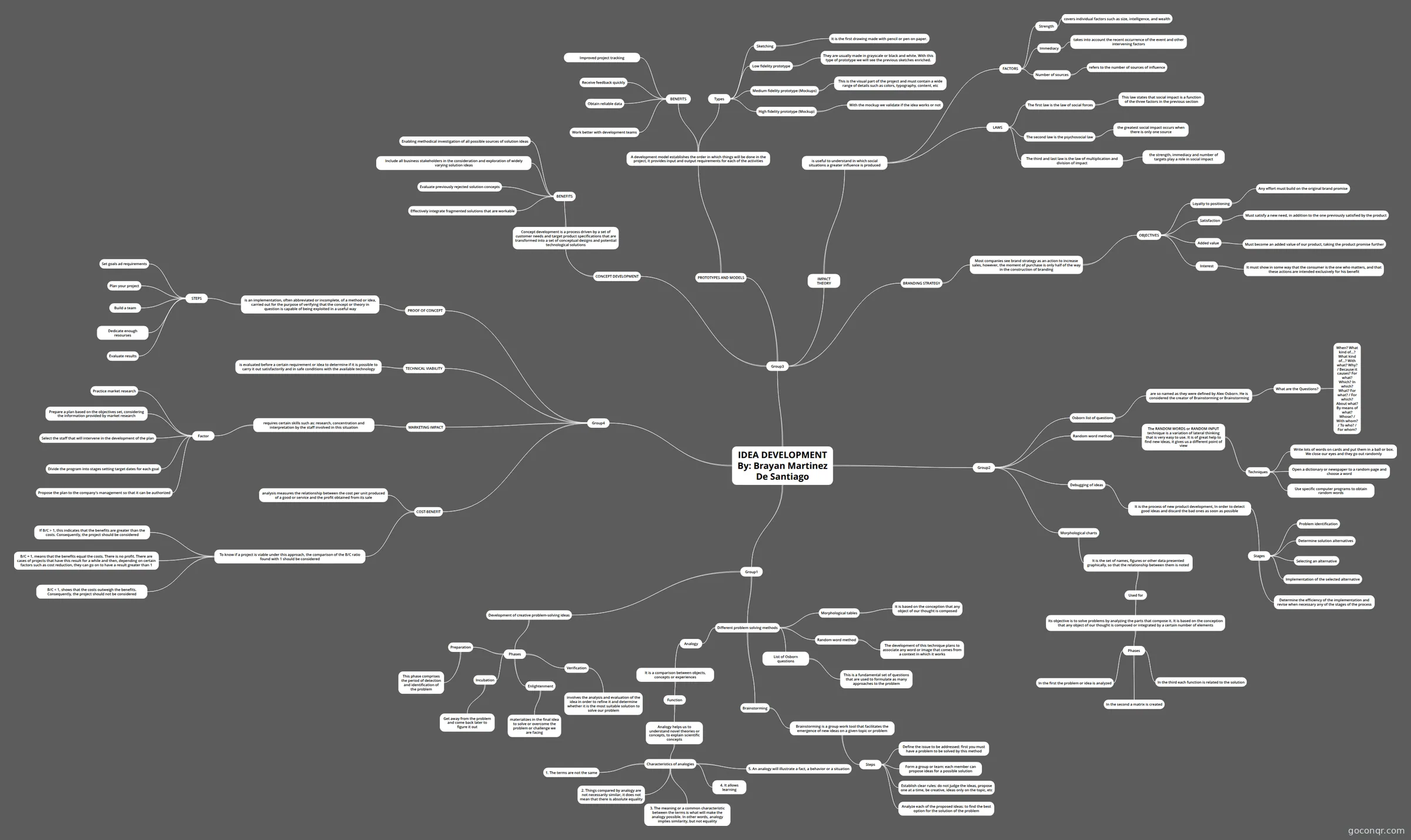
Mind map: Idea development
Map content
IDEA DEVELOPMENT By: Brayan Martinez De Santiago
Group1
- Development of creative problem-solving ideas
- Phases
- Preparation
- This phase comprises the period of detection and identification of the problem
- Incubation
- Get away from the problem and come back later to figure it out
- Enlightenment
- materializes in the final idea to solve or overcome the problem or challenge we are facing
- Verification
- involves the analysis and evaluation of the idea in order to refine it and determine whether it is the most suitable solution to solve our problem
- Preparation
- Phases
- Different problem solving methods
- List of Osborn questions
- This is a fundamental set of questions that are used to formulate as many approaches to the problem
- Random word method
- The development of this technique plans to associate any word or image that comes from a context in which it works
- Morphological tables
- It is based on the conception that any object of our thought is composed
- Analogy
- It is a comparison between objects, concepts or experiences
- Function
- Analogy helps us to understand novel theories or concepts, to explain scientific concepts
- Characteristics of analogies
- 1. The terms are not the same
- 2. Things compared by analogy are not necessarily similar, it does not mean that there is absolute equality
- 3. The meaning or a common characteristic between the terms is what will make the analogy possible. In other words, analogy implies similarity, but not equality
- 4. It allows learning
- 5. An analogy will illustrate a fact, a behavior or a situation
- Characteristics of analogies
- Analogy helps us to understand novel theories or concepts, to explain scientific concepts
- Function
- It is a comparison between objects, concepts or experiences
- Brainstorming
- Brainstorming is a group work tool that facilitates the emergence of new ideas on a given topic or problem
- Steps
- Define the issue to be addressed: first you must have a problem to be solved by this method
- Form a group or team: each member can propose ideas for a possible solution
- Establish clear rules: do not judge the ideas, propose one at a time, be creative, ideas only on the topic, etc
- Analyze each of the proposed ideas: to find the best option for the solution of the problem
- Steps
- Brainstorming is a group work tool that facilitates the emergence of new ideas on a given topic or problem
- List of Osborn questions
- Development of creative problem-solving ideas
Group2
- Osborn list of questions
- are so named as they were defined by Alex Osborn. He is considered the creator of Brainstorming or Brainstorming
- What are the Questions?
- When? What kind of...? What kind of...? With what? Why? / Because it causes? For what? Which? In which? What? For what? / For which? About what? By means of what? Whose? / With whom? / To who? / For whom?
- What are the Questions?
- are so named as they were defined by Alex Osborn. He is considered the creator of Brainstorming or Brainstorming
- Random word method
- The RANDOM WORDS or RANDOM INPUT technique is a variation of lateral thinking that is very easy to use. It is of great help to find new ideas, it gives us a different point of view
- Techniques
- Write lots of words on cards and put them in a ball or box. We close our eyes and they go out randomly
- Open a dictionary or newspaper to a random page and choose a word
- Use specific computer programs to obtain random words
- Techniques
- The RANDOM WORDS or RANDOM INPUT technique is a variation of lateral thinking that is very easy to use. It is of great help to find new ideas, it gives us a different point of view
- Debugging of ideas
- It is the process of new product development, In order to detect good ideas and discard the bad ones as soon as possible
- Stages
- Problem identification
- Determine solution alternatives
- Selecting an alternative
- Implementation of the selected alternative
- Determine the efficiency of the implementation and revise when necessary any of the stages of the process
- Stages
- It is the process of new product development, In order to detect good ideas and discard the bad ones as soon as possible
- Morphological charts
- It is the set of names, figures or other data presented graphically, so that the relationship between them is noted
- Used for
- Its objective is to solve problems by analyzing the parts that compose it. It is based on the conception that any object of our thought is composed or integrated by a certain number of elements
- Phases
- In the first the problem or idea is analyzed
- In the second a matrix is created
- In the third each function is related to the solution
- Phases
- Its objective is to solve problems by analyzing the parts that compose it. It is based on the conception that any object of our thought is composed or integrated by a certain number of elements
- Used for
- It is the set of names, figures or other data presented graphically, so that the relationship between them is noted
- Osborn list of questions
Group3
- CONCEPT DEVELOPMENT
- Concept development is a process driven by a set of customer needs and target product specifications that are transformed into a set of conceptual designs and potential technological solutions
- BENEFITS
- Enabling methodical investigation of all possible sources of solution ideas
- Include all business stakeholders in the consideration and exploration of widely varying solution ideas
- Evaluate previously rejected solution concepts
- Effectively integrate fragmented solutions that are workable
- BENEFITS
- Concept development is a process driven by a set of customer needs and target product specifications that are transformed into a set of conceptual designs and potential technological solutions
- PROTOTYPES AND MODELS
- A development model establishes the order in which things will be done in the project, it provides input and output requirements for each of the activities
- BENEFITS
- Improved project tracking
- Receive feedback quickly
- Obtain reliable data
- Work better with development teams
- Types
- Sketching
- It is the first drawing made with pencil or pen on paper.
- Low fidelity prototype
- They are usually made in grayscale or black and white. With this type of prototype we will see the previous sketches enriched.
- Medium fidelity prototype (Mockups)
- This is the visual part of the project and must contain a wide range of details such as colors, typography, content, etc
- High fidelity prototype (Mockup)
- With the mockup we validate if the idea works or not
- Sketching
- BENEFITS
- A development model establishes the order in which things will be done in the project, it provides input and output requirements for each of the activities
- IMPACT THEORY
- is useful to understand in which social situations a greater influence is produced
- FACTORS
- Strength
- covers individual factors such as size, intelligence, and wealth
- Immediacy
- takes into account the recent occurrence of the event and other intervening factors
- Number of sources
- refers to the number of sources of influence
- Strength
- LAWS
- The first law is the law of social forces
- This law states that social impact is a function of the three factors in the previous section
- The second law is the psychosocial law
- the greatest social impact occurs when there is only one source
- The third and last law is the law of multiplication and division of impact
- the strength, immediacy and number of targets play a role in social impact
- The first law is the law of social forces
- FACTORS
- is useful to understand in which social situations a greater influence is produced
- BRANDING STRATEGY
- Most companies see brand strategy as an action to increase sales, however, the moment of purchase is only half of the way in the construction of branding
- OBJECTIVES
- Loyalty to positioning
- Any effort must build on the original brand promise
- Satisfaction
- Must satisfy a new need, in addition to the one previously satisfied by the product
- Added value
- Must become an added value of our product, taking the product promise further
- Interest
- It must show in some way that the consumer is the one who matters, and that these actions are intended exclusively for his benefit
- Loyalty to positioning
- OBJECTIVES
- Most companies see brand strategy as an action to increase sales, however, the moment of purchase is only half of the way in the construction of branding
- CONCEPT DEVELOPMENT
Group4
- PROOF OF CONCEPT
- is an implementation, often abbreviated or incomplete, of a method or idea, carried out for the purpose of verifying that the concept or theory in question is capable of being exploited in a useful way
- STEPS
- Set goals ad requirements
- Plan your project
- Build a team
- Dedicate enough resourses
- Evaluate results
- STEPS
- is an implementation, often abbreviated or incomplete, of a method or idea, carried out for the purpose of verifying that the concept or theory in question is capable of being exploited in a useful way
- TECHNICAL VIABILITY
- is evaluated before a certain requirement or idea to determine if it is possible to carry it out satisfactorily and in safe conditions with the available technology
- MARKETING IMPACT
- requires certain skills such as: research, concentration and interpretation by the staff involved in this situation
- Factor
- Practice market research
- Prepare a plan based on the objectives set, considering the information provided by market research
- Select the staff that will intervene in the development of the plan
- Divide the program into stages setting target dates for each goal
- Propose the plan to the company's management so that it can be authorized
- Factor
- requires certain skills such as: research, concentration and interpretation by the staff involved in this situation
- COST-BENEFIT
- analysis measures the relationship between the cost per unit produced of a good or service and the profit obtained from its sale
- To know if a project is viable under this approach, the comparison of the B/C ratio found with 1 should be considered
- If B/C > 1, this indicates that the benefits are greater than the costs. Consequently, the project should be considered
- B/C = 1, means that the benefits equal the costs. There is no profit. There are cases of projects that have this result for a while and then, depending on certain factors such as cost reduction, they can go on to have a result greater than 1
- B/C < 1, shows that the costs outweigh the benefits. Consequently, the project should not be considered
- PROOF OF CONCEPT
Information
- Description
- Mind Map on IDEA DEVELOPMENT By: Brayan Martinez De Santiago, created by BRAYAN MARTINEZ DE SANTIAGO on 09/03/2022.
- Created by
- BRAYAN MARTINEZ DE SANTIAGO
- Views
- 40
- Rating