
Mind map
WAN Technologies
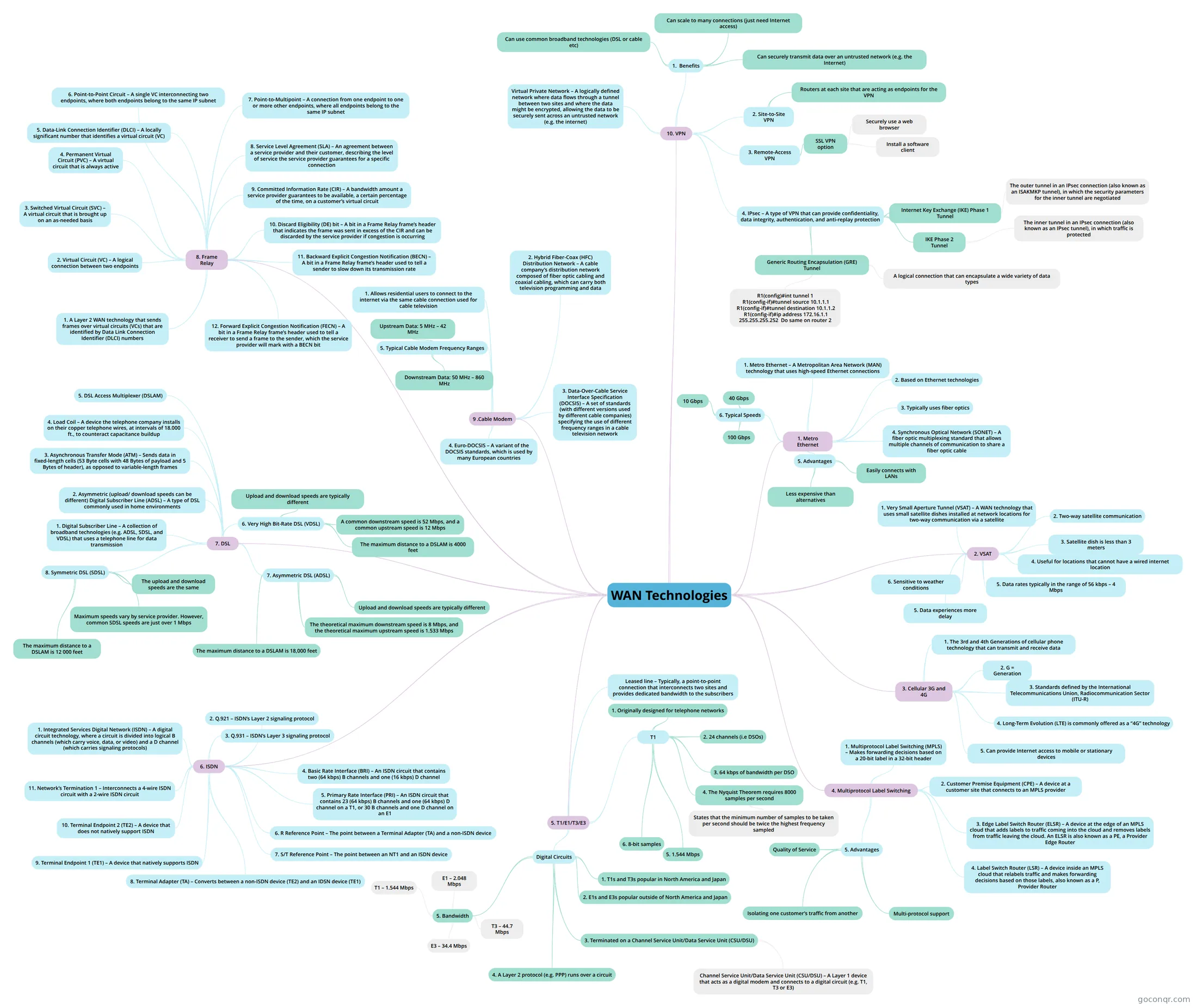
Mind map: WAN technologies
Map content
WAN Technologies
10. VPN
- Virtual Private Network – A logically defined network where data flows through a tunnel between two sites and where the data might be encrypted, allowing the data to be securely sent across an untrusted network (e.g. the internet)
- 1. Benefits
- Can use common broadband technologies (DSL or cable etc)
- Can scale to many connections (just need Internet access)
- Can securely transmit data over an untrusted network (e.g. the Internet)
- 2. Site-to-Site VPN
- Routers at each site that are acting as endpoints for the VPN
- 3. Remote-Access VPN
- SSL VPN option
- Securely use a web browser
- Install a software client
- SSL VPN option
- 4. IPsec – A type of VPN that can provide confidentiality, data integrity, authentication, and anti-replay protection
- Internet Key Exchange (IKE) Phase 1 Tunnel
- The outer tunnel in an IPsec connection (also known as an ISAKMKP tunnel), in which the security parameters for the inner tunnel are negotiated
- IKE Phase 2 Tunnel
- The inner tunnel in an IPsec connection (also known as an IPsec tunnel), in which traffic is protected
- Generic Routing Encapsulation (GRE) Tunnel
- A logical connection that can encapsulate a wide variety of data types
- R1(config)#int tunnel 1 R1(config-if)#tunnel source 10.1.1.1 R1(config-if)#tunnel destination 10.1.1.2 R1(config-if)#ip address 172.16.1.1 255.255.255.252 Do same on router 2
- Internet Key Exchange (IKE) Phase 1 Tunnel
1. Metro Ethernet
- 1. Metro Ethernet – A Metropolitan Area Network (MAN) technology that uses high-speed Ethernet connections
- 2. Based on Ethernet technologies
- 3. Typically uses fiber optics
- 4. Synchronous Optical Network (SONET) – A fiber optic multiplexing standard that allows multiple channels of communication to share a fiber optic cable
- 5. Advantages
- Easily connects with LANs
- Less expensive than alternatives
- 6. Typical Speeds
- 10 Gbps
- 40 Gbps
- 100 Gbps
2. VSAT
- 1. Very Small Aperture Tunnel (VSAT) – A WAN technology that uses small satellite dishes installed at network locations for two-way communication via a satellite
- 2. Two-way satellite communication
- 3. Satellite dish is less than 3 meters
- 4. Useful for locations that cannot have a wired internet location
- 5. Data rates typically in the range of 56 kbps – 4 Mbps
- 5. Data experiences more delay
- 6. Sensitive to weather conditions
3. Cellular 3G and 4G
- 1. The 3rd and 4th Generations of cellular phone technology that can transmit and receive data
- 2. G = Generation
- 3. Standards defined by the International Telecommunications Union, Radiocommunication Sector (ITU-R)
- 4. Long-Term Evolution (LTE) is commonly offered as a “4G” technology
- 5. Can provide Internet access to mobile or stationary devices
6. ISDN
- 1. Integrated Services Digital Network (ISDN) – A digital circuit technology, where a circuit is divided into logical B channels (which carry voice, data, or video) and a D channel (which carries signaling protocols)
- 2. Q.921 – ISDN’s Layer 2 signaling protocol
- 3. Q.931 – ISDN’s Layer 3 signaling protocol
- 4. Basic Rate Interface (BRI) – An ISDN circuit that contains two (64 kbps) B channels and one (16 kbps) D channel
- 5. Primary Rate Interface (PRI) – An ISDN circuit that contains 23 (64 kbps) B channels and one (64 kbps) D channel on a T1, or 30 B channels and one D channel on an E1
- 6. R Reference Point – The point between a Terminal Adapter (TA) and a non-ISDN device
- 7. S/T Reference Point – The point between an NT1 and an ISDN device
- 8. Terminal Adapter (TA) – Converts between a non-ISDN device (TE2) and an IDSN device (TE1)
- 9. Terminal Endpoint 1 (TE1) – A device that natively supports ISDN
- 10. Terminal Endpoint 2 (TE2) – A device that does not natively support ISDN
- 11. Network’s Termination 1 – Interconnects a 4-wire ISDN circuit with a 2-wire ISDN circuit
7. DSL
- 1. Digital Subscriber Line – A collection of broadband technologies (e.g. ADSL, SDSL, and VDSL) that uses a telephone line for data transmission
- 2. Asymmetric (upload/ download speeds can be different) Digital Subscriber Line (ADSL) – A type of DSL commonly used in home environments
- 3. Asynchronous Transfer Mode (ATM) – Sends data in fixed-length cells (53 Byte cells with 48 Bytes of payload and 5 Bytes of header), as opposed to variable-length frames
- 4. Load Coil – A device the telephone company installs on their copper telephone wires, at intervals of 18.000 ft., to counteract capacitance buildup
- 5. DSL Access Multiplexer (DSLAM)
- 7. Asymmetric DSL (ADSL)
- Upload and download speeds are typically different
- The theoretical maximum downstream speed is 8 Mbps, and the theoretical maximum upstream speed is 1.533 Mbps
- The maximum distance to a DSLAM is 18,000 feet
- 8. Symmetric DSL (SDSL)
- The upload and download speeds are the same
- Maximum speeds vary by service provider. However, common SDSL speeds are just over 1 Mbps
- The maximum distance to a DSLAM is 12 000 feet
- 6. Very High Bit-Rate DSL (VDSL)
- Upload and download speeds are typically different
- A common downstream speed is 52 Mbps, and a common upstream speed is 12 Mbps
- The maximum distance to a DSLAM is 4000 feet
8. Frame Relay
- 1. A Layer 2 WAN technology that sends frames over virtual circuits (VCs) that are identified by Data Link Connection Identifier (DLCI) numbers
- 2. Virtual Circuit (VC) – A logical connection between two endpoints
- 3. Switched Virtual Circuit (SVC) – A virtual circuit that is brought up on an as-needed basis
- 4. Permanent Virtual Circuit (PVC) – A virtual circuit that is always active
- 5. Data-Link Connection Identifier (DLCI) – A locally significant number that identifies a virtual circuit (VC)
- 6. Point-to-Point Circuit – A single VC interconnecting two endpoints, where both endpoints belong to the same IP subnet
- 7. Point-to-Multipoint – A connection from one endpoint to one or more other endpoints, where all endpoints belong to the same IP subnet
- 8. Service Level Agreement (SLA) – An agreement between a service provider and their customer, describing the level of service the service provider guarantees for a specific connection
- 9. Committed Information Rate (CIR) – A bandwidth amount a service provider guarantees to be available, a certain percentage of the time, on a customer’s virtual circuit
- 10. Discard Eligibility (DE) bit – A bit in a Frame Relay frame’s header that indicates the frame was sent in excess of the CIR and can be discarded by the service provider if congestion is occurring
- 11. Backward Explicit Congestion Notification (BECN) – A bit in a Frame Relay frame’s header used to tell a sender to slow down its transmission rate
- 12. Forward Explicit Congestion Notification (FECN) – A bit in a Frame Relay frame’s header used to tell a receiver to send a frame to the sender, which the service provider will mark with a BECN bit
9 .Cable Modem
- 1. Allows residential users to connect to the internet via the same cable connection used for cable television
- 2. Hybrid Fiber-Coax (HFC) Distribution Network – A cable company’s distribution network composed of fiber optic cabling and coaxial cabling, which can carry both television programming and data
- 5. Typical Cable Modem Frequency Ranges
- Upstream Data: 5 MHz – 42 MHz
- Downstream Data: 50 MHz – 860 MHz
- 3. Data-Over-Cable Service Interface Specification (DOCSIS) – A set of standards (with different versions used by different cable companies) specifying the use of different frequency ranges in a cable television network
- 4. Euro-DOCSIS – A variant of the DOCSIS standards, which is used by many European countries
5. T1/E1/T3/E3
- Leased line – Typically, a point-to-point connection that interconnects two sites and provides dedicated bandwidth to the subscribers
- T1
- 1. Originally designed for telephone networks
- 2. 24 channels (i.e DSOs)
- 3. 64 kbps of bandwidth per DSO
- 4. The Nyquist Theorem requires 8000 samples per second
- States that the minimum number of samples to be taken per second should be twice the highest frequency sampled
- 6. 8-bit samples
- 5. 1.544 Mbps
- Digital Circuits
- 1. T1s and T3s popular in North America and Japan
- 2. E1s and E3s popular outside of North America and Japan
- 3. Terminated on a Channel Service Unit/Data Service Unit (CSU/DSU)
- Channel Service Unit/Data Service Unit (CSU/DSU) – A Layer 1 device that acts as a digital modem and connects to a digital circuit (e.g. T1, T3 or E3)
- 4. A Layer 2 protocol (e.g. PPP) runs over a circuit
- 5. Bandwidth
- T1 – 1.544 Mbps
- E1 – 2.048 Mbps
- T3 – 44.7 Mbps
- E3 – 34.4 Mbps
4. Multiprotocol Label Switching
- 1. Multiprotocol Label Switching (MPLS) – Makes forwarding decisions based on a 20-bit label in a 32-bit header
- 2. Customer Premise Equipment (CPE) – A device at a customer site that connects to an MPLS provider
- 3. Edge Label Switch Router (ELSR) – A device at the edge of an MPLS cloud that adds labels to traffic coming into the cloud and removes labels from traffic leaving the cloud. An ELSR is also known as a PE, a Provider Edge Router
- 4. Label Switch Router (LSR) – A device inside an MPLS cloud that relabels traffic and makes forwarding decisions based on those labels, also known as a P, Provider Router
- 5. Advantages
- Quality of Service
- Isolating one customer’s traffic from another
- Multi-protocol support
Information
- Description
- Mind Map on WAN Technologies, created by Sharni Knight on 05/10/2015.
- Created by
- Sharni Knight
- Views
- 1
- Rating