
Mind map
RELATIONSHIP BETWEEN VICTOR AND THE CREATURE
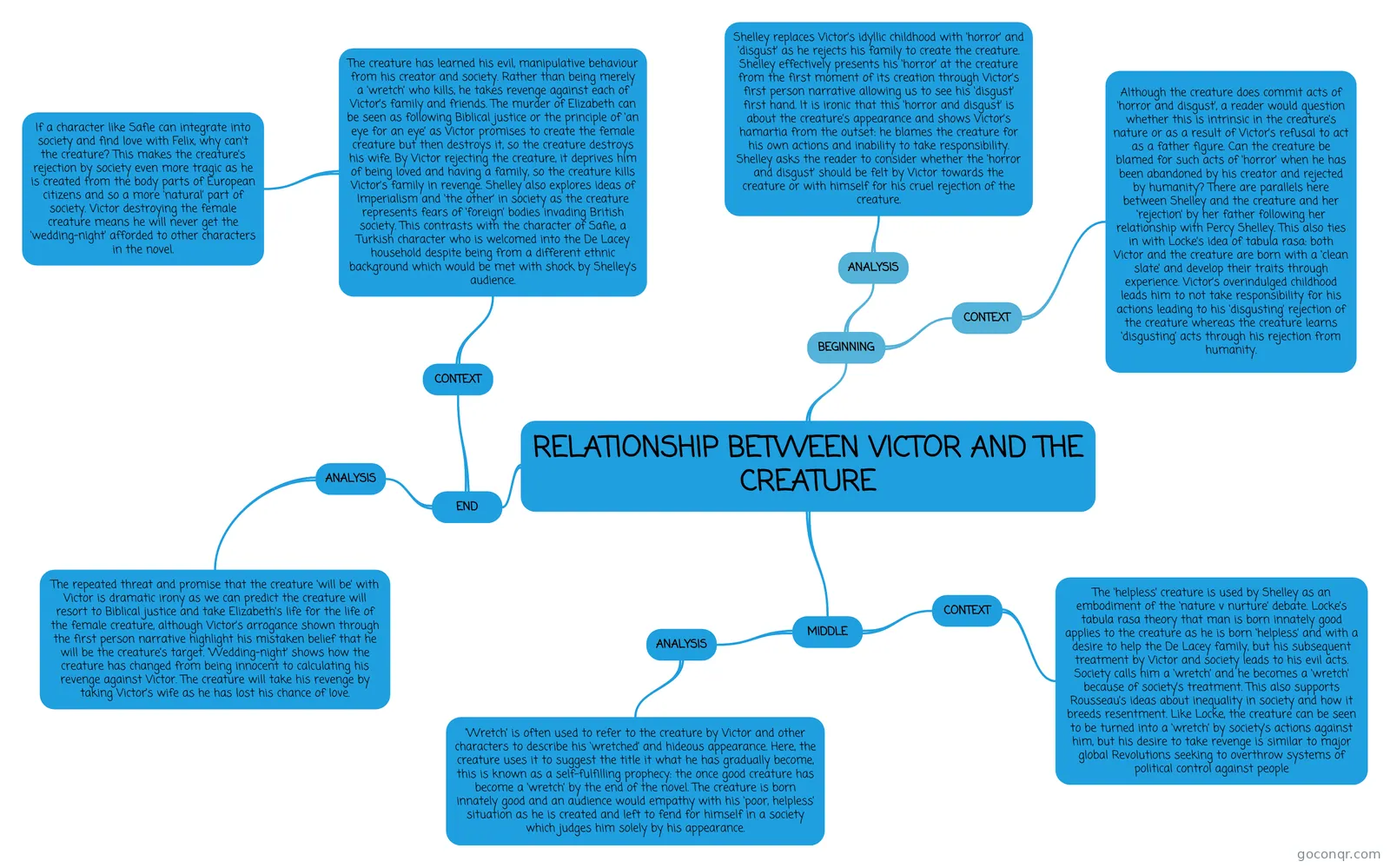
Mind map: Relationship between Victor and the creature
Map content
RELATIONSHIP BETWEEN VICTOR AND THE CREATURE
BEGINNING
- ANALYSIS
- Shelley replaces Victor’s idyllic childhood with ‘horror’ and ‘disgust’ as he rejects his family to create the creature. Shelley effectively presents his ‘horror’ at the creature from the first moment of its creation through Victor’s first person narrative allowing us to see his ‘disgust’ first hand. It is ironic that this ‘horror and disgust’ is about the creature’s appearance and shows Victor’s hamartia from the outset: he blames the creature for his own actions and inability to take responsibility. Shelley asks the reader to consider whether the ‘horror and disgust’ should be felt by Victor towards the creature or with himself for his cruel rejection of the creature.
- CONTEXT
- Although the creature does commit acts of ‘horror and disgust’, a reader would question whether this is intrinsic in the creature’s nature or as a result of Victor’s refusal to act as a father figure. Can the creature be blamed for such acts of ‘horror’ when he has been abandoned by his creator and rejected by humanity? There are parallels here between Shelley and the creature and her ‘rejection’ by her father following her relationship with Percy Shelley. This also ties in with Locke’s idea of tabula rasa: both Victor and the creature are born with a ‘clean slate’ and develop their traits through experience. Victor’s overindulged childhood leads him to not take responsibility for his actions leading to his ‘disgusting’ rejection of the creature whereas the creature learns ‘disgusting’ acts through his rejection from humanity.
- ANALYSIS
MIDDLE
- ANALYSIS
- ‘Wretch’ is often used to refer to the creature by Victor and other characters to describe his ‘wretched’ and hideous appearance. Here, the creature uses it to suggest the title it what he has gradually become, this is known as a self-fulfilling prophecy: the once good creature has become a ‘wretch’ by the end of the novel. The creature is born innately good and an audience would empathy with his ‘poor, helpless’ situation as he is created and left to fend for himself in a society which judges him solely by his appearance.
- CONTEXT
- The ‘helpless’ creature is used by Shelley as an embodiment of the ‘nature v nurture’ debate. Locke’s tabula rasa theory that man is born innately good applies to the creature as he is born ‘helpless’ and with a desire to help the De Lacey family, but his subsequent treatment by Victor and society leads to his evil acts. Society calls him a ‘wretch’ and he becomes a ‘wretch’ because of society’s treatment. This also supports Rousseau’s ideas about inequality in society and how it breeds resentment. Like Locke, the creature can be seen to be turned into a ‘wretch’ by society’s actions against him, but his desire to take revenge is similar to major global Revolutions seeking to overthrow systems of political control against people
- ANALYSIS
END
- ANALYSIS
- The repeated threat and promise that the creature ‘will be’ with Victor is dramatic irony as we can predict the creature will resort to Biblical justice and take Elizabeth’s life for the life of the female creature, although Victor’s arrogance shown through the first person narrative highlight his mistaken belief that he will be the creature’s target. ‘Wedding-night’ shows how the creature has changed from being innocent to calculating his revenge against Victor. The creature will take his revenge by taking Victor’s wife as he has lost his chance of love.
- CONTEXT
- The creature has learned his evil, manipulative behaviour from his creator and society. Rather than being merely a ‘wretch’ who kills, he takes revenge against each of Victor’s family and friends. The murder of Elizabeth can be seen as following Biblical justice or the principle of ‘an eye for an eye’ as Victor promises to create the female creature but then destroys it, so the creature destroys his wife. By Victor rejecting the creature, it deprives him of being loved and having a family, so the creature kills Victor’s family in revenge. Shelley also explores ideas of Imperialism and ‘the other’ in society as the creature represents fears of ‘foreign’ bodies invading British society. This contrasts with the character of Safie, a Turkish character who is welcomed into the De Lacey household despite being from a different ethnic background which would be met with shock by Shelley’s audience.
- If a character like Safie can integrate into society and find love with Felix, why can't the creature? This makes the creature’s rejection by society even more tragic as he is created from the body parts of European citizens and so a more ‘natural’ part of society. Victor destroying the female creature means he will never get the ‘wedding-night’ afforded to other characters in the novel.
- The creature has learned his evil, manipulative behaviour from his creator and society. Rather than being merely a ‘wretch’ who kills, he takes revenge against each of Victor’s family and friends. The murder of Elizabeth can be seen as following Biblical justice or the principle of ‘an eye for an eye’ as Victor promises to create the female creature but then destroys it, so the creature destroys his wife. By Victor rejecting the creature, it deprives him of being loved and having a family, so the creature kills Victor’s family in revenge. Shelley also explores ideas of Imperialism and ‘the other’ in society as the creature represents fears of ‘foreign’ bodies invading British society. This contrasts with the character of Safie, a Turkish character who is welcomed into the De Lacey household despite being from a different ethnic background which would be met with shock by Shelley’s audience.
- ANALYSIS
Information
- Description
- Mind Map on RELATIONSHIP BETWEEN VICTOR AND THE CREATURE, created by Sarah Mawson on 31/05/2022.
- Created by
- Sarah Mawson
- Views
- 0
- Rating