
Mind map
Enter text here
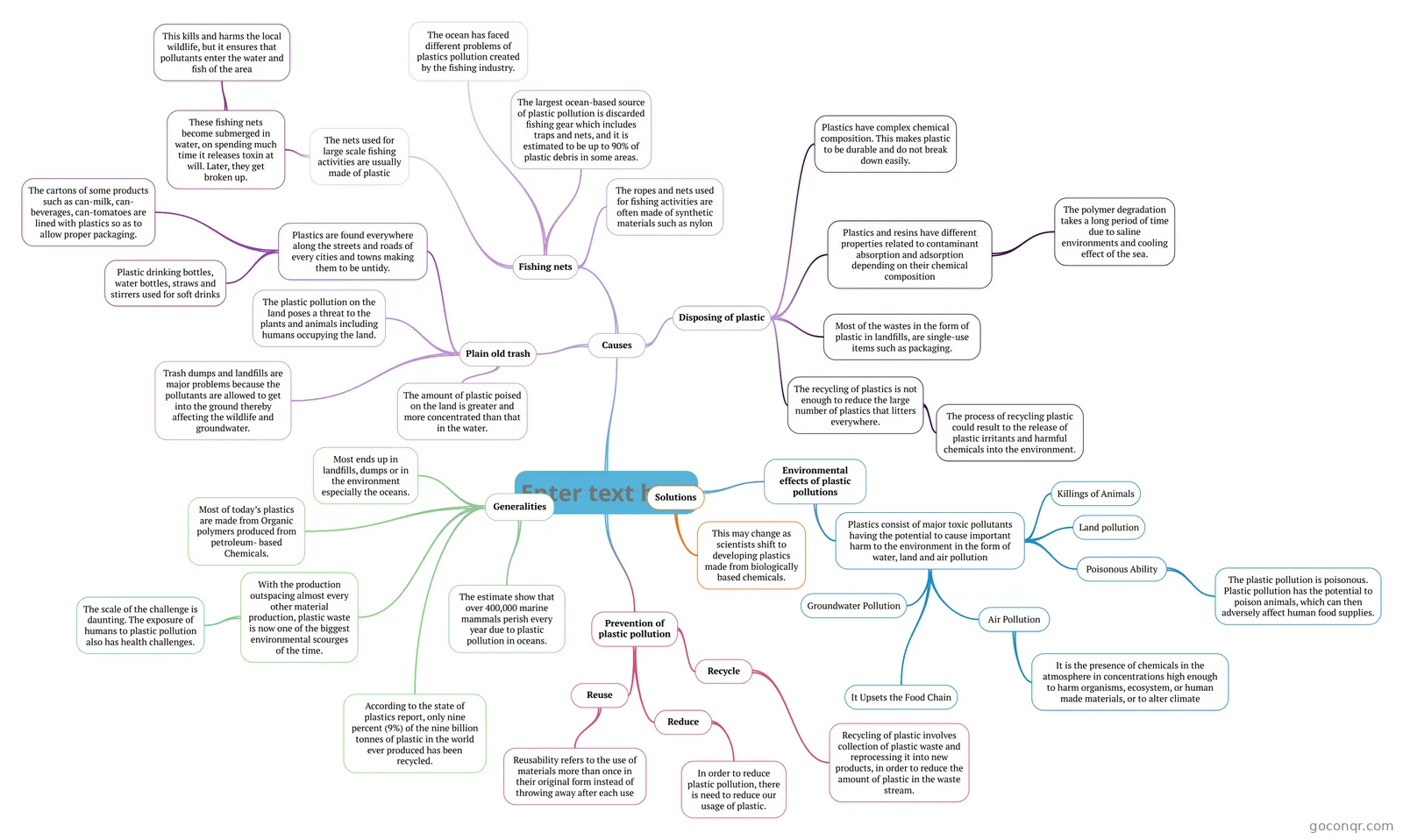
Mind map: Plastic pollution
Map content
Enter text here
Generalities
- Most of today’s plastics are made from Organic polymers produced from petroleum- based Chemicals.
- With the production outspacing almost every other material production, plastic waste is now one of the biggest environmental scourges of the time.
- The scale of the challenge is daunting. The exposure of humans to plastic pollution also has health challenges.
- According to the state of plastics report, only nine percent (9%) of the nine billion tonnes of plastic in the world ever produced has been recycled.
- Most ends up in landfills, dumps or in the environment especially the oceans.
- The estimate show that over 400,000 marine mammals perish every year due to plastic pollution in oceans.
Environmental effects of plastic pollutions
- Plastics consist of major toxic pollutants having the potential to cause important harm to the environment in the form of water, land and air pollution
- Groundwater Pollution
- It Upsets the Food Chain
- Killings of Animals
- Land pollution
- Poisonous Ability
- The plastic pollution is poisonous. Plastic pollution has the potential to poison animals, which can then adversely affect human food supplies.
- Air Pollution
- It is the presence of chemicals in the atmosphere in concentrations high enough to harm organisms, ecosystem, or human made materials, or to alter climate
- Plastics consist of major toxic pollutants having the potential to cause important harm to the environment in the form of water, land and air pollution
Causes
- Plain old trash
- Plastics are found everywhere along the streets and roads of every cities and towns making them to be untidy.
- The cartons of some products such as can-milk, can- beverages, can-tomatoes are lined with plastics so as to allow proper packaging.
- Plastic drinking bottles, water bottles, straws and stirrers used for soft drinks
- Trash dumps and landfills are major problems because the pollutants are allowed to get into the ground thereby affecting the wildlife and groundwater.
- The plastic pollution on the land poses a threat to the plants and animals including humans occupying the land.
- The amount of plastic poised on the land is greater and more concentrated than that in the water.
- Plastics are found everywhere along the streets and roads of every cities and towns making them to be untidy.
- Fishing nets
- The ocean has faced different problems of plastics pollution created by the fishing industry.
- The nets used for large scale fishing activities are usually made of plastic
- These fishing nets become submerged in water, on spending much time it releases toxin at will. Later, they get broken up.
- This kills and harms the local wildlife, but it ensures that pollutants enter the water and fish of the area
- These fishing nets become submerged in water, on spending much time it releases toxin at will. Later, they get broken up.
- The largest ocean-based source of plastic pollution is discarded fishing gear which includes traps and nets, and it is estimated to be up to 90% of plastic debris in some areas.
- The ropes and nets used for fishing activities are often made of synthetic materials such as nylon
- Disposing of plastic
- Plastics have complex chemical composition. This makes plastic to be durable and do not break down easily.
- Plastics and resins have different properties related to contaminant absorption and adsorption depending on their chemical composition
- The polymer degradation takes a long period of time due to saline environments and cooling effect of the sea.
- Most of the wastes in the form of plastic in landfills, are single-use items such as packaging.
- The recycling of plastics is not enough to reduce the large number of plastics that litters everywhere.
- The process of recycling plastic could result to the release of plastic irritants and harmful chemicals into the environment.
- Plain old trash
Solutions
- This may change as scientists shift to developing plastics made from biologically based chemicals.
Prevention of plastic pollution
- Reuse
- Reusability refers to the use of materials more than once in their original form instead of throwing away after each use
- Reduce
- In order to reduce plastic pollution, there is need to reduce our usage of plastic.
- Recycle
- Recycling of plastic involves collection of plastic waste and reprocessing it into new products, in order to reduce the amount of plastic in the waste stream.
- Reuse
Information
- Description
- Mind Map on Enter text here, created by Andrea Barrera on 21/06/2022.
- Created by
- Andrea Barrera
- Views
- 0
- Rating