
Mind map
Question 15
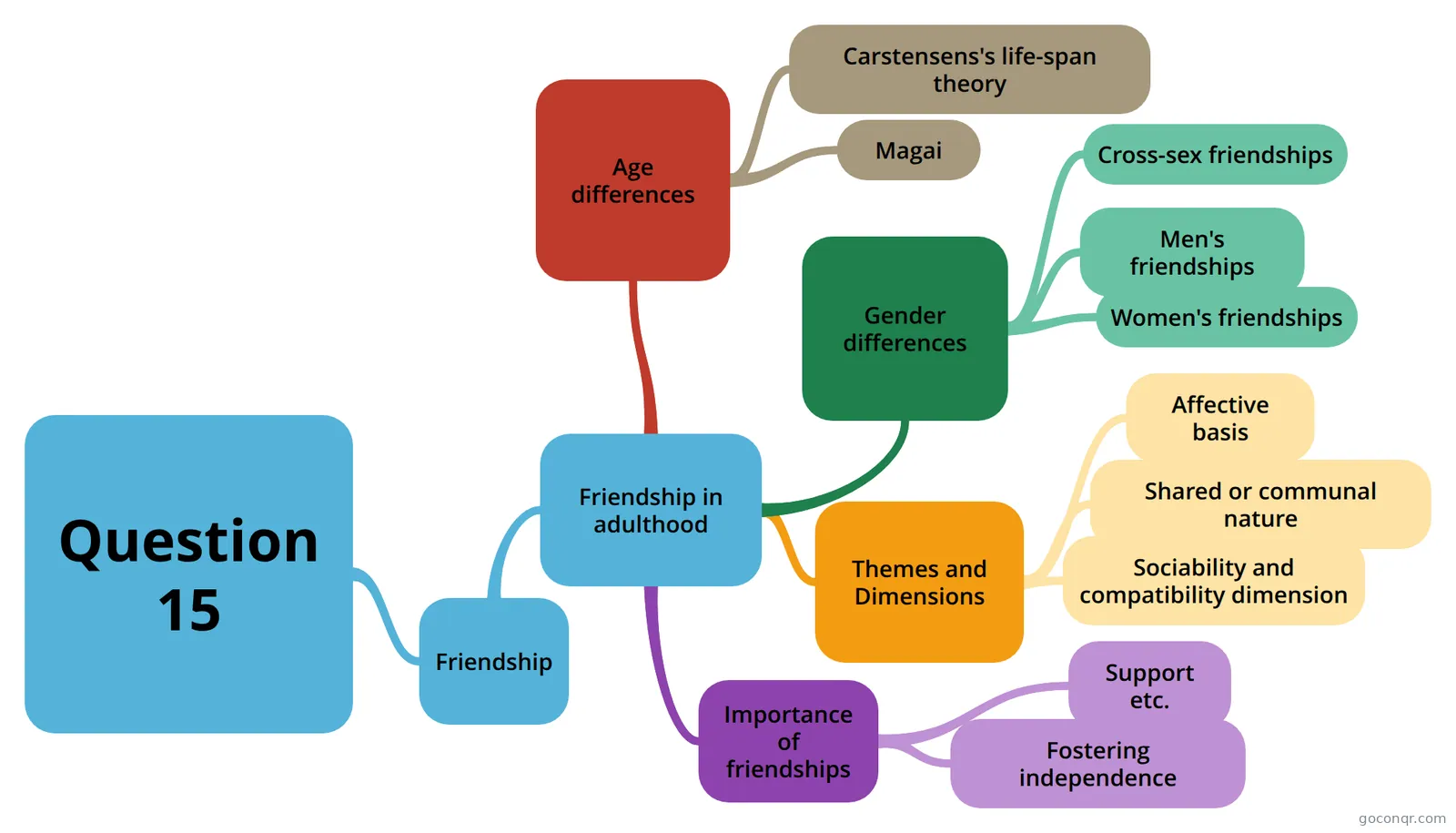
Mind map: Friendship
Map content
Question 15
Friendship
- Friendships Researchers define friendship as a mutual relationship in which those involved influence one another’s behaviours and beliefs, and define friendship quality as the satisfaction derived from the relationship. Friends are a source of support throughout adulthood. Friendships are predominantly based on feelings and grounded in reciprocity and choice. Friendships differ from love relationships mainly because friendships are less emotionally intense and usually do not involve sex. Having good friendships boosts self-esteem and happiness. Friendships also help us become socialised into hew roles throughout adulthood.
- Friendship in adulthood
- Friendship in Adulthood From a developmental perspective, adult friendships can be viewed as having identifiable stages: Acquaintanceship, Buildup, Continuation, Deterioration, and Ending. This ABCDE model describes the stages of friendship and how they change. Whether a friendship develops from an acquaintanceship depends on several factors, such as the basis of the attraction, what each person knows about the other, how good the communication is between the partners, the perceived importance of the friendship, and so on. Longitudinal research shows how friendships change across adulthood, some in ways that are predictable and others not. Life transitions usually results in fewer friends and less contact with remaining friends. People tend to have more friends and acquaintances during young adulthood than at any subsequent period, but friendships are important throughout adulthood. This is in part because a person’s life satisfaction is strongly related to the quantity and quality of contacts with friends, regardless of one’s background.
- Importance of friendships
- The quality and purpose of late-life friendships are particularly important. Having friends provides a buffer against the losses of roles and status that accompany old age, such as retirement or the death of a loved one, and can increase people’s happiness and self-esteem. Neuroscience research shows that a close friendship literally changes the way the brain functions, resulting in our perception that we are safer and that the trials we face are more manageable with friends than without them. Some researchers believe that one reason why friends are important to older adults is that they don’t want to be a burden to their families. As a result, friends help each other foster independence.Older adults tend to have fewer relationships with people in general and develop fewer new relationships than people do in midlife and particularly in young adulthood.
- Fostering independence
- Support etc.
- Gender differences
- Patterns of friendship among older adults tend do mirror those in young adulthood. Older women have more numerous and intimate friendships than older men do. Men’s friendships, like women’s evolve over time and vecome important sources of support in late life.
- Men's friendships
- Men's friendships, like women's evolve over time and become important sources of support in later life
- Women's friendships
- Women base their friendships on more intimate and emotional sharing and use friendship as a means to confide in others. For women, getting together with friends often takes the form of getting together to discuss personal matters. Confiding in others is a basis of women’s friendships. In contrast, men base friendships on shared activities or interests.
- Cross-sex friendships
- Cross-sex friendships are beneficial, especially for men. Cross-sex friendships help men have lower levels of dating anxiety and higher capacity for intimacy. Cross-sex friendships can also prove troublesome because of misperceptions. Some research shows that men overestimate and women underestimate their friends’ sexual interest in them. Maintaining cross-sex friendships once individuals enter into exclusive dating relationships, marriage, or committed relationships is difficult, and often results in one partner feeling jealous.
- Themes and Dimensions
- Themes Three broad themes characterise both traditional (face to face) and new forms (e.g. online) of adult friendships: - The affective or emotional basis of friendship refers to self-disclosure and expressions of intimacy, appreciation, affection, and support, and all are based on trust, loyalty, and commitment. - The shared or communal nature of friendship reflects how friends participate in or support activities of mutual interest - The sociability and compatibility dimension represents how our friends keep us entertained and are sources of amusement, fun, and recreation. In the case of online friendships, trust develops on the basis of four sources: 1) Reputation 2) Performance, or what users do online 3) Pre-commitment, through personal self-disclosure, and 4) Situational factors, especially the premium placed on intimacy and the relationship Online social network friendships develop much like face-to-face ones in that the more time people spend online with people the more likely they are to self-disclose.
- Affective basis
- Shared or communal nature
- Sociability and compatibility dimension
- Age differences
- Carstensens's life-span theory
- Carstensen and colleagues have shown that the changes in social behaviour seen in late life reflect a more complicated and important process. They propose a life-span theory of socioemotional selectivity, which argues that social contact is motivated by a variety of goals, including information seeking, self-concept, and emotional regulation. Each of these goals is differentially salient at different points of the adult life span and results in different social behaviours. Carstensen and colleagues believe that information seeking (e.g. exploring the world, finding where one fits in) is the predominant goal for young adults, whereas emotional regulation is the major goal for older people (who thus seek out more familiar people), and both goals are in balance in midlife. Their research supports this view; people become increasingly selective in whom they choose to have contact with.
- Magai
- Magai summarized several approaches to emotional development across adulthood and concludes that people orient more toward emotional aspects of life and personal relationships as they grow older and emotional expression and experience become more complex and nuanced. Older adults are more selective and have fewer opportunities to make new friends, especially in view of the emotional bonds involved in friendship.
- Carstensens's life-span theory
Information
- Description
- Mind Map on Question 15, created by Rudolph Basson on 11/10/2015.
- Created by
- Rudolph Basson
- Views
- 0
- Rating