
Mind map
PHONETICS - PHONOLOGY
Map content
PHONETICS - PHONOLOGY
Phonetics is a branch of linguistics that gives objective ways to analyze and describe the sounds which humans use in their languages. Phonetics looks the production of speech, the interaction of organs like: teeth ang tongue to produce sound.
- Phonetics is a branch of linguistics that gives objective ways to analyze and describe the sounds which humans use in their languages. Phonetics looks the production of speech, the interaction of organs like: teeth ang tongue to produce sound.
- Articulatory features
- Articulatory phonetics are devided in three areas to describe consonants. They are voice, place and manner respectively.
- VOICE
- There are sounds that inply vocal fold vibrations when they are produced. Examples of voiced sounds are /b,d,v,m/.
- PLACE
- The vocal tract has different sections, which play a pivotal role in the production of speech. These sections are called articulators and are what make speech sounds possible. They are divided into two types.
- The active articulator is the articulator that moves towards another articulator in the production of a speech sound. This articulator moves towards another articulator to form a closure of some type in the vocal tract.
- The passive articulator is the articulator that remains stationary in the production of a speech sound. Often, this is the destination that the active articulator moves towards
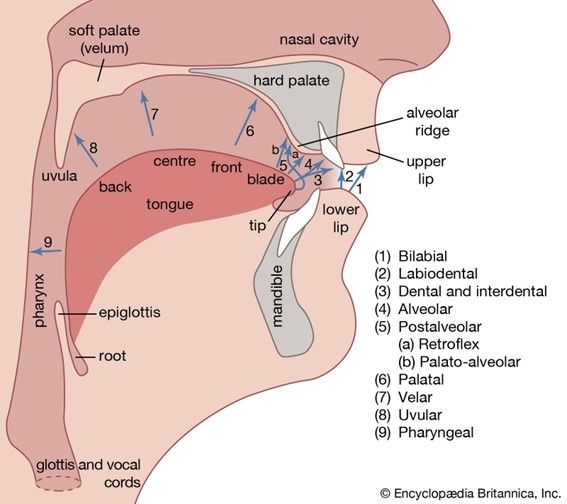
- PLACES OF ARTICULATION IN THE VOCAL TRACT
- 1.Bilabial: Bilabial sounds inply the upper and lower lips. In the production of a bilabial sound, the lips come into contact with each other to form an effective constriction. In English, /p,b,m/ are bilabial sounds.
- 2.Labiodental: the sounds are made with top teeth on the bottom lip. Some Examples are of /f,v/.
- 4.Alveolar sounds are made by raising the tip of the tongue towards the ridge, somme examples are: d,z,n do,zoo,now
- 5.Postalveolar sound are consonants articulated with the tongue near or touching the back of the alveolar ridge, placing them a bit further back in the mouth than the alveolar consonants.
- 6.Palatal, a consonant sound produced by raising the blade, or front, of the tongue toward or against the hard palate just behind the alveolar ridge (the gums).
- 7.Velar.made by the tongue touching the velum: In English, /k/ and /g/ are examples of velar sounds.
- The vocal tract has different sections, which play a pivotal role in the production of speech. These sections are called articulators and are what make speech sounds possible. They are divided into two types.
- MANNER
- This refers to the way a sound is made, Sounds differ in the way they are produced.
- Stop articulations: are sounds that imply a closure in the vocal track, it is formed when two articulators come together to prevent air escaping between them. Stop articulations are categorized in two types: Plosives which are sounds that are made with a complete closure in the oral (vocal) tract and Nasals which are made with a complete closure in the oral (vocal) tract.
- Apporximant: sounds are created by narrowing the distance between the two articulators. English has 4 approximant sounds which are /w,j,r,l/.
- Fricatives: These are produced by bringing the mouth into position to block the passage of the airstream.
- This refers to the way a sound is made, Sounds differ in the way they are produced.
- VOICE
- Articulatory phonetics are devided in three areas to describe consonants. They are voice, place and manner respectively.
Phonology describes the way how sounds and abstract sounds units work, a word can be changed in another by changing one sound, this is basically the relationship between speech sounds and components of a language.
- DIFERENCE: The main diference betwen these is that phonetics is the study of human sounds and phonology studies the classification of the sounds within the system of lenguages
- DIFERENCE The main diference betwen these is that phonetics is the study of human sounds and phonology studies the classification of the sounds within the system of lenguages
- suprasegmental features
- Is a speech feature such as stress, tone or word which linear elements that affect segments larger than the phoneme.
- The acent: The intensity accent is a force with which a phoneme vowel is pronounced of each word.
- The pauses: They are that interrupt the speech and separate some segments (phrases, phrases …) of others. This is necesary sometimes to recover air and keep talking
- The intonation. This is the main feature and i help us to change the meaning of a sentence for intance in the next phrase: your name is Andrew-your name is Andrew? depends on the intonation the fir sentence sounds like an afirmation and the second one sounds like a question.
- Is a speech feature such as stress, tone or word which linear elements that affect segments larger than the phoneme.
- DIFERENCE: The main diference betwen these is that phonetics is the study of human sounds and phonology studies the classification of the sounds within the system of lenguages
Images and files in the map
Information
- Description
- Mind Map on PHONETICS - PHONOLOGY, created by RONALD ANDRES RAMIREZ CAÑAVERAL on 28/08/2022.
- Created by
- RONALD ANDRES RAMIREZ CAÑAVERAL
- Views
- 7
- Rating