
3923383
Description

Mind Map by wardajamshaid990, updated more than 1 year ago
|
|
Created by wardajamshaid990
over 10 years ago
|
|
Cellular Respiration
- 4 SATGES
- Glycolysis
- END Products
- Net gain 2 ATP and
2 Reduced NAD and
2 pyruvate
molecules
- Net gain 2 ATP and
2 Reduced NAD and
2 pyruvate
molecules
- Description
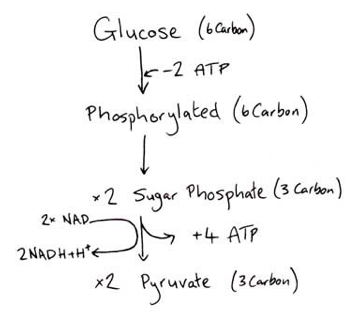
- Glucose is first activated by
phosphorylation to make it more
reactive and to lower the
activation energy for the
enzyme-controlled reactions by
the addition of two molecules of
ATP.
- The glucose is converted to
hexose phosphate (6-C)
molecule which splits to
form two molecules of trios
phosphate(3-C).
- Hydrogen is removed from each
of the TP molecules and
transferred to two molecules of
NAD forming two molecules of
reduced NAD. While two TP molecules are converted into two molecules of pyruvate (3-C).
- The above two steps yield sufficient
energy for the synthesis of four
molecules of ATP by Substrate-level
phosphorylation. There is a net gain of
two molecules of ATP since two were
used to phosphorylate glucose initially.
- The above two steps yield sufficient
energy for the synthesis of four
molecules of ATP by Substrate-level
phosphorylation. There is a net gain of
two molecules of ATP since two were
used to phosphorylate glucose initially.
- Hydrogen is removed from each
of the TP molecules and
transferred to two molecules of
NAD forming two molecules of
reduced NAD. While two TP molecules are converted into two molecules of pyruvate (3-C).
- The glucose is converted to
hexose phosphate (6-C)
molecule which splits to
form two molecules of trios
phosphate(3-C).
- Glucose is first activated by
phosphorylation to make it more
reactive and to lower the
activation energy for the
enzyme-controlled reactions by
the addition of two molecules of
ATP.
- Both aerobic and anaerobic
- Diagram
- END Products
- Link Reaction
- END PRODUCTS
- Acetyl CoA and
Carbon dioxide
and reduced NAD.
- Acetyl CoA and
Carbon dioxide
and reduced NAD.
- Description (applies for each one turn of cycle).
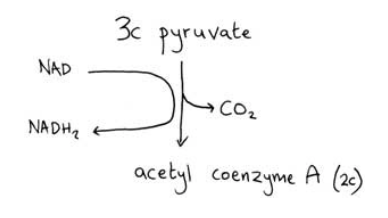
- Pyruvate diffuses from cytoplasm to mitochondrial matrix.
- Pyruvate (3-C) decarboxylated with loss of Co2 and dehydrogenated with
loss of hydrogen. These two steps convert pyruvate to acetate (2-C).
- The hydrogen released is accepted by NAD to form reduced NAD.
- Acetate (2-C) combines with coenzyme A to form Acetyl coenzyme A.
- Acetate (2-C) combines with coenzyme A to form Acetyl coenzyme A.
- The hydrogen released is accepted by NAD to form reduced NAD.
- Pyruvate (3-C) decarboxylated with loss of Co2 and dehydrogenated with
loss of hydrogen. These two steps convert pyruvate to acetate (2-C).
- Pyruvate diffuses from cytoplasm to mitochondrial matrix.
- END PRODUCTS
- Krebs Cycle
- Description (applies for each one turn of cycle)
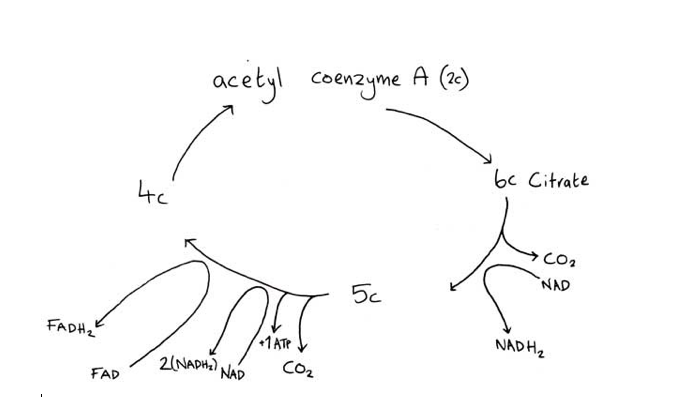
- Acetyl CoA combines with 4-C compound (Oxaloacetate) to produce a 6-C compound
(Citrate). The coenzyme A is regenerated.
- Citrate is broken down by a series of oxidative decarboxylation reactions (six of these). Two of the steps involve
decarboxylation and four of the steps involve dehydrogenation. During these reactions, tow molecules of carbon dioxide
are formed and four hydrogen atoms are removed. The hydrogen atoms lost are collected by two different carriers with
the formation of three molecules of reduced NAD and one molecule of reduced FAD. Also, during this one ATP molecule is
produced as a result of substrate-level phosphorylation.
- After these reactions, the acetate fragment is broken down and the remaining 4-C residue
undergoes conversion to regenerate the 4-C compound (oxaloacetate). It is important that
this 4-C compound is regenerated so it can combine with more incoming acetyl CoA
otherwise the latter would accumulate and the process will not be able to continue.
- After these reactions, the acetate fragment is broken down and the remaining 4-C residue
undergoes conversion to regenerate the 4-C compound (oxaloacetate). It is important that
this 4-C compound is regenerated so it can combine with more incoming acetyl CoA
otherwise the latter would accumulate and the process will not be able to continue.
- Citrate is broken down by a series of oxidative decarboxylation reactions (six of these). Two of the steps involve
decarboxylation and four of the steps involve dehydrogenation. During these reactions, tow molecules of carbon dioxide
are formed and four hydrogen atoms are removed. The hydrogen atoms lost are collected by two different carriers with
the formation of three molecules of reduced NAD and one molecule of reduced FAD. Also, during this one ATP molecule is
produced as a result of substrate-level phosphorylation.
- Acetyl CoA combines with 4-C compound (Oxaloacetate) to produce a 6-C compound
(Citrate). The coenzyme A is regenerated.
- Overall
- The function of the Krebs is a
means of liberating energy
from carbon bonds to provide
ATP and reduced NAD (and
FAD) with the release of
carbon dioxide.
- Reduced NAD (and FAD) deliver
the hydrogen to the ET system so
act as triggers for this system.
- Reduced NAD (and FAD) deliver
the hydrogen to the ET system so
act as triggers for this system.
- END PRODUCTS
- 2 ATP, 6 Reduced NAD,
2 Reduced FAD and 4
carbon dioxide
- (each turn of cycle)
- 1 ATP, 3 Reduced
NAD, I Reduced
FAD and 2 Carbon
dioxide.
- 1 ATP, 3 Reduced
NAD, I Reduced
FAD and 2 Carbon
dioxide.
- 2 ATP, 6 Reduced NAD,
2 Reduced FAD and 4
carbon dioxide
- The function of the Krebs is a
means of liberating energy
from carbon bonds to provide
ATP and reduced NAD (and
FAD) with the release of
carbon dioxide.
- Description (applies for each one turn of cycle)
- Electron Transport Chain
- Description
- Hydrogen atoms are
carried by the coenzymes
NAD and FAD into the
Electron Transport Chain. They are termed as hydrogen carriers.
- The synthesis of ATP through oxidative Phosphorylation in the
electron transport chain can be explained using Chemiosmotic
Theory.
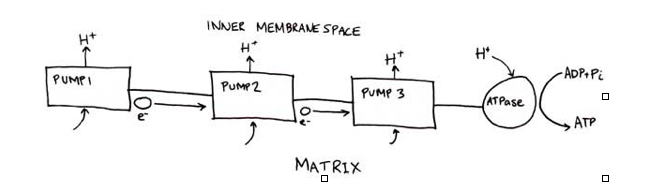
- Hydrogen carrier molecules like reduced NAD donate the electrons of the
hydrogens they are carrying to the first of the series of three electron carriers in
the electron transport chain. The H+ ions remain in solution in the mitochondrial
matrix.
- The electrons released provide energy for the first proton pump. The energy is used to
pump protons from the matrix across the inner membrane to the inter-membrane
space.
- The electrons pass along the chain of electron carrier molecules providing energy for each pump in turn.
- The protons accumulate in the inter-membrane space and the concentration of protons
becomes higher in this space than in the matrix hence an electrochemical gradient is set up.
- Protons diffuse back into the matrix through special protein
channels in the inner membrane. Associated with each channel is the
enzyme, ATP Synthetase.
- As protons diffuse back, ATP Synthetase uses their electrical potential energy to produce ATP.
- At the end of the chain, the electrons and protons combine with oxygen to form water.
Oxygen acts as the 'final electron acceptor'. It is essential in the process for the removal
of protons and electrons. Without it the protons and electrons would accumulate and
cause a 'back-up' along the chain and bring the process to a halt.
- At the end of the chain, the electrons and protons combine with oxygen to form water.
Oxygen acts as the 'final electron acceptor'. It is essential in the process for the removal
of protons and electrons. Without it the protons and electrons would accumulate and
cause a 'back-up' along the chain and bring the process to a halt.
- As protons diffuse back, ATP Synthetase uses their electrical potential energy to produce ATP.
- Protons diffuse back into the matrix through special protein
channels in the inner membrane. Associated with each channel is the
enzyme, ATP Synthetase.
- The protons accumulate in the inter-membrane space and the concentration of protons
becomes higher in this space than in the matrix hence an electrochemical gradient is set up.
- The electrons pass along the chain of electron carrier molecules providing energy for each pump in turn.
- Reduced FAD in the ETC provide
energy in the same way however it
passes the hydrogens directly to
second pump hence the carrier
system involving FAD has two
pumps and yields two ATP
molecules.
- The electrons released provide energy for the first proton pump. The energy is used to
pump protons from the matrix across the inner membrane to the inter-membrane
space.
- Chemiosmotic Theory
- A model to explain the synthesis
of ATP. The theory proposes that
the energy for ATP synthesis
originates from electrochemical
gradient of protons across a
membrane
- A model to explain the synthesis
of ATP. The theory proposes that
the energy for ATP synthesis
originates from electrochemical
gradient of protons across a
membrane
- Hydrogen carrier molecules like reduced NAD donate the electrons of the
hydrogens they are carrying to the first of the series of three electron carriers in
the electron transport chain. The H+ ions remain in solution in the mitochondrial
matrix.
- The synthesis of ATP through oxidative Phosphorylation in the
electron transport chain can be explained using Chemiosmotic
Theory.
- Hydrogen atoms are
carried by the coenzymes
NAD and FAD into the
Electron Transport Chain. They are termed as hydrogen carriers.
- Description
- Glycolysis
- 2 Types
- Aerobic respiration
- Requires oxygen and
produces carbon
dioxide, water and
much ATP.
- Requires oxygen and
produces carbon
dioxide, water and
much ATP.
- Anaerobic Respiration
- Takes place in absence of
oxygen and produces
lactate in animals and
ethanol and carbon
dioxide in yeast.
(together with little
energy---2 ATP from
glycolysis).
- Takes place in absence of
oxygen and produces
lactate in animals and
ethanol and carbon
dioxide in yeast.
(together with little
energy---2 ATP from
glycolysis).
- Aerobic respiration
- ANAEROBIC RESPIRATION
- When there is an absence of oxygen, there is no
oxygen to combine with hydrogen to form water.
Hence the electron transport chain cannot
function due to the back-up along the chain and
accumulation and ATP cannot be formed by
oxidative phosphorylation. Since the ETC cannot
function, reduced NAD cannot be deoxidised and
therefore made available to pick up more
hydrogen, and so the link reaction and the Krebs
cycle cannot take place.
- Only the first stage, glycolysis can take place. This
is because the reoxidised NAD is made available
by anaerobic pathway.
- ANAEROBIC PATHWAY
- Animals
- Pyruvate accepts hydrogen atoms from reduced NAD and is
converted into lactic acid. This reoxidises NAD which is now
available for more glycolysis.
- This takes place most commonly in the muscle tissue. During vigorous
exercise, the human body cannot get sufficient oxygen t the muscle cells.
Hence only glycolysis can occur to produce ATP for cells to function.
Pyruvate acts as the hydrogen acceptor and is converted to lactate to
continue glycolysis.
- This takes place most commonly in the muscle tissue. During vigorous
exercise, the human body cannot get sufficient oxygen t the muscle cells.
Hence only glycolysis can occur to produce ATP for cells to function.
Pyruvate acts as the hydrogen acceptor and is converted to lactate to
continue glycolysis.
- Pyruvate accepts hydrogen atoms from reduced NAD and is
converted into lactic acid. This reoxidises NAD which is now
available for more glycolysis.
- Little energy---2 ATP molecules produced each time.
- Yeast as well as plant cells (under certain conditions
such as root cells in waterlogged soils)
- Alcoholic fermentation
- Pyruvate is decarboxylated to produce ethanal and carbon
dioxide. Reduced NAD transfers hydrogen atoms to ethanal
which forms ethanol and NAD is reoxidised.
- Pyruvate is decarboxylated to produce ethanal and carbon
dioxide. Reduced NAD transfers hydrogen atoms to ethanal
which forms ethanol and NAD is reoxidised.
- Alcoholic fermentation
- Takes place in the cytoplasm
- Animals
- ANAEROBIC PATHWAY
- Only the first stage, glycolysis can take place. This
is because the reoxidised NAD is made available
by anaerobic pathway.
- When there is an absence of oxygen, there is no
oxygen to combine with hydrogen to form water.
Hence the electron transport chain cannot
function due to the back-up along the chain and
accumulation and ATP cannot be formed by
oxidative phosphorylation. Since the ETC cannot
function, reduced NAD cannot be deoxidised and
therefore made available to pick up more
hydrogen, and so the link reaction and the Krebs
cycle cannot take place.
- Other
- For Reduced NAD, each pair of hydrogen atoms yields enough energy for the synthesis of three molecules of ATP.
For Reduced FAD, each pair of hydrogen atoms yields sufficient energy for the synthesis of two molecules of ATP.
- This is because in the ETC, reduced NAD passes hydrogen atoms to first pump
in the series whereas reduced FAD passes hydrogens toms directly
to second pump. Hence the carrier system involving NAD has three
pumps yielding three molecules of ATP while the carrier system
involving FAD has two pumps yielding two molecules of ATP.
- This is because in the ETC, reduced NAD passes hydrogen atoms to first pump
in the series whereas reduced FAD passes hydrogens toms directly
to second pump. Hence the carrier system involving NAD has three
pumps yielding three molecules of ATP while the carrier system
involving FAD has two pumps yielding two molecules of ATP.
- Coenzyme
- A molecule required by some enzymes in order to function.
- A molecule required by some enzymes in order to function.
- The carbon dioxide is a waste
product of respiration but the
hydrogen carrier molecules are
a potential for an additional
molecules of ATP from the ETC
and act as triggers for the
system.
- Facts
- Prior to ETC, all ATP produced by Substrate-level phosphorylation.
- No direct ATP produced in link reaction.
- No carbon dioxide produced in glycolysis or ETC.
- Link reaction and Krebs Cycle run twice for each molecule of glucose. (2 pyruvate and thus
two acetyl coA)
- Oxygen only needed in ETC.
- ATP only needed in beginning for phosphorylation of glucose molecules.
- Hydrogen carrier molecules like NAD are reduced
in the first three stages but oxidised in the last
stage of ETC.
- Hydrogen carrier molecules like NAD are reduced
in the first three stages but oxidised in the last
stage of ETC.
- Oxygen only needed in ETC.
- Link reaction and Krebs Cycle run twice for each molecule of glucose. (2 pyruvate and thus
two acetyl coA)
- No carbon dioxide produced in glycolysis or ETC.
- Prior to ETC, all ATP produced by Substrate-level phosphorylation.
- ATP Synthetase
- As the protons move down the concentration
gradient through the ATP synthetase, the energy
released causes the rotor (F0) and stalk of ATP
synthesise to rotate. The mechanical energy form
this rotation is converted into chemical energy as
Pi is added to ADP to form ATP in the catalytic
head (F1 domain).
- As the protons move down the concentration
gradient through the ATP synthetase, the energy
released causes the rotor (F0) and stalk of ATP
synthesise to rotate. The mechanical energy form
this rotation is converted into chemical energy as
Pi is added to ADP to form ATP in the catalytic
head (F1 domain).
- To determine the order of the carrier
molecules in the ETC , an experiment was
carried out using a series of different
inhibitors.
- Cyanide is a poison that acts
as a non-competitive
inhibitor of the final acceptor
in the ETC (final pump).
Cyanide deactivates the
enzyme cytochrome c
oxidase. This is the last
enzyme of the electron
transport chain (the final
step of cell respiration). This
results in the accumulation
of protons and electrons thus
causing causing a back up
along the chain and bringing
the process to a halt.
- For Reduced NAD, each pair of hydrogen atoms yields enough energy for the synthesis of three molecules of ATP.
For Reduced FAD, each pair of hydrogen atoms yields sufficient energy for the synthesis of two molecules of ATP.
- Alternative Respiratory Substrates
- Lipids
- One gram of fat yields twice
as much as one gram of
carbohydrate.
- Fast are used an energy store and
are used only when carbohydrate
levels are low.
- Lipids are first split into
constituent molecules of
glycerol and fatty acids by
hydrolysis.
- Glycerol is phosphorylated with
ATP and dehydrogenated with NAD
and converted into 3-C triose
phosphate, which enters the
glycolysis pathway and respires.
- Fatty acid chain molecules are split
into 2-C fragments which enter the
Krebs cycle as acetyl CoA. The large
number of hydrogens released are
picked up by the NAD and fed into
the ET chains.
- Fatty acid chain molecules are split
into 2-C fragments which enter the
Krebs cycle as acetyl CoA. The large
number of hydrogens released are
picked up by the NAD and fed into
the ET chains.
- Glycerol is phosphorylated with
ATP and dehydrogenated with NAD
and converted into 3-C triose
phosphate, which enters the
glycolysis pathway and respires.
- Lipids are first split into
constituent molecules of
glycerol and fatty acids by
hydrolysis.
- Fast are used an energy store and
are used only when carbohydrate
levels are low.
- One gram of fat yields twice
as much as one gram of
carbohydrate.
- Proteins
- Rarely ever used---only when all
reserves of carbohydrate and
fats have depleted.
- Tissue protein is mobilised to supply
energy. The protein of the food is diverted
for energy purposes.
- The protein is hydrolysed into its constituent
amino acids and then it is deaminated in the
liver.
- The amino group is converted into urea and excreted
while the residue is converted to either pyruvate, acetyl
CoA or any other Krebs cycle intermediate and
oxidised.
- The amino group is converted into urea and excreted
while the residue is converted to either pyruvate, acetyl
CoA or any other Krebs cycle intermediate and
oxidised.
- The protein is hydrolysed into its constituent
amino acids and then it is deaminated in the
liver.
- Rarely ever used---only when all
reserves of carbohydrate and
fats have depleted.
- Most metabolic processes lead to
Acetyl CoA which is a kind of
crossroads in metabolism. As well as
its formation during the oxidation of
carbohydrates, it is also formed
during the oxidation of fats and
proteins.
- Lipids
Media attachments
Want to create your own Mind Maps for free with GoConqr? Learn more.