
Mind map
Biology notes Variation and Inheritance
Map content
Biology notes Variation and Inheritance
- Living organisms vary in many ways. For example, humans all have the same general shape and the same set of body organs, but some features differ from one person to the next, such as height, weight, eye and hair colour, shape of nose, knowledge and skills. These are examples of Individual variation.
Individual varitation
- Individual varitation are features that differ from one person to the next such as height, weight and hair colour.
Inheritance
- Inheritance is the transmission of genetic information from generation ro generation. Examples of these inherited (or hereditary) characteristics include the tendency to develop some diseases, such as cystic fibrosis, and the permanent colour of the skin.
- Acquired characteristics
- Acquired characteristics can be changed, an example can be body mass which can be changed by an adjustment to the diet. Inherited characteristics cannot usually be altered(except temporarily).
Genetics
- The study of inherited characteristics, and the way they are passed on from one generation to another, is called genetics.
Sexual reproduction and inheritance
- The production of offspring by sexual reproduction always involves the production of gametes and fertilisation. In sexual reproduction: o The only part of the male gamete (sperm in mammals) that goes goes to form the zygote is the nucleus. o The gametes are formed by cell division. o The young organism develops from a single fertilised egg by cell division.
Chromosome
- A thread-like structure of DNA carrying genetic information in the form of genes.
- Carry genetic information
- Genetic information is the information that gives particular characteristics to a cell: o If sections of chromosome are transferred from one cell to another, the characteristics of the recipient cell change this information suggests that chromosomes carry genetic information.
Proteins
- It has been discrovered that the characteristics that a cell or organism posseses depend on the proteins that the cell can manufacture.
- Cell Characteristics depend on proteins
- Hair cells contain keratin a structural protein. Antibodies are proteins which play a part in the immine response. Neurotransmitters in the nervous system bind to receptor proteins in the synapse. Saliva contains the enzyme (protein) amylase. Enzymes (proteins) control photosynthesis.
Genes
- The instructions as to which proteins should be manufactured at any one time in a cell are carried as genes on the chromosomes.
Deoxyribonnucleic acid/DNA
- DNA carries its instructions as coded messages using just four different chemical compounds called nucleotide bases or organic bases.
- Replicating
- For one organims to pass on characteristics to its offspring, it must be able to copy the coded instructions for these characteristics and hand them on. In other words, DNA in the chromosomes must be copied or replicated.
Nucleotides
- The DNA molecule is made up of nucleotides. THere may be millions of nucleotides in a DNA milecule, but there are only four different ones. The nucleotides form very long ladders with bases at the rungs of the ladder. The base pairs are always one of two types, either adenine with thymine or guanine with cytosine. Certain physical forces cause the ladder to twist around itself to form a shape similar to a spiral, called a double helix.
DNA code words for amino acids
- How does the DNA in the genes instruct the cell to make particular proteins? The following points are important in understanding this link: * Each gene carries a series of coded instructions ('code word') for the synthesis of proteins. * Each 'code word' on the DNA is made up of three bases (three letters) in a certain sequence.* Each 'code word'- called a triplet- corresponds to a single amino acid in a protein.
- Passing the messages to the ribosomes
- This coded information in the genes is located on the chromosomes, which are in the nucleus. You may remember that the protein-manufacturing stations, called ribosoems, are found outside the nucleus, in the cyptoplasm. How does the code pass from the nucleus to the ribosomes in the cyptoplasm? It is carried by another type of nucleic acid, called messenger RNA (mRNA).
Transcription and translation
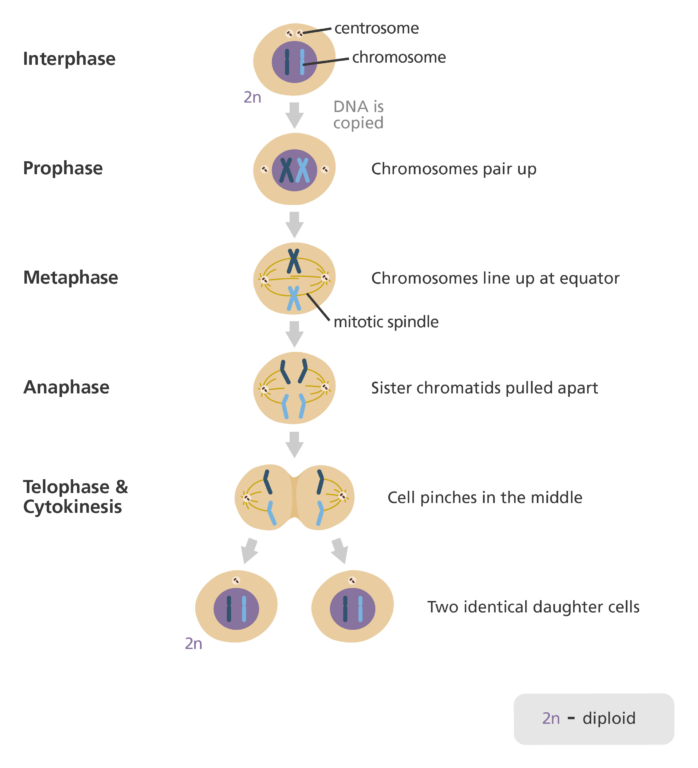
Mitosis
- Characteristics are transmitted from one generation of cells to the next. For this to happen, the chromosomes must be accurately copied and passed on when cells divide. Each chromosome has a parter, forming homologous pairs.
- Mitosis is for growth
- Both plants and animals grow by mitosis. * in animals each tissue provides its own new cells when they are needed, e.g. liver produces liver cells. * Stem cells are unspecialised cells that divide mitosis to produce daughter cells that can become specialised for specific functions. * In plants, cell division in the cambium increases the plant girth (the plant gets thicker), and cell division in the meristems at the tips of the roots and shoots leads to an increase in length.
Zygote
- A zygote results from the fusion of egg and sperm.
Chromatids
- When DNA is replicated exactly each chromosome now becomes two identical chromatids joined at the centromere.
Meiosis
- Each cell of an organism has a fixed number of chromosomes within the nucleus. The number of chromosomes in a normal body cell is the haploid number ( or n). Fertilisationn is the fusion of haploid gametes to restore the diploid (two complete sets chromosomes present in an organism's cells) number in the zygote. Gametes are formed by a type of cell division called meiosis or reduction division. * meiosis only happens in the gamete-producing organs: the testes and the ovaries in animals, and the pollen sacs of the stamens and the ovules in the ovary in plants. *Meiosis is called reduction division because it halves the number of chromosomes in cells.
Mitotic cell division
- Produces many smaller, identical cells.
- Stem cells
- Inner cell mass contains embryonic stem cells. * stem cellls are unspecialised cells that divide by mitosis to produce daughter cells that can become specialised for specific functions.
- Adult stem cells
- More mitosis, during which cells differentiate into different specialised tissues. A small proportion of the cells remain as unspecialised adult stem cells. Normally these can only differentiate into a limited range of other cells. Bone marrow stem cells for example, normally produce only different types of blood cell.
- Organ transplantation
- Mature specialised cells are no longer able to divide. In theory, these organs and tissues could be transplanted into a patient to cure a disease. A problem with organ transplantation is rejection. The recipient's immune system may recognise and destroy the transplanted organ.
- Adult stem cell cloning
- Adult stem cell cloning may produce tissues which are a genetic match for the patient, so patient will need less medication and care after the treatment. This is great for patients with type 1 diabetes.
Homologous pair
- Each chromosome in the nucleus of a diploid organism has a partner that carries the same genes. Such a pair of chromosomes is called an homologous pair.
Alleles
- Allales are different forms of a gene that code for alternatives of the same characteristic.
Pure-breeding
- Pure-breeding is when two individuals which are homozygous for the same characteristic breed together.
Heterozygous
- In a heterozygous cell, when the members of the homologous pair separate during meiosis the gametes will contain different alleles.
Homozygous
- If the nucleus in a cell carries the same allele on both members of the homologous pair, then the cell is homozygous.
Dominant
- Dominant alleles can control the development of a characteristic when there is only one present on the chromosome pair.
Recessive
- Recessive alleles control the development of a characteristic only if there are two recessive alleles on a chromosome pair.
- Abinism
- Albinism is caused by a recessive allele. Heteroztgous invididuals are not affected by the condition, but they are carriers of the mutant, recessive allele. People with albinism do not produce the pigment melanin. This pigment normally makes skin, the iris of the eye and hair a dark colour.
Phenotype
- Phenotype is the phyiscal caracteristics that are observable if the phenotype interacts with the environment.
Geneticists
- Geneticists are scientists that study the inheritance of characteristics by carrying out breeding experiments.
Probability
- Probability is that there is a chance for something to happen but it's not certain.
Test cross
- A test cross can distinguish different genotypes with the same phenotype. As it might be important to know wether a particular organism is homozygous or heterozygous, particulary in the breeding of domestic animals. The results of genetic crosses are sometimes shown as a pedigree.
Images and files in the map
Information
- Description
- Mind Map on Biology notes Variation and Inheritance, created by max lekkerkerk on 21/10/2024.
- Created by
- max lekkerkerk
- Views
- 0
- Rating